

Declining House Sales in Spain’s Tourist Hotspots
House prices in highly stressed tourist areas, notably the Balearic Islands and the Canary Islands, have surged to levels that neither British nor German buyers—who have historically been the most active and affluent foreign investors in these regions—can afford. The dramatic rise in real estate prices is reshaping the landscape of property sales on these popular islands.
According to a report from Express, this trend is corroborated by the latest data from the General Council of Notaries, reflecting a notable transformation in the Spanish real estate market . Specifically, the islands, long regarded as real estate havens for foreigners, are witnessing a slowdown fueled by rising costs.
Significant Decrease in Property Transactions
Recent statistics reveal a stark decline in property sales. The Canary Islands experienced a 7.7% drop, while the Balearic Islands saw a 6.8% decrease in foreign sales during the first half of 2025. Additionally, other regions, such as Valencia and Navarra, also reported declines, with reductions of 3.6% and 3.7%, respectively.
These statistics highlight a troubling reality—foreign investment in these regions is weakening substantially. The rise in average property costs is perceived as one of the primary factors behind this downturn.
Skyrocketing Property Prices
The surge in housing prices in these regions has created an environment where foreign buyers feel priced out. The General Council of Notaries shows that the average price for properties purchased by foreigners across Spain rose to €2,417 per square meter, marking a 7.6% increase compared to the previous year. In the Canary Islands, prices jumped by 14.1%, while the Balearic Islands saw an overall increase of 9%.
This rapid escalation has diminished the allure for traditional buyers in these areas, particularly impacting British and German investors who have historically favored these destinations.
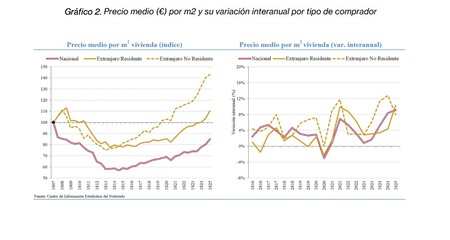
Source: General Council of Notaries
The Changing Demographics of Buyers
Despite significant fluctuations in tourist areas like the Canary and Balearic Islands, the overall number of home purchases by foreigners in Spain has not decreased. In fact, foreign acquisitions increased by 2% from the previous year, reaching a total of 71,155 transactions.
The variation in foreign buy patterns suggests that while interest in buying has not waned, buyers are now gravitating towards less tourist-loaded locales, where housing prices remain more reasonable.
Who Are the Buyers?
Leading the foreign buyer statistics in Spain are the British, with 5,731 transactions recorded. They are closely followed by Moroccans and Germans, having 5,654 and 4,756 transactions, respectively.
However, foreign purchases have only comprised 19.3% of the total sales, a decline from 20.3% in 2024, reflecting the shifting dynamics in the real estate market, particularly on the islands where British and German buyers have dominated historically.
The Effects of Policy Changes
The recent elimination of the Golden Visa program has also contributed to this decline in demand. This visa allowed foreign investors to gain residency through property investment, a lucrative incentive for many.
By the first half of 2025, foreign residents accounted for 60.9% of property purchases, showing a 6.4% increase year-on-year. Conversely, non-resident purchases decreased by 4.1% , partly due to new tax regulations and the absence of the Golden Visa.
In conclusion, the remarkable rise in property prices in Spain’s most sought-after tourist destinations is reshaping the landscape of foreign investment. Buyers are currently reevaluating their purchase decisions, moving towards more affordable locations. Consequently, while the allure of Spanish properties remains, the pressure of escalating prices and recent policy changes have altered the dynamics of the real estate market.