
Reviving the Rust Belt: The Dawn of a New Industrial Era
For decades, the Rust Belt symbolized American industrial decline: derelict factories, landscapes marked by unemployment, and generations witnessing the fading of the American dream. Against this backdrop of abandonment, no one anticipated a renaissance. Yet, amidst the remnants of former industrial might, a jarring new sound has emerged—not from engines but from the ambitious pulse of innovation . This resurgence is significantly influenced by geopolitical tensions, notably the war in Ukraine.
The Industrial Rebirth
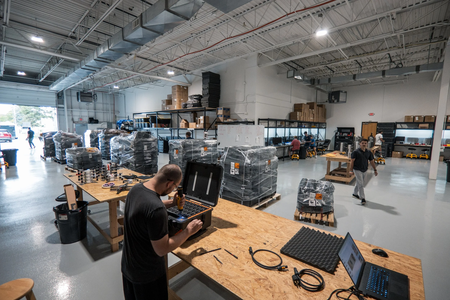
This transformation was vividly illustrated in a recent feature by the New York Times. In the heart of what was once America’s automobile stronghold, a new industry is instilling fresh life into the factory towns of the Midwest and Northeast. Instead of assembling engines and car bodies, we now find companies like Swarm Defense Technologies producing drones and autonomous systems . The atmospheric shift is notable in places like Auburn Hills, Michigan, where a once-abandoned factory has been rejuvenated to produce thousands of drones monthly, marking a shift from decay to military innovation .
The New Industrial Map
This revival extends beyond isolated instances. Companies like Anduril, backed by artificial intelligence, are investing billions in factories dedicated to drones and autonomous weaponry across Ohio, Rhode Island, and Mississippi. Meanwhile, Regent and UXV Technologies are carving niches in electric marine gliders and drone technology, respectively. These ventures benefit from skilled labor pools , affordable land, and government incentives aimed at reviving employment in traditional industrial locales.
The Political Calculation
This reindustrialization has not escaped the political arena. President Trump is utilizing military revival as a strategic approach, imposing tariffs, restricting foreign purchases, and striving for reduced dependency on Chinese technologies . Politicians like Ohio Senator Jon Husted laud these developments as historical reparations for communities long affected by factory closures and job losses. Investors are recognizing the strategic advantage of manufacturing in these regions, emphasizing that every new position consolidates a relationship between industry and the state.
The Factory of the Future
Despite these transformations, the revival does not replicate the industrial past. Modern factories will not employ hundreds of thousands of workers but will instead rely on specialized technicians and programmers diligently working on autonomous systems. For example, Anduril’s expansive modular installations in Ohio are designed to adapt rapidly to various military needs. Automation and AI are redefining the factory: less manual labor and more programming , shifting from assembly lines to calibration stations. Cities like Warren and Auburn Hills are being reimagined, trading steel and oil for silicon and sensors.
Between Tradition and Innovation
The new industrial players are rediscovering the latent value of traditional crafts. Companies like Regent are setting up shop in Rhode Island, leveraging the state’s rich naval heritage. Meanwhile, Swarm Defense Technologies is drawing upon extensive automotive knowledge passed down through generations of workers. Such a blend of artisanal skill with cutting-edge tech manifests a new form of industrial patriotism, where defense contracts become the bedrock of economic revival and factory restoration symbolizes technological sovereignty .
The Manufacturing Spirit
The resurgence of the factory towns tells a story rich with cultural transformation. For many workers, returning to the factories where their parents worked signifies a meaningful reconciliation with their heritage. The infrastructure that once supported cities like Detroit is now evolving to meet contemporary needs— national defense, automation, and industrial independence . What was once the decline of American manufacturing could herald the dawn of a technological renaissance, marrying the nostalgia of assembly lines with the potentials of a future driven by algorithms and electric vehicles .
This industrial revival not only reshapes the Rust Belt into a modern tech hub but also rejuvenates the spirit and pride of communities long yearning for purpose and opportunity in a changing world.