
Tencent Launches Hunyuan Image 3.0: A Game-Changer in AI-Generated Imagery
Tencent has just unveiled its latest model, Hunyuan Image 3.0 , capable of generating images from text prompts . Traditionally, proprietary models have been at the forefront of this creative technology, but recent benchmarks indicate that Tencent’s model has outperformed its competitors, including tech giants like Google and OpenAI.
According to the LMARENA classification, Hunyuan Image 3.0 has surpassed models such as Gemini 2.5 Flash —popularly known as Nano Banana —alongside other proprietary systems like GPT-IMAGE-1 , FLUX-1-KONTEXT-MAX , and QWEN-IMAGE . This remarkable leap forward establishes Tencent as a formidable player in the AI-generated imagery sector.

The Tencent image model has already managed to overcome its competitors according to LM Arena experts.
Blind Vote System : The *LMA Arena classification* operates on a blind voting system , allowing users to select their favorite images without knowing which model generated them. Preliminary results show that this Tencent model outperformed all its rivals, including Google’s Nano Banana. However, it is crucial to note that the results are still classified as preliminary due to the model’s short availability period.
How Hunyuan Image 3.0 Works : Tencent has revealed that they have employed a new diffusion architecture , utilizing dual encoders: a multimodal LLM and another that enhances language character recognition. Additionally, the Reinforcement Learning from Human Feedback (RLHF) technique refines the images produced. This dual programming allows the production of high-quality images while minimizing resource consumption.

Open Weights and Commercial License : Hunyuan Image 3.0 stands out by sharing its code on GitHub. Tencent offers a surprisingly permissive license that allows the model to be utilized for commercial and professional purposes . This open-source approach marks a significant shift in how advanced technologies are distributed and utilized.
Cost Structure : While the model can be tested for free on its official project website, the credits system reveals a less economical pricing structure: for $8 per month, users acquire 500 credits , allowing approximately 50 images to be generated at $0.16 each . Comparatively, Nano Banana’s images cost only $0.039 , making it a more budget-friendly option. Nonetheless, alternatives for testing, such as Hugging Face “Spaces”, and the option for an API key through Tencent Cloud, provide variety for potential users.
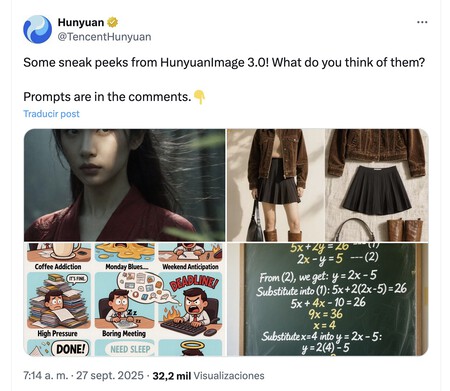
Navigating the AI Landscape : Although the Tencent model is a notable contender, Nano Banana continues to hold its ground as a top choice for users seeking to edit images. It has evolved into an alternative to traditional software like Photoshop . Users can input their desired edits directly to the AI rather than working through conventional editing tools.
Conversational Models : While Hunyuan Image 3.0 offers impressive capabilities, it appears more focused on single prompts compared to the conversational interface of Gemini. Competitors like Alibaba with Qwen-Image-Editor emphasize user interaction, allowing for dialogue with images for real-time modifications. This approach contrasts with Tencent’s more straightforward prompt-based system.
The Industry Implication : The emergence of Hunyuan Image 3.0 suggests that performance in generating images, previously thought to be dominated by proprietary models, can now rival or even exceed open-source alternatives . This move reflects a broader trend in the industry, emphasizing how Chinese companies are challenging the traditional, closed-off philosophy much admired in the American tech sector .
Image insights can be found in their latest developments and interactive demonstrations via Hunyuan’s Twitter. With Hunyuan Image 3.0, we are reminded that innovation is multidimensional, and the future of AI-generated imagery might be exponentially more inclusive and accessible than ever before.