
Modern automobiles have increasingly transitioned to screens, a transformation that perhaps seems paradoxical. While purists express their skepticism and luxury brands like Bugatti remain hesitant about their widespread adoption, it’s clear the general populace craves vehicles filled with screens . A glance at market trends reveals this. Tesla revolutionized the automotive experience with its minimalistic dashboard , prompting both mainstream and luxury brands to embrace large, tactile screen surfaces. Even Mazda, known for championing ergonomics and non-touch displays , has succumbed to the trend.
This shift is not merely incidental; car manufacturers conduct extensive studies to gauge consumer preferences, and the data suggests that buyers are inclined towards options featuring larger and more prominent screens.
<img alt="Mercedes has filled its cars with screens, now its software chief deems traditional buttons better" width="375" height="142" src="https://i.blogs.es/4876ac/mercedes-clg/375_142.jpeg"/>BMW is among the automakers leaning into this trend. The German company’s vehicle interiors are evolving into multimedia spaces as physical buttons gradually disappear to accommodate larger touchscreen layouts. Notably, even the light switch in a BMW 5 Series is now a tactile interface.
BMW faces a unique challenge as it prepares to launch an arsenal of disruptive innovations marked by the debut of their Neue Klasse , the technological foundation for the new BMW iX3 and the future Series 3, including a fully electric variant. Yet, the Neue Klasse represents more than just a technical milestone; it embodies a new philosophy .
This philosophy is also reflected in the interior design, notably through the introduction of Panoramic iDrive , a groundbreaking feature first unveiled in 2023, which has already been noted as a reference point by brands like Xiaomi.
<img alt="I bought this car for one simple reason: I am tired of giant screens" width="375" height="142" src="https://i.blogs.es/8259c5/mazda-3-2019-1600-73/375_142.jpeg"/>Why does an electric car have less autonomy than advertised?
From iDrive to Panoramic iDrive
While the Panoramic iDrive might seem radical, it’s not the first time BMW has embraced such disruptive changes. The Neue Klasse recalls the origins of the Series 3, created in the 1960s to unify BMW’s offerings between compact cars and large sedans. Just as that model was revolutionary for its time, the evolution of the iDrive system also marked a significant moment in automotive design.
As noted by Motorpasión , BMW redefined its interiors in the early 2000s to adapt to new connected systems. I can vividly recall a friend marveling about a BMW Series 7 that allowed drivers to call a restaurant or book a hotel room while driving.
These advancements necessitated a complete overhaul of the car’s cockpit. Enter the iDrive, a rotary control that has acted as a navigation tool among various menus for over two decades. This innovative approach influenced competitors worldwide.
<img alt="We thought we were going crazy with the screens. BMW believes there are too few and doubles down" width="375" height="142" src="https://i.blogs.es/42e016/img_3598/375_142.jpeg"/>Twenty-five years later, BMW has further revolutionized its interiors, challenging preconceived notions regarding central displays. With the Panoramic iDrive , drivers have a sweeping view of vital information divided into four sections.
- The Central Screen: Shaped rhomboidally, this 17.9-inch display is designed for optimal driver interaction. Its positioning allows the left side to be easily reachable, while the right side, though slightly farther, remains accessible without contortion.
- The Steering Wheel: This new multi-function steering wheel organizes its controls into two categories, with illuminated buttons signaling their current functions. The right side handles infotainment and voice commands, while the left focuses on Advanced Driver Assistance Systems (ADAS).
- Panoramic Vision: The centerpiece of this innovation, featuring three integrated screens. The left screen functions as a traditional instrument cluster while the other two display customizable widgets—everything from navigation to music. Users can swipe applications from the central screen to this display effortlessly.
- 3D Head-Up Display: This optional feature adds depth to the driving experience by complementing the Panoramic Vision, ensuring vital information isn’t duplicated.
As a result, physical controls are nearly obsolete.
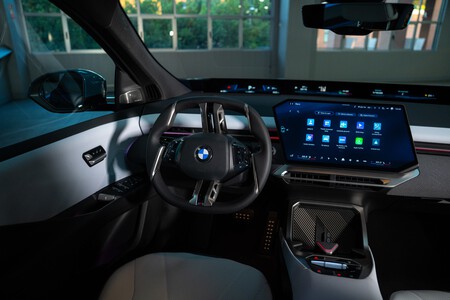
<span>Interior of the BMW iX3 featuring the Panoramic iDrive</span>Sometimes more is less
What does this all feel like behind the wheel? It’s essential to clarify that my experience so far has been static. Some concepts leave me intrigued; however, overall, I sense that Panoramic iDrive could define the future of automotive design and may inspire other manufacturers.
I must admit; I’ve been outspoken about excessive screen stimulation. Poorly managed displays can indeed pose dangers if drivers are distracted while setting them up. Yet, I acknowledge my shortcomings; often, I neglect to customize the settings in press vehicles, resulting in confusion.
The BMW approach, however, has struck me as a logical evolution. This revolutionary system allows drivers to access essential information at a glance without diverting their attention from the road. The instrument cluster is positioned perfectly, ensuring that key data—like remaining journey time—remains visible without navigating a central screen.
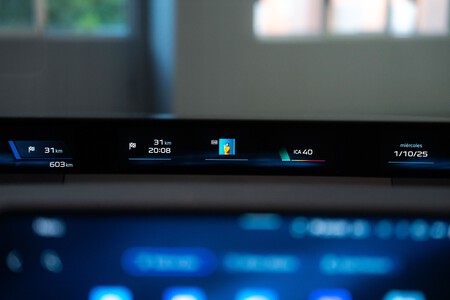
<span>The quality of the Panoramic Vision is exceptionally high</span>This entire upper area, above the dashboard, near the windshield, is a fantastic design choice, enhancing depth perception. It allows for comprehensive access to essential information: time left until the destination, current weather, and radio frequency—all tailored to each driver’s needs. For some, it may be the three widgets, while others might prioritize their calendar.
The key innovation is transforming a substantial 17.9-inch display (3,340 x 1,440 pixels resolution) into a panel for stationary use. Redesigned with the BMW X system built on Android, the interface has been simplified, moving away from submenus that can clutter the experience during driving.
The interface is intuitively designed. Leveraging the rhomboidal shape, frequently consulted widgets sit nearest to the driver, allowing users to interact without delving into secondary menus. It’s designed for quick actions, like calling contacts or routing to favorite destinations with a single tap, streamlining essential tasks significantly.
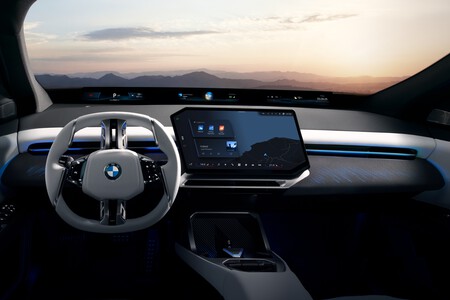
<span>Icons on the left of the screen are widgets with shortcuts integrated.</span>In our limited time exploring the BMW, it appears they’ve crafted a streamlined operating system, ensuring crucial touchpoints are easily accessible while others are intelligently hidden away. With a fantastic display clarity and responsiveness, navigating through the panel feels fluid and pleasant.
Despite these advancements, BMW aims for minimal interaction with the touchscreen. The steering wheel now features essential controls, and the company promises an advanced voice chat system to minimize tactile engagement. If it works flawlessly, it could transform how drivers interact with their vehicle, but there remain some concerns regarding reliance on steering controls.
As mentioned, the presentation was static, meaning features like the 3D Head-Up Display and the tactile controls of the steering wheel remain untested. The right side will control basic infotainment functions, lighting up for quick recognition, while the left focuses on automated driving features, lighting up only when relevant.
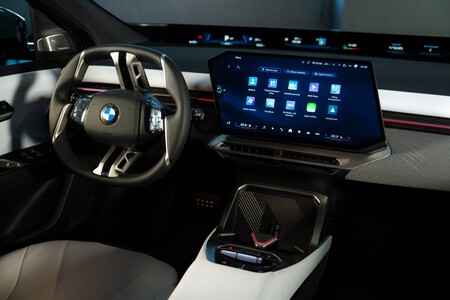
<span>The steering wheel is... peculiar?</span>Interestingly, the left side encompasses automated driving functions. The goal is for the surface to largely remain dark, illuminating only pertinent controls. For instance, when merging onto a highway, the adaptive cruise control button would glow to encourage driver interaction. Conversely, during parking, only parking assist controls will illuminate.
We’ll have to see how everything functions in motion. I harbor two principal concerns: firstly, the tactile buttons’ performance to avoid unintended touches while driving at speed; and secondly, the usability of the Panoramic Display in bright sunlight, which risks blinding the driver without a sunshade protection.
<img alt="After all, we love buttons" width="375" height="142" src="https://i.blogs.es/39b4df/boton/375_142.jpeg"/>Overall, my initial experience with BMW’s new system has been overwhelmingly positive. It seems to represent the natural evolution of screens, repositioning the central panel into a supporting role and leaving primary displays for crucial driving information. This potential breakthrough is underpinned by a refreshing operating system, prioritizing a streamlined interface that is both practical and ergonomically sound. The integration of customizable widgets on the side panel is both a smart and effective decision.
The new Panoramic iDrive feels modern but, above all, it’s efficient and clever. I confidently predict that many will aspire to mirror this design in their future models.
In the absence of a live driving experience, it feels like BMW has made a strong case for the future of car interiors.
Photos | BMW
In Xataka | “Not a phone, it’s a car”: Volkswagen believes the proliferation of screens in cars has gone too far.