
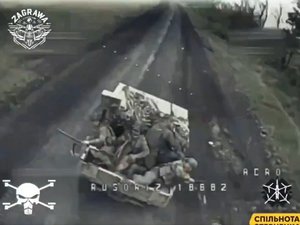
The Russian army is once again pushing the boundaries of military technology by utilizing remote-controlled golf carts on the battlefield. These adaptations of the Desertcross 1000-3 , originally designed in China, have evolved into versatile vehicles capable of supporting various missions on the Ukrainian front. With a load capacity of 300 kg , these modified golf carts are proving to be invaluable assets in modern warfare.
These innovative adaptations of golf carts mark a significant shift in battlefield operations. According to the media outlet Interesting Engineering, Moscow has begun using these remote-controlled vehicles for high-risk missions that would traditionally require human involvement.
The Desertcross 1000-3 was first observed in action in October 2024 . These vehicles are not only cost-effective but also incredibly versatile. Deployed by the 36th Russian Army , they are specifically designed to take over dangerous tasks such as the installation of fiber optic cables , thereby keeping soldiers out of harm’s way.
[Desertcross 1000-3] The 36th Interarmes army command unit master the operation of a specialized remote control system installed on a vehicle for the layout of optical fibers based on all-terrain Desertcross 1000-3 (China).
Informant pic.twitter.com/pyxnijpw1w– The mouse (@la_souris_da) September 28, 2025
Multiple Roles
These machines are especially useful as they can lay up to five kilometers of cables across various terrains . This capability greatly enhances communication and connectivity on the battlefield. Moreover, they can be armed with machine guns , grenade launchers , or even nets designed to protect against drone attacks. The versatility of the Desertcross 1000-3 allows for not just logistical applications but also offensive strategies, giving Russian forces a new avenue for assaulting Ukrainian positions.
In addition, these remote-controlled vehicles can operate in environments that might be too dangerous for personnel. By deploying these carts in hazardous areas, Russian forces aim to minimize human casualties while still maintaining operational effectiveness. With the ongoing conflict in Ukraine, the use of such technology highlights a trend toward automation in military strategies, emphasizing the importance of cutting-edge developments in warfare.
The implications of this technology extend beyond operational efficiency. The Desertcross 1000-3 has raised questions regarding the future of warfare . The reliance on autonomous systems can alter combat dynamics, making it essential for both sides to adapt to the changing landscape. As countries invest in unmanned vehicles , battlefield strategies may increasingly focus on technology rather than sheer manpower.
A Game Changer
Another critical aspect of the Desertcross 1000-3 is its cost-effectiveness compared to traditional military vehicles. By leveraging commercial products like golf carts, armies can reallocate funds toward other essential resources without compromising functionality. This approach allows for a more efficient use of materials, making it appealing for military operations facing budget constraints.
Moreover, the integration of civilian technologies into military applications can lead to rapid advancements. As companies and militaries collaborate on these innovations, we can expect to see a continual evolution in how these vehicles are used, ranging from reconnaissance to direct combat roles. The potential to add features through software updates offers flexibility that traditional military vehicles may lack.
While the Desertcross 1000-3 serves as a testament to creativity in military engineering, it also poses ethical questions about remote warfare . As nations rely more on tools like these, the separation between human operators and the battlefield blurs. This shifting paradigm warrants reflection on moral responsibilities when engaging in conflicts.
As the war in Ukraine continues to unfold, we will undoubtedly witness further adaptations of such technologies on both sides. The Desertcross 1000-3 is not merely a novelty; it represents a new wave of thinking in military strategy, one that embraces automation while exploring the complexities it entails. The future of warfare may be shaped not just by the might of armies, but by the ingenuity of technology.