
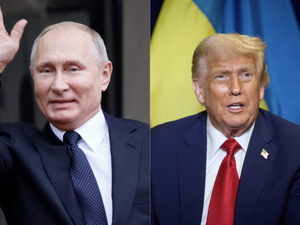
On Wednesday, Russian officials unequivocally rejected former President Donald Trump’s recent criticisms, branding Russia a “paper tiger” in its ongoing conflict in Ukraine . The Kremlin asserted that it has “no alternative” in its military pursuits, which began in February 2022 , and criticized the stagnation of relations between Moscow and Washington . Despite the geopolitical tensions, officials claimed that Russia maintained its overall economic stability .
In response to Trump’s remarks, Russian officials firmly denied any vulnerability in their military operations, countering claims of being a “paper tiger.” The Kremlin emphasized its dedication to continuing its so-called “special military operation,” aimed at securing national interests and fulfilling goals set forth by President Vladimir Putin from the outset of the conflict. Russian Presidential spokesman Dmitri Peskov highlighted that their actions are taken for the benefit of current and future generations, stating that “we have no other alternative.”
Russia, a “paper tiger”, according to Trump
The exchange comes after Trump publicly criticized Russia while voicing strong support for Ukraine. Peskov noted that the relationship between Russia and the U.S. has seen little improvement since Trump’s presidency, indicating that efforts to reduce friction between the two nations are progressing at a frustratingly slow pace.
Trump stated on social media, “It’s been three and a half years since Russia led a war for a clear direction that a real military power would have won in less than a week.” He asserted that Ukraine could potentially reclaim its territories and even advance beyond its original borders without clarifying the role the United States would play in this situation.
“Russia retains its economic stability”
Despite ongoing sanctions and international backlash, Peskov assured that the Russian economy remains “stable,” although he acknowledged the nation is facing challenges in various sectors. “Russia retains its economic stability,” he asserted, while also admitting that there are some “tensions and problems” affecting different parts of the economy.
The economic dialogue contrasts sharply with the military situation, where diplomatic efforts to resolve the conflict have repeatedly proven unsuccessful. Negotiations over possible cease-fire terms or discussions between the leaders of Russia and Ukraine have reached a standstill due to fundamentally opposing positions. For instance, Russia is demanding that Ukraine concede five regions and abandon any intentions of joining NATO , while Ukraine remains firm in its stance for the deployment of Western troops to safeguard its sovereignty, a suggestion that Russia categorically rejects.
Amidst these developments, both countries continue to prepare for what appears to be a long, grueling conflict devoid of a clear resolution. While the Kremlin plays down the criticisms from Washington and the economic challenges they face, geopolitical analysts point out that the tide of public opinion and the effects of international sanctions could alter the dynamics of the conflict, potentially forcing a diplomatic reassessment sooner rather than later.
In the wider context of U.S. political discourse, Trump’s comments echo a sentiment among many Americans about the ongoing conflict, raising questions about what role the U.S. should play moving forward. Economic support for Ukraine and the complexities of international diplomacy might further complicate any peace negotiations that may arise. As the situation evolves, the impact of Trump’s statements may ripple through the halls of power in both Moscow and Washington, influencing future discussions and policy decisions.
The Kremlin’s strong rebuttal to Trump’s remarks reflects not only the charged political atmosphere but also the stark contrasts in messaging between the two nations. As neither side appears willing to back down, the conflict in Ukraine continues to shape the geopolitical landscape, leaving citizens and leaders alike bracing for an uncertain future.
Overall, the ongoing confrontation serves as a reminder of the intricate and deeply rooted tensions that define U.S.-Russia relations, showcasing how historical legacies and national interests can be both a catalyst for conflict and a feature of diplomatic dialogues as they unfold.