

“The other day I went to the post office, and everyone was sitting everywhere, spread out in a corner of the room, etc… there was no queue.” This is how British Tiktoker @edwardthelife described what he perceives as one of the greatest cultural differences: the phenomenon of queuing . In many cultures, especially in Spain , the idea of queuing is not as rigidly defined as it is in Britain.
Although this may seem like an exaggeration, it resonates with many. “An English person, even when alone, will form an orderly line,” remarked George Mikes, a statement affirmed by anthropologist Kate Fox. The British seem to have an almost instinctive need to queue, making it an automatic response that reflects their cultural understanding of order.
But is there any logic behind this inclination?
The Theory of Queues. One of the earliest serious mathematical studies on queues was conducted by Danish mathematician Agner Krarup Erlang. His goal was to determine how to efficiently dimension telephone switches to handle calls without significant delays. At that time, operators managed calls manually, and Erlang aimed to minimize wait times without excessive costs.
Since then, we’ve learned many fascinating insights. For example, common sense often tells us to simply increase the number of lanes , but this doesn’t always resolve the issue. In traffic situations, there’s an optimal lane count for a given volume of vehicles; exceeding this limit can lead to erratic lane changes, ultimately slowing down traffic flow.
Are Both Queues Really the Same? The core distinction between the “English queue” and the “Spanish wait” isn’t about physical formation but rather the rules governing each . The Spanish wait often relies on a verbal understanding , lacking a physical formation. This informal method allows individuals to occupy other spaces during the wait, leading to a different social dynamic .
Is Either System Better? Based on research on virtual queues, an informal waiting process can often enhance customer satisfaction . It alleviates the pressure of simply “standing around.” However, this method does encourage more abandonment than another approach. Thus, when managing client expectations, it’s important that the wait time is not excessively prolonged. A single orderly line, particularly when multiple service points are available, tends to promote a sense of fairness among waiting customers.
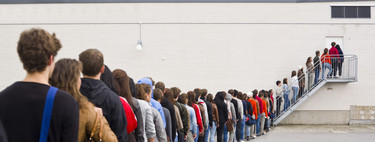
And there may be a rational explanation for these differences. In Spain, physical queues emerge during lengthy waits or when spatial constraints prevent an orderly formation. It is during these instances that the concept of “asking for time” becomes more relevant.
Ultimately, the key takeaway for businesses, especially in service industries like postal systems, is to be attentive to customer feedback. The mail service mentioned by the Tiktoker would benefit greatly from understanding that neither excessive wait times nor inadequate queuing structure creates a positive experience for customers.
For anyone seeking to understand these cultural nuances, it’s important to consider that while queues may seem trivial, they reflect larger societal norms about order, patience, and communication.
Image | Xiangkun Zhu
In conclusion, the examination of queuing systems offers a window into the intersections of culture, mathematics, and human behavior. The contrast between British and Spanish approaches to waiting reveals underlying values and social norms. Understanding these differences can not only improve customer satisfaction but also enhance inter-cultural relations.