

The technological jump in the Ukraine War is surpassing expectations at an astonishing pace. The evolution from simple machines capturing prisoners to autonomous drones conducting attacks has occurred in mere weeks. Today, teams of robots capable of coordinating independently have gained access to a devastating new weapon: artificial intelligence (AI) that enables them to generate military controls between algorithms, significantly enhancing their operational capabilities .
The Rise of Drone Swarms marks a pivotal shift in modern warfare. Drone swarms guided by AI are rapidly moving from theoretical concepts to practical applications. Software solutions like Nemyx from Auterion transform compatible drone platforms into a cohesive, coordinated force that can maneuver, make decisions, and launch attacks collectively, saturating enemy defenses.
In fact, the United States is set to send 33,000 updateable “attack kits” to Ukraine, indicating a clear understanding that deploying smart volumes of low-cost, interconnected drones can play a crucial role in shifting the battlefield dynamics.
Understanding Swarm Dynamics is essential for grasping this new mode of warfare. The key does not lie in each drone being more capable but rather in the cooperation among multiple drones acting like a single organism . These drones share information, distribute roles—designating one as the “general”—reconfigure in response to interference, and evade defenses through coordinated routes and timing. An operator can manage multiple vectors, with decision-making at the tactical level being automated. This enables a “precision mass” that can overwhelm enemy radars, missiles, and anti-aircraft systems.
The Ukrainian Ecosystem reflects this technological advancement. Recently, reports from The Financial Times revealed that Auterion’s Nemyx was presented as an app on its operating system, enabling drones to swarm with a simple update. Concurrently, companies like Helsing, in cooperation with Systematic, are unveiling swarm capabilities guided by AI.
Ukrainian firms such as Swarmer claim to have engaged in 82,000 operations, using software that allows them to autonomously approach Russian positions and select the optimal attack timings. This reflects a trend that began in 2016, where micro-drones were launched from F-18 aircraft, which has gained momentum following China’s demonstration of large swarms since 2017.
The Ukrainian Advantage lies in having a vast operational video database, including classified datasets like the Universal Military Dataset , which inform the AI’s learning and autonomy models—an asset that Ukrainian companies deem critical. By promoting open software standards, they enable rapid integration of various platforms, significantly reducing barriers for manufacturers and accelerating innovation cycles compared to adversaries.
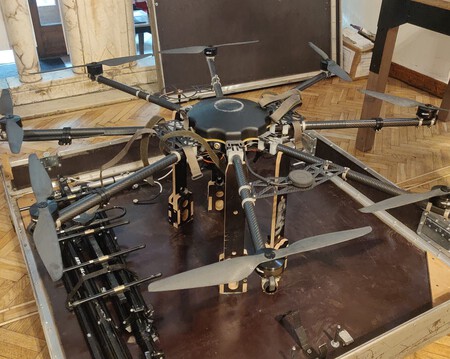
Ukrainian drone R18
Evolving Warfare Tactics is also vital for understanding how combat is changing. While Russia has enhanced its capabilities through coordinated long-range Shahed attacks, these tactics resemble waves rather than true intelligent swarms. The new generation of drones introduces learning and coordination, reducing reliance on a single communications relay and allowing each drone to adjust its behavior in real-time. This leads to saturating defenses not just through volume but with tactical adaptability .
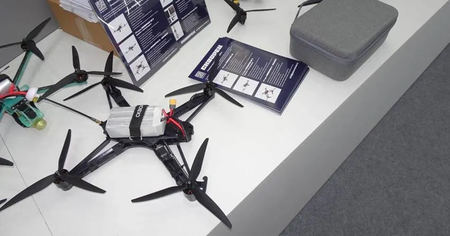
Cust manufactures several drones of the Skvorets FPV family, some with a high degree of automation.
The Russian Leap Forward is significant too. Recent announcements from Russia indicate advancements that could transform drone warfare through the development of an orbit system by the Cust consortium—a network of over 200 startups that have broken the stagnation of traditional defense industries. This system allows FPV operators to manage drone operations from hundreds of kilometers away, reducing risk and exposing only drones rather than operators.
Training for these operator roles has been reduced from four weeks to just one hour, democratizing the capabilities necessary for effective piloting . This innovation would enable Russia to maintain a high volume of drones—projecting plans for 30,000 drones delivered by 2024—while safeguarding their most valuable asset: experienced operators.
Skvorets Evolution showcases the advancements made by Russia. From basic models carrying loads up to 4 kg with maximum ranges of over 10 km, new versions are emerging with features like thermal cameras and autonomous targeting . The introduction of naval models launched from robotic vessels indicates a maturing concept of remote control prior to the development of the orbit system.

Ethics and Legality are increasingly pressing in light of these advancements. Ukrainian developers emphasize that operators maintain authority and oversight over targeting decisions, aligning with international law. However, this fine line between tactical automation and complete autonomy is becoming increasingly blurred as algorithms make more decisions autonomously. In contrast, Russia’s plans suggest a future where machines battle remotely, replacing the “boots on the ground” concept with robotic combatants , advancing the realm of modern warfare.
In conclusion, the rapid technological evolution during the Ukraine War presents both opportunities and challenges. As drone warfare becomes more sophisticated, ethical considerations and technical advancements will play a pivotal role in shaping the future of combat. The implications for global defense strategies will be profound as nations adapt to this new reality.