
Intel’s Transformative Deal: What It Means for the Future of Technology
Intel, a name synonymous with innovation in the semiconductor industry, has recently made headlines by selling 10% of its shares to the United States government for a staggering $8.9 billion. This bold move signifies a pivotal moment for the iconic chip manufacturer, long viewed as a titan in the tech world. The operation underlines a growing sentiment that even the most established companies may no longer thrive without extensive state support.
A Glimpse into Intel’s Pivotal Role
For three decades, the “Intel Inside” stickers adorning millions of computers stood as emblems of American supremacy in semiconductor technology. Intel, alongside Microsoft, shaped the personal computing landscape, giving birth to what many refer to as the “Wintel” era. However, the tides have shifted. In 2009, the Obama administration even filed antitrust charges against Intel, highlighting its dominance in the tech sphere.
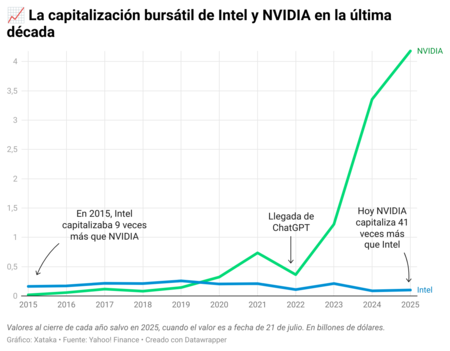
Currently, Intel’s valuation hovers around $108 billion, a stark contrast to its former rival, Nvidia, which boasts a market cap of $4.3 trillion. This shift echoes a broader trend affecting the balance of power within the industry.
The Government’s Bold Investment
Last Friday, former President Donald Trump announced the government’s acquisition of a significant stake in Intel. He framed the deal as a strategic financial maneuver: “I paid zero for Intel; it is worth approximately $11 billion.” However, the situation is more nuanced. Intel was anticipating these funds, which had been pledged by the previous administration and were years in the making.
Desperation drove Intel’s decision. The company faced enormous financial strain, illustrated by staggering losses in its foundry division amounting to $13.4 billion last year. The company also has undergone significant layoffs, with reports indicating between 8,000 and 10,900 employees were let go.
Perhaps most alarming is that even internal teams within Intel have opted against utilizing its own manufacturing facilities, instead favoring services from global competitor TSMC.
Why This Matters
This transaction marks a significant turning point across several levels:
Loss of Independence: For Intel, this partnership with the government signifies a diminished business autonomy. The company has noted that 76% of its revenue comes from overseas markets, with China representing 29%. As their decisions now fall under political scrutiny, the potential for adverse reactions from investors, employees, and clients is heightened.
Governmental Intervention in Technology: For the U.S., Intel’s acquisition symbolizes a return to state capitalism. This direct intervention is reminiscent of past government bailouts post-2008 financial crisis, showcasing a shift in how the U.S. views technological leadership.
Impact on Europe: The message is especially concerning for the European Union, which relies on Intel for its aspirations towards technological sovereignty in semiconductors. If Intel is now effectively a tool of U.S. industrial policy, Europe finds itself in a precarious position, vulnerable to the shifting dynamics of global semiconductor production.
The Trump administration has since sought assistance from TSMC to help support Intel’s factories, emphasizing the national security implications of the semiconductor industry. More broadly, this indicates a shift in government policy, as Trump hinted at further acquisitions, foreshadowing a potentially expansive U.S. intervention in tech.
Unresolved Challenges
Despite this influx of public funds, Intel’s core issues remain unaddressed. Notably, Intel’s history of setbacks is well-documented:
- The company infamously missed the smartphone revolution by declining to produce chips for the inaugural iPhone.
- Intel has also fallen behind in the fast-growing AI sector, where competitors like Nvidia have taken a commanding lead.
- On the manufacturing front, TSMC has consistently outpaced Intel, benefiting from a superior business model focused solely on foundry services.
Intel’s CEO highlighted the stark reality: “Twenty or thirty years ago, we were leaders. Now the world has changed. We are not among the ten main semiconductor companies.”
Looking Ahead
With the government now holding a stake in Intel, the landscape of competition in the tech industry has dramatically altered. Companies such as AMD, Qualcomm, and others now face the unique challenge of competing against a competitor backed by the U.S. government, which could influence government contracts and key political decisions.
Senator Rand Paul offered a satirical observation: “If socialism is the government possessing the means of production, wouldn’t the government owning part of Intel be a step towards socialism?” Ironically, even Bernie Sanders, a self-proclaimed socialist, has praised the government’s intervention.
Intel has transitioned from a beacon of American capitalism to what may be its first major semi-nationalized enterprise in the modern era. For Europe, which strives to keep pace in the global tech race, this development serves as a warning; the era of free-market dominance in semiconductors appears to be coming to an end.