
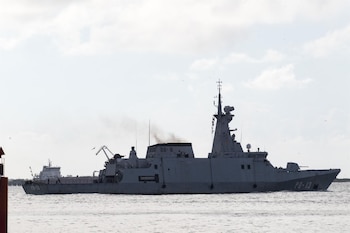
Venezuela Strengthens Military Presence Amid US Naval Deployments
The geopolitical landscape in Latin America has become increasingly tense following Venezuelan Defense Minister Vladimir Padrino López’s announcement of a significant military buildup. This decision has arisen in direct response to the United States deploying warships in the Caribbean Basin, ostensibly under the guise of a drug warfare operation. The implications of these developments extend beyond mere military posturing; they symbolize a potential escalation in regional tensions.
Padrino López stated that Venezuela would integrate drones and naval ships into its territorial waters, emphasizing their utility for multiple missions ranging from citizen assistance to surveillance. “We are also going to have an important deployment of drones with different missions, citizen attention points, exploration and surveillance points,” he explained. Such a rapid mobilization underscores the Venezuelan government’s intent to assert its presence and counteract perceived external threats.
The Defense Minister further detailed that this comprehensive deployment of naval patrols and infantry would encompass key locations, particularly in regions like Catatumbo, notorious for being a hotspot for armed groups and drug trafficking. “We are sure that we are going to give many results,” he promised, confirming the activation of an additional 15,000 troops.
This swift military response indicates a profound awareness of both geographical and operational factors influencing the situation. Padrino López emphasized their understanding of the terrain and the tactics employed by armed groups and traffickers, suggesting that the Venezuelan military is well-prepared for engagement.
In parallel, Venezuela’s permanent mission to the United Nations has voiced serious objections to the U.S. naval deployments, particularly pointing to the arrival of vessels like the USS Lake Erie and USS Newport News. This rhetoric equates the presence of a nuclear submarine, like Newport News, with direct threats to regional security. A spokesperson stated, “The presence of a nuclear submarine, of an offensive nature, in the region of Latin America and the Caribbean contradicts the historical commitment of our nations and peoples with disarmament.”
The Venezuelan government has escalated its condemnation, demanding immediate cessation of U.S. military activities in the Caribbean. They further urged that assurances be provided to prevent the deployment or use of nuclear weapons in the area, citing the importance of maintaining a nuclear-free zone in Latin America.
The regional repercussions are yet to be seen as neighboring countries observe this ebb and flow of military activity. This escalation follows a recurring pattern of tension wherein U.S. involvement in Latin America is often viewed through a prism of historical grievances. The Venezuelan government designated these maneuvers as “a serious threat” and a “clear act of intimidation,” leading to heightened diplomatic discourse at international forums.
Moreover, calls for a united front have emerged, with Venezuelan officials urging other UN member states to recognize the importance of a denuclearized region. The assertion of military strength by both sides raises concerns about the possibility of an armed conflict, further complicating an already volatile situation. The specter of a nuclear-capable vessel near Venezuela’s borders has serious implications for regional stability.
As tensions escalate, the broader implications of such military deployments remain uncertain. While the U.S. argues that its operations are aimed at combating the drug trade, these assertions are met with skepticism from the Venezuelan government. It highlights how military strategies and policies can often be perceived as interventions, leading to more complex international relations laden with mistrust.
In conclusion, the declaration of increased military readiness on both sides reflects not only the immediate strategic calculations of government officials in Caracas and Washington D.C. but also long-standing historical animosities that shape their interactions. The global community must approach this evolving situation cautiously, recognizing the delicate balance of power in a region that has seen far too many conflicts fueled by both external and internal forces.