
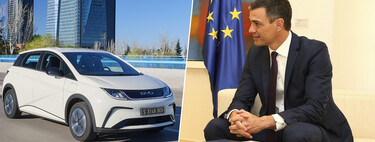
When Ebro arrived in Spain, the aim was to reinstate the company as a pinnacle of Spanish automotive history . However, the reality is that, for now, the Ebro S700 and S800 are essentially variations of the Chery Tiggo, made operational through a system known as DKD (Knock Down). This method, akin to assembling a puzzle, involves Chery sending nearly assembled vehicles in containers, where only a few parts are finalized before the cars make their way out of the factory.
This assembly approach has sparked debate. While it has boosted employment in the aging Nissan factory in Barcelona—previously facing uncertainty about its future—the DKD system has implications for the local economy. The model requires fewer workers, as all the components (and suppliers) are outsourced from China .
This way of operating, in fact, has not been well-received by the European Union , which has warned Chery that they would not facilitate tariff exemptions for their electric vehicles, arguing that they are benefitting from minimal investments. Such criticisms signify a growing concern over trade practices and investments in the automotive sector.
A parallel situation exists in Algeria , where the government has delivered a clear message: the time for superficial investments is over.
<img alt="Europe wants to complicate things to China but Spain has other plans: go for free to attract MG and Byd factories" width="375" height="142" src="https://i.blogs.es/46ffcb/pedro-sanchez/375_142.jpeg"/>“We want to produce cars”
“We want to produce global cars locally, and the time of inflating tires is over,” stated Abdelmajid Tebboune , the president of Algeria, during an interview with local media. This metaphor of “inflating tires” reflects the superficial investments that manufacturers make, which do not lead to genuine local production of vehicles. Currently, companies like Stellantis, Volkswagen, and Renault have manufacturing operations in Algeria, while others, such as Hyundai and Chery, are expected to set up new plants soon.
Nevertheless, Algeria faces significant challenges in its automotive industry. Similar to the case with Ebro, the local investments made by manufacturers are scant, primarily aimed at circumventing tariffs and navigating stringent regulations on imported vehicles that have been established to safeguard the local economy. For instance, Renault’s operations, particularly with the Renault Clio , mirror the approach of Chery with Ebro in Spain, where the goal remains profit rather than authentic local manufacturing.
“The vehicle arrives semi or completely finished, so there is nothing to assemble,” remarked Mohamed Bairi , head of Ival, a Iveco importer, to local media. Moving forward, the intent is to increase the use of locally sourced components and enhance the involvement of Algerian facilities.
Stellantis claims it will increase the use of local parts by a minimum of 35% by 2026 . The Algerian government demands that local parts integration reach at least 30%. According to reports, currently, merely 5% of the components utilized in Algeria derive from local suppliers. This stark disparity highlights the challenges faced in achieving the government’s goals and cultivating a sustainable automotive industry in Algeria.
<img alt="Spain walks on the tightrope with China. Chinese electric car tariffs are confirmation that we play without a network" width="375" height="142" src="https://i.blogs.es/4d1581/image_7-2/375_142.jpeg"/>It remains to be seen how these developments will affect plans for companies like Hyundai and Chery , which have relied heavily on the CKD system to market their vehicles domestically. While this model raises employment in regions where the companies operate, the heavy reliance on foreign components has raised concerns among European authorities, who wish to avoid similar outcomes in Algeria as well.
As the automotive landscape continues to evolve, both Spain and Algeria face critical moments. With mounting pressure from governments and international bodies to localize production and invest substantively in the domestic economy, the question remains: will car manufacturers adapt to embrace a more sustainable approach, or will they continue to navigate the fine line between superficial presence and genuine commitment? Only time will tell how these dynamics will unfold in the rapidly changing automotive industry.
Photo | Renault
In Xataka | Morocco is positioning itself as a competitor to beat in the electric car market: China has clearer intentions than ever.