
The Alarming Decline of Baidu: Analyzing Its Falling Stock Performance
In the stock market, investors often turn to the Price to Earnings Ratio (P/E Ratio) to gauge whether a stock is overpriced or undervalued. When we focus on the Chinese technology sector, one company stands out due to its concerning P/E Ratio : Baidu. This esteemed contender, often dubbed “the Chinese Google,” is facing a turbulent phase, leading to considerable investor anxiety.
Fall of a Giant
Just recently, Baidu released dismal financial results for the quarter. This downturn highlights a 3% drop in share value on the Hong Kong Stock Exchange, marking the worst quarterly income performance in the last three years. The figures raise serious concerns about the previous market perception of Baidu as a stable investment opportunity.
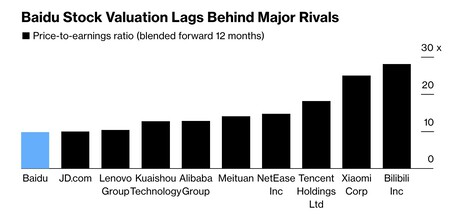
Source: Bloomberg.
A Worrying P/E Ratio
At present, Baidu’s P/E Ratio hovers around 9.7 , the lowest among profitable companies listed in the Hang Seng Tech Index (HSTECH). This data, when compared to its peers, signals that Baidu’s shares are overly cheap , raising questions about the company’s market position and future potential.
Loss of Popularity as a Search Engine
For many years, Baidu was the go-to platform for online searches in China, akin to how Google functions in the West. However, its relevance is waning. Many younger Chinese consumers have opted for different platforms, skirting past Baidu and Google altogether.
Fierce Competition
New social media platforms like TikTok and Instagram are capturing the attention of younger audiences, effectively drawing users away from traditional search engines. In China, niche platforms such as Xiaohongshu and Douyin follow suit, establishing vibrant community ecosystems that offer dynamic content. As Eric Shen, an analyst at Third Bridge, points out, these competitors have successfully crafted an engaging content ecosystem that has made Baidu appear static and outdated.
A Disappointing 2025
2025 has thus far been troubling for Baidu, especially when compared to its AI-focused competitors, which have seen an impressive 24% gain this year. In contrast, Baidu’s stock has suffered a 3% decline since January. This juxtaposition raises important questions about Baidu’s ability to adapt and innovate in an increasingly competitive technological landscape.
Challenges in AI Development
In the realm of artificial intelligence (AI), Baidu faced further setbacks. The company quickly introduced Ernie , a competitor to ChatGPT , in March 2023, but performance issues hindered its initial reception. As the AI landscape evolves, Baidu is struggling to maintain its footing amidst rising competitors like Deepseek and Qwen , developed by Alibaba and Bytedance, respectively.
Attempts to Revive AI Strategy
To regain traction, Baidu introduced a free version of Ernie in April 2023. Furthermore, their latest model, Ernie 4.5 , celebrated its release as an open-source initiative, moving away from a proprietary model. Yet, despite these efforts, discussions surrounding its capabilities have been relatively muted compared to the buzz around other emerging models like Deepseek or Qwen. As anticipation builds for Ernie 5.0, scheduled for release at the end of August, stakeholders are hopeful it can compete in this swiftly transforming market.
Looking Ahead
While Baidu’s challenges are apparent, analysts express cautious optimism concerning the company’s latest strategic decisions. Investments in robotaxis and initiatives aimed at revitalizing their AI offerings appear to be part of a broader strategy to reclaim its dominance in the tech landscape.
In conclusion, Baidu stands at a crucial juncture, facing an uphill battle against fierce competitors in both the search engine and AI sectors. The company’s new strategic initiatives could pave the way for a resurgence, but whether it can regain its relevance in the rapidly evolving tech landscape remains to be seen.