
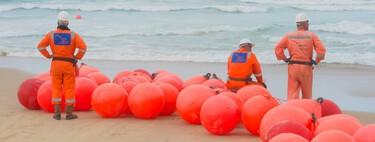
An underwater cable costing 49 million euros is set to connect the Canary Islands with Africa, but its journey will end precisely where legal complexities arise: the border of Western Sahara .
What is Happening
This ambitious project, known as the Ring of the East , will initially connect Gran Canaria, Lanzarote, and Fuerteventura through cutting-edge fiber technology. Once it reaches the African continent, it will extend to Tarfaya , the last Moroccan city before entering the contentious territory of Western Sahara.
The Canarian government has been transparent regarding the project, stating categorically, “The cable goes to Tarfaya, it has nothing to do with Western Sahara.” However, Morocco has different aspirations. The Moroccan government aims to extend this cable to what it refers to as its “South Provinces,” a euphemism for the Saharawi territory that has been the center of conflict since Spain withdrew from the region in 1975.
<img alt="The office of underwater cable technician, counted by someone who has been in it: "My worst enemy are earthquakes"" width="375" height="142" src="https://i.blogs.es/88bfbc/1366_2000-1/375_142.jpg"/>Why is it Important?
Submarine cables serve as the highways of the internet, with 99% of global data traffic traversing through them. This upcoming project holds the promise of transforming the Canary Islands into a vital digital hub connecting Europe and Africa.
However, there are significant legal challenges to consider. The EU Court of Justice has ruled that any economic activity in Western Sahara must have the approval of the Polisario Front , which is recognized by the UN as the legitimate representative of the Saharawi people. The Polisario has already issued a stern warning: if the cable crosses into Saharawi territory, they intend to pursue legal action.
The Context
Since Pedro Sánchez backed Morocco’s Autonomy Plan for Western Sahara in 2022, Spain has struggled to balance its economic relationships with Morocco against its international legal responsibilities. This cable project poses a unique test of that balance. Should the infrastructure funded by European investments facilitate Moroccan expansion into Western Sahara , it could expose Spain to significant legal troubles within European courts.
The Money Trail
The construction of the cable is already underway, with notable financial specifics:
- Total budget: 49 million euros .
- Contribution from the European Investment Bank: 20 million euros .
- Additional funding for connecting Tarfaya: 7.5 million euros .
In February , technicians from Canalink —the Canarian public company leading the initiative—visited Tarfaya to assess the land and plan the submarine layout. The cable is set to be manufactured in 2025 and deployed in 2026 .
The Precedent
This isn’t the first time the Canary Islands have connected with Morocco. Since 2011 , there has been a cable linking the islands with Asilah , located in northern Morocco. This scenario did not provoke any controversy due to the geographical distance from the disputed territory.
In contrast, this new initiative approaches the boundary of Western Sahara. Although the cable will technically stop there, it sets a foundational stage for Morocco to complete what European firms cannot do due to legal restrictions.
The Threat
The Polisario Front has previously achieved significant victories in European courts, including annulments of fishing agreements and agricultural contracts between the EU and Morocco that involved Saharawi resources without proper consent. Abdulah Arabi, a representative of the Polisario in Spain, has remarked, “We will carry out any action to guarantee the rights of the Saharawi people.” If the cable crosses the border into Saharawi territory, it could become their next target.
And Now What?
The project will move forward since the Canary Islands require this essential connection. The ESSI in Spain retains an illusion of detachment, claiming responsibility ends at Tarfaya. If Morocco chooses to extend the cable into Western Sahara using European-financed infrastructure, Spain may again find itself embroiled in a clash between economic objectives and obligations to a territory it relinquished over fifty years ago.
This time, however, the contest is not over fishing quotas or phosphates; it revolves around control of data flow between two continents, a new frontier in the ongoing saga of global connectivity.
In Xataka | The Google Maps of submarine cables: an imposing interactive map that allows us to know the skeleton of the modern world
Outstanding image | Telefónica