
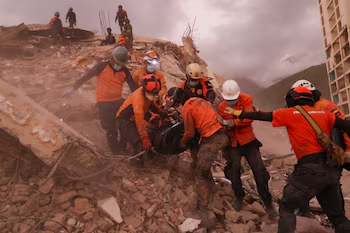
The Rising Death Toll in Venezuela’s Earthquake Crisis
The aftermath of the devastating earthquakes that struck Venezuela on June 24 has led to a staggering increase in the death toll, now reported at 4,333. This alarming figure follows the discovery of 215 new bodies, as announced by Jorge Rodriguez, president of the National Assembly, during a press briefing. This catastrophe is being recognized as one of the most severe in Venezuela’s recent history, with ongoing recovery efforts revealing the extent of the devastation.
A Desperate Search for the Missing
Currently, there are 315 unidentified bodies, a number that Rodriguez articulated in defense of the government’s approach to avoid speculation regarding missing persons. This has raised concerns about the accuracy and transparency of the information being provided to the public and the media.
The coastal region of La Guaira is reported to be the most heavily affected area, concentrating much of the rescue efforts and the ensuing humanitarian crisis. As the situation evolves, the Venezuelan government is facing increasing pressure from both citizens and international organizations to manage the aftermath effectively.
Temporary Camps and Displacement
As the death toll rises, so does the number of displaced individuals. The government has set up 94 temporary camps for the homeless, a number that has escalated from 89 in recent days. Currently, there are approximately 18,437 people living in these makeshift shelters, highlighting the urgent need for humanitarian assistance.
- 6,133 individuals are residing in 40 camps in Caracas.
- 10,981 are housed in 28 camps located in La Guaira.
- 1,323 are living across 26 facilities in the state of Miranda.
International and Government Responses
To aid in managing this crisis, the Venezuelan government has initiated a biometric census for all victims, utilizing fingerprint technology to accurately register those affected. Delcy Rodriguez, the acting president, emphasized the goal of comprehensively understanding each individual’s situation, though specifics about the methodology have yet to be disclosed.
International organizations have also mobilized to assist. Tom Fletcher, the UN Deputy Secretary-General for Humanitarian Affairs, revealed that the UN’s response plan includes sending prefabricated housing to address urgent housing needs in the aftermath of the earthquakes.
Future Steps Toward Recovery
Venezuela’s authorities are reportedly in advanced discussions with countries such as the USA and Brazil, as well as financial institutions like the International Monetary Fund (IMF) and the World Bank, to facilitate a recovery process post-disaster. The situation remains critical, with over 16,000 reported injuries and extensive damage to infrastructure, services, and housing.
The immediate challenges lie in expanding the capacities of temporary camps and ensuring basic living conditions for displaced families. Authorities hope that by improving the management of resources through the biometric census, they will be better positioned to offer personalized assistance to the victims.
In summary, the catastrophic impact of the earthquakes in Venezuela is not only tragic but calls for immediate global attention and collaboration to alleviate the suffering of thousands affected by this humanitarian crisis.