
For months, the sentiment was clear: OpenAI needed to make a significant impact. GPT-4 elevated expectations, while its subsequent iteration, GPT-4.5 , was seen as underwhelming; many criticized it for offering only minimal enhancements and failing to deliver on lofty promises. Today, with the arrival of GPT-5 , the company aims to regain momentum. The new model debuts in three variations, each designed to reflect OpenAI’s evolving capabilities.
OpenAI has designated GPT-5 as its most comprehensive model to date. Training efforts emphasize three core pillars: a better grasp of complex instructions, management of longer contextual interactions, and seamless integration with external tools. The ambition is nothing short of revolutionary: to transform the model into a highly functional digital agent.
The hallmark of this new model lies in how users interact with it. In GPT-4 , users faced the limitation of having to choose between speed , vision , or reasoning . GPT-5 eliminates these constraints. Now, the model intelligently decides in real-time whether to respond immediately or take a moment for deeper thought. This innovation offers a more fluid user experience, sidestepping the need for manual mode selection or specific functionalities.
What Can GPT-5 Do?
GPT-5 goes beyond mere question-and-answer functionality; it executes a variety of tasks . According to OpenAI, the model can generate software, organize calendar events, and draft technical reports. Moreover, its effectiveness extends to subjective domains such as writing and design .
In the realm of programming , GPT-5 is making waves. According to the Benchmark Swe-Bench Verified that focuses on real GitHub tasks, GPT-5 boasts a remarkable 74.9% success rate on the first attempt. No previous model has achieved this level of efficacy. As per OpenAI’s claims, it outperforms Claude Opus 4.1 (74.5%) and Gemini 2.5 Pro (59.6%).
It’s worth noting that GPT-5 is now the default model available on the free ChatGPT plan, marking a significant milestone where anyone can access such an advanced reasoning system without a subscription fee.
<img alt="David Reber, CSO of Nvidia, discusses AI safety" width="375" height="142" src="https://i.blogs.es/fa3710/nvidia-portada-1/375_142.jpeg"/>In internal tests, GPT-5 Pro performed exceptionally well, achieving an error rate of just 4.8%. This is a marked improvement over GPT-4 , which boasted a significantly higher error rate of 20.6%. Additionally, GPT-5 enhances security features, providing more reasoned responses, rejecting inappropriate inquiries, and avoiding nonsensical responses that plagued earlier versions.
Moreover, GPT-5 not only enhances its internal faculty but also refines user interaction. With its release, ChatGPT introduces four new personalities: Cynic , Robot , Listener , and Nerd . Each persona adapts its tone, attitude, and focus naturally, without the need for any prompts, fostering a more tailored user experience.
How Much Does It Cost to Use GPT-5 in ChatGPT?
- ChatGPT Free : Limited access. After a certain number of interactions, users will access the GPT-5-mini model.
- ChatGPT Plus ($20 per month): Enhanced access with expanded limits.
- ChatGPT Pro ($200 per month): Unlimited access to GPT-5 Pro , offering reinforced capabilities, better responses, and advanced functions such as voice communication, search, and deep reasoning.
Enterprise, Team, and Educational plans will receive the model in the following week as the default offering.
GPT-5 Also Reaches the API in Three Sizes
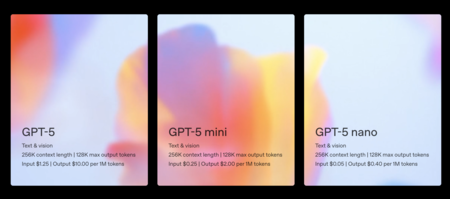
GPT-5 has also made its way to the API, available in three sizes to accommodate various user needs. This flexibility allows developers to choose a more robust model for complex tasks or a lightweight version for quick, cost-efficient responses.
- GPT-5 : Designed for complex logic and reasoning tasks.
- GPT-5-mini : A lightweight alternative for budget-conscious applications.
- GPT-5-Nano : Optimized for speed and low latency.
Official pricing structures include:
- $1.25 per million input tokens
- $10 per million output tokens
One More Step in OpenAI’s Strategy
GPT-5 arrives following a week brimming with developments. Just days ago, OpenAI unveiled GPT-Oss , its open-weight model aimed at operational efficiency at a lower cost. In contrast, GPT-5 reverts to a high-performance, closed model directed at handling complex, professional, and autonomous tasks. Is it the best iteration yet? In some areas, yes; in others, it may fall short. Nonetheless, it signals a pivotal shift in the evolving narrative we’ll explore in subsequent articles here at Xataka.
In development.
Images | OpenAI
In Xataka | I have tried the new OpenAI models. It has been a small odyssey with a prize: I have a ChatGPT at home.