
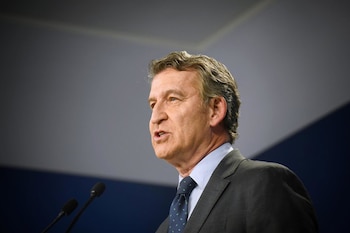
Alberto Núñez Feijóo’s Critique: A Standoff with Pedro Sánchez
In a recent political address at the headquarters of the People’s Party (PP) in Genoa, Alberto Núñez Feijóo, the president of the PP, offered a scathing critique of the current Spanish government, led by Pedro Sánchez. This address came just three days after Sánchez’s own evaluation of the political course taken by his administration. The stark contrast between the two leaders’ positions is reflective of the growing divide in Spanish politics.
Feijóo’s remarks were pointed, as he accused Sánchez of relying on “bites and audios” to govern, emphasizing that such tactics betray a lack of integrity. “Today, there is more distance than ever between what is written in Moncloa and the reality faced by the citizens across our country,” Feijóo declared, signaling a disconnect between government proclamations and public sentiment.
A Landscape of Triumphalisms
Feijóo criticized what he termed as the triumphalism projected by Sánchez’s government, arguing that crucial commitments by the coalition have gone unfulfilled. He pointed out the absence of a legislative debate on the national budget, and remarked on Sánchez’s failure to convene a state of the nation debate, suggesting it stems from the government’s lack of a stable parliamentary majority. “He has not summoned elections because he knows that he would lose them,” claimed Feijóo, further reinforcing his view of Sánchez’s political vulnerability.
Alberto Núñez Feijóo’s dissection of Sánchez’s administrative approach reflects a growing sentiment among many Spanish citizens who are disillusioned with the perceived inefficacy of the government. His insistence on the notion that “Spain suffers from an institutional crisis” serves to highlight the escalating frustrations that are prevalent among constituents.
The Unraveling of Political Masks
The political climate has become increasingly hostile, with Feijóo asserting that “the masks have been uncovered” under Sánchez’s lead. He referenced the ongoing scandal involving Secretary of Organization of the PSOE, Santos Cerdán, and former Transportation Minister José Luis Ábalos, who are embroiled in charges linked to bribery in exchange for public works contracts. This part of Feijóo’s address underscores the ethical concerns that have begun to plague the PSOE leadership, putting their integrity into question.
In a striking rhetoric, Feijóo also criticized Sánchez’s claim of standing as a champion for feminist values. He accused the Prime Minister of neglecting serious issues surrounding the treatment of women, pointing to audio recordings that supposedly reveal conversations about exploiting women. The implications of these allegations further paint a picture of a government that is, according to the PP leader, deeply flawed.
Foreign Policy and the Perception of Weakness
Shifting gears to foreign policy, Feijóo relegated Sánchez to the role of a “great international farce,” arguing that he is primarily concerned about maintaining alliances with his parliamentary partners rather than addressing Spain’s global positioning. “There has never been true governance in Moncloa,” Feijóo lamented, indicating that the leadership is characterized more by cover-ups than by substantive action.
His sharp criticism gains added weight when considering the broader implications for Spain’s role within the European Union. Feijóo’s stance implies that the perceived weakness of Sánchez could undermine Spain’s ability to navigate complex international challenges, particularly in times when unity among EU nations is crucial.
A Vision for the Future: Repealing “Sanchist Laws”
As Feijóo summarized the political course, he pointed out the contrasting narratives of the two major political parties. He characterized the PSOE’s Congress as a mere “submission ceremony,” while the PP’s gathering was a “celebration of principles.” Feijóo expressed confidence that the PP has a concrete “nation project” in mind, one that involves the repeal of what he calls “Sanchist laws.” This includes possible plans to amend the Amnesty Law and replace the Democratic Memory Law with a proposed Concord Law.
Furthermore, Feijóo subtly hinted that tax increases implemented by the current administration have not yielded the promised improvements in public services. “If citizens ponder whether raised taxes have facilitated better services, the answer is no,” he asserted, spotlighting the growing discontent about the government’s fiscal policies.
While Feijóo concedes that the timing of the next election is largely out of his hands, he remained resolute in his commitment to prepare for when the elections do arrive. His determination signals a robust campaign strategy where the PP evinces readiness to engage with the electorate once more.
In this highly charged political landscape, Alberto Núñez Feijóo’s address not only highlights the divisions within Spanish politics but also showcases the contrasting visions of leadership espoused by the two main parties. His criticism of Pedro Sánchez resonates with a notable segment of the population that craves transparency, accountability, and effective governance. As the political course unfolds, the coming months will be pivotal in shaping the trajectory of Spanish politics.