
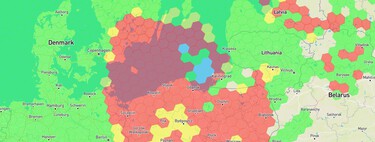
A pilot recently took to the skies over the Baltic Sea , only to find his navigation systems betraying him, indicating he was tens of kilometers off course and spiraling into Russian territory . Remarkably, this is not an isolated event. Weeks earlier in the Middle East , more than 20 airline crews reported experiencing a “total navigation failure,” forcing them to navigate without reliable electronic guidance.
These were not mere technical issues. Instead, they were deliberate attacks on GPS systems known as spoofing or signal supplantation. In these attacks, a powerful transmitter on the ground emits deceptive signals designed to mimic those of satellites. This trickery leads aircraft to miscalculate their actual position and intended route, creating a dangerous situation for pilots and passengers alike.
Back in 2012 , a team from the University of Texas demonstrated that it was possible to take control of a civil drone using spoofing techniques . By 2017 , incidents were reported with ships passing through the Black Sea . Fast-forward to today, and the Baltic Sea and the Persian Gulf have become notorious for similar incidents, with maritime operators and airlines increasingly concerned about safety.
Europe is taking action. Fortunately, the aviation sector has largely avoided catastrophe, thanks in part to redundant systems and the expertise of the pilots navigating through these dangerous waters. However, as threats escalate, a robust technological response is essential.
The Galileo constellation , Europe’s equivalent of GPS, has recently activated its Open Service Navigation Message Authentication (OSNMA) service. This cutting-edge technology adds an additional security layer that effectively mitigates spoofing threats without compromising the performance or precision of positioning data.
How OSNMA Works. OSNMA acts as a type of digital authentication seal available for free to all Galileo users. Essentially, it is a cryptographic protocol that embeds authentication data directly into the signaling system. Specifically, it employs the I/NAV message of the E1-B signal, a reserved area that won’t affect service performance.
To utilize this feature, developers must obtain the cryptographic public key from the European GNSS Services Center (GSC) . When a receiver picks up the signal, it uses that key to verify the message’s “digital signature.” If the signature is found to be false or nonexistent, the receiver alerts the pilot or the autonomous navigational system, thereby providing a critical safeguard against deception.
OSNMA Prevents Spoofing, but Not Jamming. While OSNMA dramatically increases the difficulty of successfully spoofing a Galileo signal, it does not eliminate the jamming threat. Jamming occurs when someone uses brute-force methods to overwhelm the receptors with noise. The silver lining is that it is no longer enough to simply broadcast a false signal; malicious actors must also replicate a real-time cryptographic signature, which presents a formidable computational challenge.
OSNMA aims not only to bolster security in air and sea traffic management but will also play a pivotal role in the future of autonomous vehicles , smart tachographs, and advanced road usage systems. Additionally, industries such as telecommunications, energy, and finance, which depend on ultra-precise timing signals for synchronization, will benefit significantly from this technology.
Image | ESA, Euspa
In summary, as the GPS vulnerabilities of modern aviation systems become increasingly clear, advancements like OSNMA are crucial in fortifying navigation against sophisticated threats. By embedding authentication into the navigation signal itself, Europe is taking a proactive stance to ensure the safety of aerial and maritime navigation, ultimately paving the way for a more secure technological future across various sectors.