
Thousands of kilometers of coastline, a complex web of strategic trade routes, and an increasingly perilous sea environment have compelled Europe to rethink its maritime security. The threats now arrive not just from navy ships, but through drones , sabotages , and undercover operations . With the increasing aggressiveness in the maritime domain, Europe has embarked on a rearmament journey, focusing on advanced technologies that go beyond conventional military assets. Enter Arrow, a new beacon of hope in the fog of modern warfare, set to become the new sentinel of the sea .
A European system for an increasingly hostile environment. Recent incidents, including suicide drones crossing the Red Sea or attacks on critical infrastructure, illuminate the vulnerabilities faced by maritime nations. The silent yet disruptive nature of modern warfare has been well understood by European authorities: large vessels alone will no longer suffice for national defense. There is an urgent need for a stealthy , agile , and robust surveillance system that can detect threats early , enhancing overall maritime security before issues escalate.
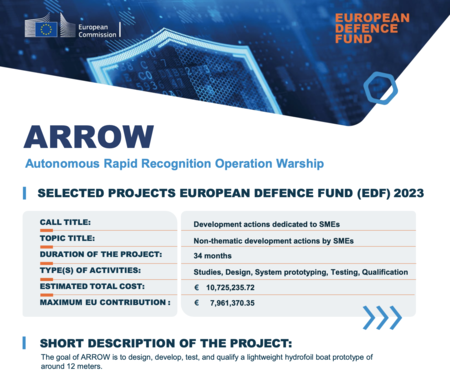
What is Arrow and what makes it different. Envision a vessel without a pilot, producing very little noise yet capable of traversing 740 kilometers of coastline without needing to refuel. This is the Vision Arrow, a 12-meter European naval drone designed to operate autonomously or with crew onboard. Officially launched in July 2025, Arrow is currently in its design phase, with a prototype scheduled for testing around 2027 . The goal is to achieve speeds of up to 45 knots , cut fuel consumption by 50% , and drastically reduce its acoustic and visual signatures. Unlike traditional military technology aimed at confronting major threats, Arrow’s main function is early detection and alerting —acting before the situation grows dire.
Arrow does not aim to replace conventional patrol vessels or satellites. Instead, it seeks to enhance existing capabilities by delivering a highly agile platform that combines discretion , artificial intelligence , and operational efficiency—tools designed for anticipation , not aggression.
What will Arrow be and what makes it possible. Arrow’s design stands out—its elongated , slim form drastically reduces turbulence and noise in the water. Unlike ordinary unmanned vehicles, Arrow features a retractable hydrofoil, allowing it to skim across the surface and reach speeds of 45 knots (approximately 83 kilometers per hour) while slashing fuel consumption in half. This innovative approach to naval mobility is critical in ensuring effective operations in challenging environments.
A system that does not need a pilot. Arrow is not merely a faster version of conventional unmanned boats; it is equipped with an advanced autonomous navigation system integrated with real-time data processing capabilities. This technological leap enables it to detect obstacles, adjust its course accordingly, and maintain open communication channels, thus eliminating the need for constant human oversight. Such autonomy is paramount for missions in degraded or GPS-denied environments, where fast decision-making can make the difference between success and failure.
Who is behind the Arrow Project. The Arrow project is spearheaded by the European Defence Agency, with an estimated total cost of 10.7 million euros . The European Union will contribute almost 8 million euros through the European Defense Fund. Coordinated by the French company Seair, the consortium includes ten organizations from eight EU member states or associated countries.
The consortium comprises a mix of technological SMEs and research institutions, including:
- Seair (France)
- Maritime Robotics (Norway)
- D3 Applied Technologies (Spain)
- Knierim Yachtbau (Germany)
- Sierra Tango (Belgium)
- Maxwell Applied Tech (Spain)
- C & V Defense (Belgium)
- EU3Star BV (Netherlands)
- Taltech – Tallinn University of Technology (Estonia)
- Riga Technical University (Latvia)
Collectively, their mission is to pool industrial and scientific expertise to create a European , autonomous , and exportable solution.
Arrow is not an isolated case: it is part of something bigger. The Arrow project is part of a broader strategic initiative within the European Union to establish independent capabilities for national defense. This initiative includes the development of new fighters (FCAS), satellites (IRIS2), and air defense systems (Sky Shield). The creation of naval drones like Arrow underscores Europe’s commitment to defend its interests autonomously.
What is expected now. Although Arrow is currently a concept, it is set to transform into reality over the next three years. The project timeline indicates that by 2028, Arrow should be ready for operational deployment, with the first major prototypes expected to undergo sea trials in 2027 . The development phase will involve refining the technical architecture and constructing a functional prototype. This rigorous framework is designed to ensure the readiness of Arrow for its intended purpose.
Currently, images of Arrow’s final design remain under wraps. However, during the project’s launch, Naval News released partial images showcasing a physical model, giving us a glimpse into what this innovative maritime system might look like in action.
Images | Xataka with ChatGPT
In conclusion, Arrow signifies a significant leap in Europe’s maritime defense capabilities, emphasizing the need for innovation in response to modern threats. As this project progresses, it holds the promise of enhancing maritime security while also representing a strategic shift towards greater independence in defense technology.