
The Curious Journey of 24 Tons of Volcanic Sand from La Palma to Madrid
Every summer has its own informative saga , often resembling an intricate soap opera. This year, the unusual story centers on 24 tons of volcanic sand that embarked on a 1,800-kilometer journey to promote Canarian culture, only to find itself abandoned once it reached its destination. This peculiar scenario unfolded in La Palma, linked to the Tajogaite volcano , and has left many baffled.
This story began several months ago, when Canary Authorities devised a unique idea. They collected over 20 tons of volcanic sand from the Tajogaite volcano, bagged it into large sacks, and loaded it onto a ship headed for Cádiz. From there, trucks transported it to Madrid, a process that spanned several days. Once in the capital, the bags were torn open and the dark grains of sand scattered in Callao Square , formulating an enormous, visually striking circle.
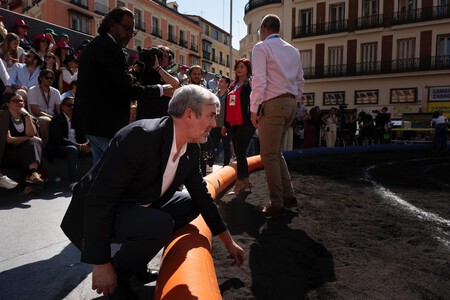
The motive behind this remarkable endeavor was to celebrate the Canarian struggle , a sport popular in the islands, yet relatively unknown on the Spanish mainland. To coincide with the Month of the Canary Islands , an outdoor arena was constructed in Callao Square where two renowned teams from the islands, Saladar de Jandía and Candelaria de Mirca , were set to compete in one of the most anticipated events organized by the DISA Government of the Canary Islands .
This marked the first time in the extensive history of Canarian sports that an official fighting day took place in Madrid. The event was enhanced by the symbolic gesture of using genuine volcanic sand from La Palma, demonstrating the lengths the authorities were willing to go to celebrate their culture.
The event itself was a resounding success, drawing a large audience, including dignitaries such as Fernando Clavijo , the island president. “Competing on the same sand that many palm trees rely on for their livelihoods was a spectacular moment,” stated Lorena Hernández , the general director of native sports for the regional government. Initially, the decision to use volcanic sand came off as a “crazy” idea, but its romantic significance ultimately prevailed.
However, once the competition concluded, the inevitable question arose: what to do with the remaining 24 tons of volcanic sand? Some initially planned to repurpose it for beach volleyball , but the sand proved too hot, rendering it unsuitable for that purpose. The subsequent rumors suggested that the sand had vanished into thin air.
As reports emerged, it was revealed that the sand had ended up in a warehouse in Torrelodones , waiting for the City Council to formally accept it and explore new applications. Initially discarded from the beach volleyball concept, the focus shifted to environmental uses, leading to the ‘Dry Garden’ initiative.
The idea now is to utilize the sand in gardens designed for low water consumption, reflecting the native flora of the Canary Islands. Additionally, its porous structure is valuable for drainage , making it suitable for other green spaces. “If this sand can breathe new life into our gardens, that would be wonderful,” Hernández remarked.
Yet, the logistical concerns associated with such a donation are complex. The Cabildo had prepared initial documentation detailing the donation, but modifications were necessary to align with the new intended uses. “Being a donation between public institutions, it necessitates extensive paperwork,” officials noted. They anticipate resolution in a week or two.

This narrative, while fascinating, highlights the complexities involved when regional pride is expressed through community interactions. The journey of La Palma’s volcanic sand, laden with cultural significance, may finally find a productive use, transforming the story from one of mere transportation to an environmentally beneficial initiative .
As steps are taken to realize the vision of sustainable gardens with Canarian roots, one can only hope that this saga will end positively, enriching Madrid’s landscape—both ecologically and culturally.