
AI’s New Arms Race: Data Centers and Supercomputers
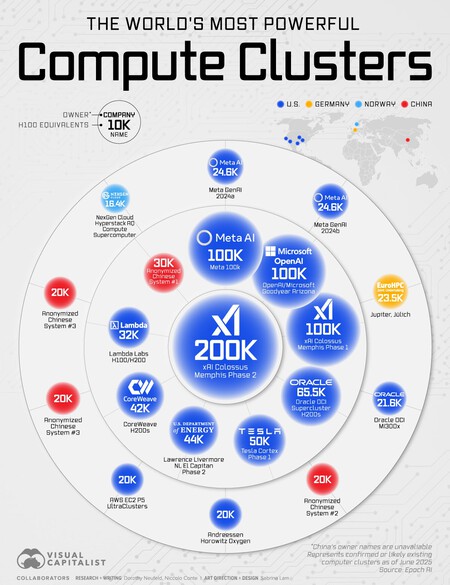
The development of artificial intelligence (AI) has sparked a new kind of ‘arms race’ worldwide. This competition is not about territorial dominance but rather a quest for greater computing power . Major technology companies are deploying data centers across the globe, each with the overarching objective of training increasingly sophisticated AI systems. Within this landscape, certain data centers have become analogous to modern-day fortresses, reflecting both the competition and collaboration in the AI sector. The graph below illustrates some of these powerful data clusters, with one name standing out prominently: Elon Musk.
Understanding Clusters and Supercomputers
Before diving into the numerical data of these computing behemoths, it is essential to distinguish between a supercomputer and a computer cluster . A supercomputer represents an incredibly powerful system typically built with specialized processors designed to achieve exceptional calculation speeds. These machines are often employed in high-stakes scientific simulations and other calculations that necessitate significant processing power, and their price tag can be staggering.
On the other hand, a computer cluster is a less expensive alternative. It comprises multiple interconnected workstations that collaborate to solve complex problems in parallel. The flexibility of clusters allows for easy expansion; as more computing power is needed, additional units can be seamlessly added. While the cost is generally lower, advancements in technology have somewhat blurred the lines between these two concepts in recent years.
The 100,000 GPU Club
Referring back to the graph crafted by Visual Capitalist, which pulls data from EPOCH AI, we can explore the unprecedented computing capabilities offered by these powerful clusters, both planned and operational. X, the company founded by Musk, inaugurated the XAI Colossus Memphis Phase 1 last year—a massive data center outfitted with 100,000 NVIDIA GPU H100 units designed for training its AI model, ‘Grok.’ This achievement startled even Jensen Huang, the CEO of NVIDIA.
The compute capacity is staggering, and projections suggest that this figure may eventually double to 200,000 GPUs . As we shall see, this growth will have significant energy implications. Following Musk’s ambitious project, Meta announced they possess a cluster “greater than 100,000 GPU H100” for their ‘Llama 4’ model. Other contenders, like Microsoft with its Azure cluster, are also estimated to have similar capabilities, including a mix of H100 and H200 GPUs.
Geopolitical Aspects of AI Power
Stepping outside of the 100,000 GPU Club , we find Oracle with its 65,536 NVIDIA H200s , Musk’s other venture—Cortex Phase 1—featuring 50,000 GPUs , and the U.S. Department of Energy boasting the most powerful supercomputer in the world. It’s evident that the United States is leading the charge in AI computing. Out of the top ten AI clusters, nine are situated in the U.S., with the only exception being in China. This trend indicates that the U.S. is not only building more data centers domestically but is also eyeing international expansion, including ambitious projects in countries like Spain.
Europe’s Aspirations in AI
Among the global AI players, Europe is making strides as well. The JÜLICH Supercomputing Center in Germany is home to a notable cluster, JUPITER, while Norway’s Nexgen boasts about 16,300 GPUs . With initiatives like Genai4eu , which comes with a budget of €700 million targeted for investments between 2024 and 2026, Europe aims to enhance its competitive position in AI. Proposals for large data centers are already in motion, with 76 proposals submitted from 16 different countries by 2025. However, these efforts must align with the AI ACT, which mandates ethical guidelines and transparency in AI deployment.
China’s Unique Strategy
Meanwhile, China has adopted a distinctively different roadmap in the AI race. Their focus emphasizes efficiency over sheer quantity—they aim to run fewer GPUs but at a significantly higher efficiency level, all while maintaining significantly lower operational costs. Examples like Deepseek and the new Kimi showcase this approach.
Nvidia Emerges as the Front-Runner
Within the competitive landscape of AI, one name has emerged as the clear winner : NVIDIA. Despite the competition, NVIDIA’s architecture, particularly the H100 and H200 graphics units, has become the backbone of numerous global data centers. Even though China faces trade restrictions that complicate access to NVIDIA technology, countries worldwide predominantly rely on NVIDIA’s powerful specs to execute their AI endeavors.
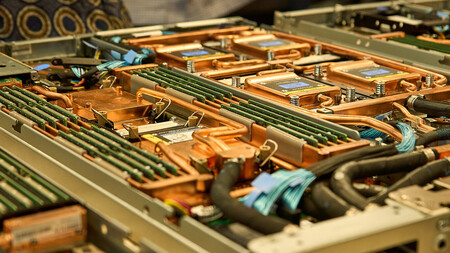
Lenovo data center servers employing energy-efficient technologies.
Environmental Considerations
As this AI arms race escalates, another pressing concern is environmental impact. Data centers not only require immense amounts of energy but also large volumes of water for cooling purposes. Notably, major industry players like Google and Microsoft need nuclear power to sustain their operations. The energy consumption of these giant data centers is staggering; Musk’s 200,000 GPU Colossus , for example, is estimated to require 300 MW —enough to sustain 300,000 homes . Coupled with this energy demand is the water requirement, which has sparked discussions in potential host countries for new data centers. In extreme cases, solutions even include building data centers underwater to mitigate overheating.
In summary, the ongoing development and deployment of AI technologies are ushering in a new era characterized by unprecedented power demands, geopolitical tensions, and significant environmental implications. As companies race forward in this new competition for computational excellence, maintaining a balance between innovation and sustainability will prove essential to the future of AI.