
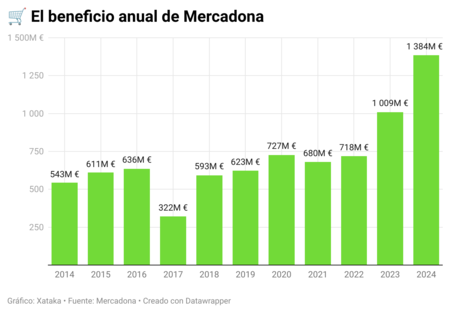
Mercadona has effectively dominated its competitors in Spain, setting a benchmark for international giants like Costco , Walmart , and Tesco when it comes to profit margins. This impressive performance is underpinned by specific figures from Wordpanel by Numerator (formerly Kantar), which offer insights into the supermarket’s incredible market position as detailed by Expansión.
Absolute Leader in Market Share
Mercadona holds an outstanding 26.7% market share, according to Wordpanel data. This figure highlights a massive lead over its nearest competitor, Carrefour , which stands at 9.2%. Other notable players in the market include Lidl (6.7%), Eroski (4.3%), DIA (3.7%), Consum (3.5%), and Alcampo (2.9%). This significant gap in market share underscores Mercadona’s unrivaled position in the Spanish supermarket sector.
Stronger in Hegemony
The striking aspect of Mercadona’s dominance is that it is also the second supermarket to experience the highest growth compared to 2024, trailing only Lidl (+0.3% vs +0.4%). Moreover, Mercadona topped the list as the supermarket that saw the most growth in 2024. The company does not stop at food; it has diversified its revenue streams, with one in seven euros of its profits generated from non-food sales.
93.2%: Spaniards Are Truly Mercadona Loyalists
The most astonishing statistic about Mercadona is that an incredible 93.2% of Spaniards have shopped at least once at its stores. This reveals not only the strong consumer loyalty to its brand but also the supermarket’s expansive market presence. The company boasts 1,602 supermarkets across Spain, featuring establishments in every autonomous community. The only noteworthy exceptions are the islands of La Gomera , El Hierro , and Formentera .
Lidl Is Far Behind
In stark contrast to Mercadona’s extensive consumer base, only 69% of the population has shopped at Lidl at least once. This figure is already a commendable achievement, showing an increase of nearly two percentage points from the previous year. While Lidl is growing its customer base, it remains significantly behind Mercadona.

Without the Need for More Stores
The total number of Mercadona establishments has remained relatively stagnant over the past five years. Since 2019 , the company operated 1,626 shops, but today that figure has dropped to 1,602. This trend reflects a significant expansion period that occurred between 2000 and 2010 , during which they nearly tripled their store count. Since 2015 , the numbers have largely plateaued.
Transformations in Existing Stores
Mercadona has innovated by implementing deep transformations in its existing stores. The company has been transitioning to what they term “ Stores 8 ,” characterized by larger spaces, advanced technology, and sections designed for convenience, such as “ready-to-eat” meals aimed at consumers who prioritize time over food. According to Juan Roig , these stores are “twice as profitable.”
A Unique Model
Beyond Spanish borders, Wordpanel by Numerator collects data on market shares in countries such as France , Ireland , the United Kingdom , and China . In several of these markets, supermarkets have captured over 20% of their respective quotas. For instance, Tesco leads in the UK, while Dunnes takes the lead in Ireland. Despite these successes, Mercadona stands out as the only supermarket to dominate its home market to such an extent over its closest competitor. In countries like Ireland, multiple supermarkets exceed 20% market share, illustrating the unique landscape of Spain’s grocery market.
Images sourced from Mercadona and INE.
As Mercadona continues to show resilience and adaptability in the competitive supermarket landscape, its unique business model and dominant market penetration serve as an intriguing case study. Its ability to evolve while maintaining brand loyalty positions it as a significant player not only in Spain but potentially on the international stage as well.