
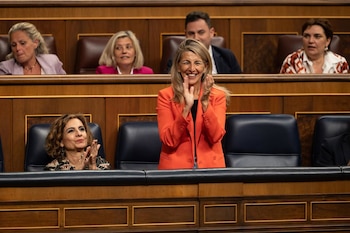
The second vice president of Spain, Yolanda Díaz , has recently shared her vision for fostering unity among different left-wing sectors in the country. In a candid interview on Antena 3, she emphasized the need for a “minimum and democratic emergency program” to facilitate these alliances. However, she was clear that this approach should not turn into a mere aggregation of political parties, highlighting the inefficacy of such strategies in the pursuit of democratic goals.
Díaz’s comments came in response to suggestions made by ERC spokesman Gabriel Rufián , who proposed the creation of a truly plurinational left space ahead of the upcoming general elections. This proposal draws inspiration from the collaborative model employed during the last European elections, where ERC partnered with Bildu and BNG . However, Díaz pointed out that ERC’s leadership has not endorsed this idea, suggesting a rift in the left’s strategic direction.
Reflecting on the current political climate, Díaz articulated the urgent need to defend democracy, particularly against the backdrop of rising conservative and right-wing movements around the globe. She referenced the alarming actions of leaders such as Donald Trump in the U.S., Javier Milei in Argentina, and Viktor Orbán in Hungary, which she described as contributing to a reactionary shift in politics. “We are experiencing a time of dispute,” she noted. “If we do not rally to defend democracy, what are we fighting for?”
In her view, the left must unify around a shared agenda that resonates with the hopes and needs of everyday citizens. “It’s not just about the party names,” Díaz insisted. “What matters is creating a relevant and actionable program that gives hope to citizens and inspires them to engage with the political process.” She stressed that the call for unity should transcend mere acronym-fueled alliances , as past attempts have proven to be ineffective in mobilizing support.
Díaz highlighted specific challenges within Spain itself. She criticized the anti-democratic agenda advanced by Vox , which she claimed exerts considerable influence over the Popular Party (PP) . She believes it’s imperative to forge a “democratic alliance” that can effectively mobilize progressive elements within society to counter this rising tide of right-wing extremism. “There is nothing that mobilizes progressives more than the prospect of governing together,” she reiterated, positioning governance not just as a goal but as a catalyst for activism.
Meanwhile, the deputy from Compromís , Àgueda Micó , also weighed in on the discussions. During her statements, she opened the door to collaborations with other “sovereignty or state forces” in the future. Although she acknowledged Rufián’s proposals, Micó expressed caution about the timing and feasibility of such alliances given the impending elections. “We hope that whatever we do is meaningful and impactful,” she said, subtly echoing Diaz’s calls for strategic unity .
As Spain navigates this complex political landscape, the task ahead is monumental. The left’s ability to come together will not only define the effectiveness of their strategies leading into the elections but also shape the future discourse on governance and democracy in the country. As Yolanda Díaz has articulated, the unification of diverse leftist forces must be rooted in shared principles and actionable programs rather than superficial political branding. Only then can they hope to counteract the threats posed by increasingly authoritarian tendencies both at home and abroad.
The coming months are crucial. What happens now not only influences the direction of leftist politics in Spain but also serves as a litmus test for the broader global leftist movements in the wake of ongoing political upheavals.