
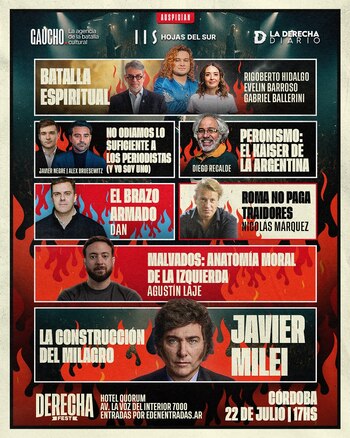
The Liberating Spirit of Córdoba: A Deep Dive into “La Derecha Fest”
Córdoba Capital transformed into a vibrant hub of libertarian principles this Tuesday, hosting the much-anticipated event known as “La Derecha Fest.” Dubbed by its organizers as “the most anti-leftist event in the world,” this festival united passionate individuals supporting a free-market ideology and the fight against what they perceive as the encroachments of socialism.
An impressive 2,500 attendees made their way to this dynamic gathering, far surpassing expectations and showcasing a formidable grassroots movement. The ticket price was set at $35,000, with a limited number of passes offered to security personnel as a token of appreciation for their ongoing contributions to public safety.
Security protocols were strictly enforced, with attendees navigating three checkpoints before gaining access to the venue at the Quorum Hotel, near the Ingeniero Aeronáutico Ambrosio Taravella International Airport. This meticulous preparation reflected the event’s commitment to safety and organization.
The event commenced at 5 PM, attracting political advocates and national figures eager to rally support for their ideas and prepare for the approaching elections in October. The atmosphere inside the venue was electric; each speaker brought their unique flair, instantly drawing in crowds. Agustín Laje, known for his rousing oratory skills, made an entrance akin to a rock star, complete with a live band to amplify his presentation. Yet, it was Karina “El Jefe” Milei, the President’s brother, who stole the show, earning the first ovation from the crowd before Milei took the stage.
The cultural battle resonated throughout the evening, with ongoing chants like “Rome does not pay traitors” intermittently echoing amidst raucous applause and whistles. The phrase became a recurring motif, even appearing on merchandise being sold at the venue.
Among the political figures spotted was Lilia Lemoine, a national deputy, alongside Mario Lugones, the Minister of Health, and other influential local leaders. Notably absent, however, was Santiago Caputo, who had reportedly been invited but chose not to attend.
The event began with speeches from Rigoberto Hidalgo and Gabriel Ballerini, discussing the spiritual perspective in the cultural battle. Their speeches paved the way for a panel discussion led by Javier Negre of Derecha Diario, featuring prominent figures such as Alex Bruesewitz and filmmaker Diego Recalde.
Rising Stars and Strategic Speakers
The show picked up pace when “El Gordo Dan” (Daniel Parisini), known for his influential online presence, captured the audience’s attention. Parisini, introduced as “the armed wing,” highlighted the vital role of social media in the propagation of libertarian ideas and digital mobilization. He lauded Milei, stating that he had discovered the “philosopher’s stone.”
Parisini’s remarks resonated with attendees as he emphasized the telephone as the most powerful weapon in human history, fueling the possibility of widespread information dissemination. He roused the crowd, concluding with a motivational call to arms for his followers, reminding them that they are the “small armed wings in defense of freedom.”
The event was designed to foster a sense of unity and shared purpose among libertarians, who are committed to standing firm in the face of perceived encroachments on individual liberty.
Ideas in Action: The Fight for Culture
As the night progressed, Nicolás Márquez, Milei’s biographer, took the stage, delving into themes of leadership and libertarian values. His potent rhetoric painted a picture of a society besieged by adverse forces, stressing that traditional dialogues with those opposing libertarian ideals were futile. His assertion that “We must crush them politically and ideologically” reverberated within the walls of the venue, igniting fervor among supporters.
Márquez’s remarks pointedly criticized Victoria Villaruel, hinting that a suitable running mate should be found for Milei should he seek re-election in the future.
In a more academic vein, Agustín Laje’s presentation captivated audiences with its depth. Time constraints were visible with a countdown timer on stage, adding a sense of urgency to his insightful commentary. Drawing parallels from the Old Testament and influential philosophers like Nietzsche and Freud, Laje discussed how ideologies of the left often stoke envy, while the right directs its focus toward self-improvement and personal growth.
The Moment of Triumph: Milei Takes the Stage
As the momentous arrival of Javier Milei approached, the atmosphere morphed into a celebration. Unlike other speakers, Milei entered through the front of the stage, making a grand entrance and receiving a thunderous welcome. Just moments before speaking, he exchanged emotional hugs with El Gordo Dan and Laje, reinforcing their strong personal connections.
In his address, Milei did not shy away from critiquing Villaruel, labeling her as “the brutal traitor” for her economic positions. His passionate invitation to the crowd reiterated that this was the time for a robust cultural battle against old political establishments, signifying that October elections would be a decisive moment for their movement.
Milei underscored the importance of cultural battlegrounds—the venues where ideas vie for supremacy, informing public policy decisions. He encouraged his supporters, proclaiming, “You are the soldiers who will fight the battle for culture…” His message was clear: “We are here to give hope,” marking a rallying cry for his constituents.
This edition of La Derecha Fest was expertly organized by three key pillars: Editorial Hojas del Sur, El Gaucho, and La Derecha Diario. The goal was explicit: to solidify the festival as an essential platform for cultural debates and discussions.
With riveting discussion panels, food trucks, and entrepreneur-led merchandise stands, the event exemplified a successful blend of political activism and cultural celebration, urging attendees to embrace their mission while enjoying a festive atmosphere.
As the night concluded, it was apparent that La Derecha Fest has not only established its mark as a significant political event but aims to be a lasting influence in the ongoing cultural discourse in Argentina.