
The Real State of Productivity in Spain: Debunking Myths and Unpacking Data
The OECD has long placed Spain at the bottom of the productivity rankings among developed nations. However, this perception does not accurately reflect the complexities of the Spanish economy, as highlighted by recent OECD reports. For instance, while the overall growth in productivity appears sluggish, companies with between 10 and 250 employees often exceed the productivity averages of their OECD peers. This anomaly is due to the fact that 95.1% of Spanish businesses are small and medium-sized enterprises (SMEs) , most of which consist of fewer than 10 employees .
What the OECD Reports Reveal
The *OECD’s Productivity Report 2024* shows that the annual growth rate of productivity per hour worked in Spain stands at 0.5% , compared to the OECD average of 1.2% . This results in Spain being clearly positioned below the average of other developed economies.
Interestingly, a BBVA Foundation Analysis points to a 0.9% year-on-year increase in total productivity of factors (PTF), which takes into account both labor and capital productivity. These findings corroborate OECD conclusions, placing Spain as the second-fastest-growing country in productivity over the past two decades.
However, notable discrepancies surface between different company sizes within Spain. The productivity gap is less about Spain versus Europe and more about how various sized companies operate in unison. This insight reveals the inefficiencies at the microenterprise level.
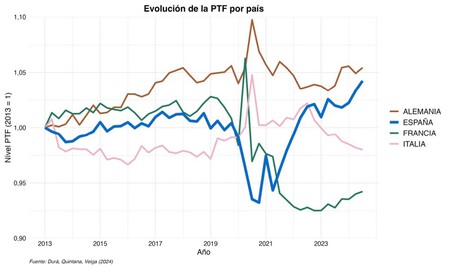
Total productivity of the factors (PTF) by country. Source: Productivity Council of Spain
The Issue of Microenterprises
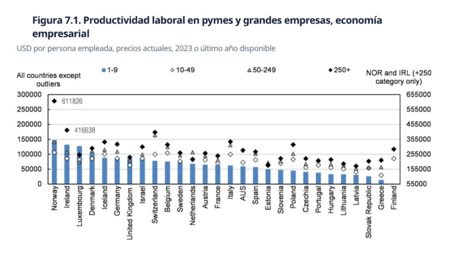
The Productivity Council of Spain reports that the essential characteristic of the country’s productive landscape is its microenterprises . These account for 95.1% of Spanish companies, demonstrating that microbusinesses are the rule, not the exception. As per OECD data, Spanish microenterprises generated an added value of $56,990 per worker in 2023, while large companies achieved $108,356 . This stark difference indicates that large firms are 90% more productive than their smaller counterparts.
The productivity of these microenterprises stands at 15.3% below the OECD average, significantly dragging down the national average. The OECD has consistently noted that having too many very small companies limits overall productivity improvements and capacity for investment.
Medium-Sized Companies: A Silver Lining
A notable finding is that the medium-sized companies in Spain have reported higher productivity than the EU average, outperforming other advanced economies within their category. Companies with 10 to 49 employees have been shown to be 8.7% more productive than the OECD average, while those with 50 to 250 employees are 9.1% more productive, and organizations exceeding 250 employees are 5.2% above the average.
Only 4.9% of Spanish firms maintain productivity levels above the OECD average, positioning these companies at the forefront of international competitiveness .
Addressing the Challenges of Size and Investment
The OECD suggests that improvement in productivity among microenterprises requires focused initiatives geared toward investment and innovation aimed at increasing the value added per employee . Spain’s performance in investment for machinery, ICT assets, and R&D is notably lagging. Recent Bank of Spain reports indicate that while public investment is recovering and performing well, private business investment has yet to regain its pre-pandemic levels.
In summary, while Spain has faced criticisms regarding its overall productivity, deeper analysis reveals a more nuanced picture. Medium and large companies are thriving and outperforming many of their global counterparts. The challenge remains to uplift the microenterprise sector, enabling it to contribute more significantly to the national economy and productivity levels.