
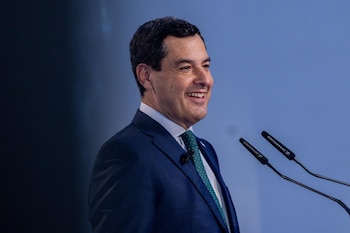
Juanma Moreno: Advocating for Equality in Spain Amidst Catalan Separatism
In a recent statement that has sparked discussion across Spain, Juanma Moreno, the president of the Junta de Andalucía, voiced serious concerns regarding what he termed the “enormous gravity” of the imposed “Catalan separatist quota.” This quota is presented under the guise of solidarity and equality among Spaniards but is perceived by Moreno as a fundamental threat to the integrity of the Spanish Constitution. “This is not about Catalonia or Andalusia; this goes deeper, to the essence of Spain,” Moreno emphasized, stressing the implications for national unity.
The Push Against Disparity
Moreno’s commitment to equality is evident in his intention to form an alliance with the presidents of other regions, specifically Castilla-La Mancha, to collectively resist policies that, in his view, undermine equality across Spain. During a speech at a forum organized by the newspaper La Razón in Madrid, he asserted the need for a return to a Spain where citizens are perceived as equal before the law, in accordance with the Constitution.
“The government, under the leadership of Sánchez, has made a mockery of equality and solidarity among Spaniards,” Moreno accused, implying that current policies favor certain regions at the expense of others. He underscored the importance of a united Spain that is built not just from the core regions but, equally, recognizes the contributions of all territories.
Addressing Privilege
Moreno’s criticism was particularly aimed at the agreement reached between the Central Government and the Catalan Generalitat regarding singular financing for Catalonia. “This is a case of privilege, and when you step out of the ordinary, it implies that you wish to ‘eat at a separate table’,” he stated, highlighting the potential inequality that could arise from such arrangements.
The timing of the announcement, coming in mid-July, adds another layer of controversy. Moreno suggested a lack of transparency and propriety from the government, indicating that discussions were occurring “through the back door” and characterized by “cowardice.” He called out the apparent absence of María Jesús Montero, the First Vice President and Minister of Finance, questioning why she was not present at the announcement table if she holds such a significant position. This absence, he noted, points to a shift in governance that prioritizes bilateral agreements with regions over multilateral discussions.
Breaking Down the Threat
Moreno framed the agreements made regarding Catalonia as part of a broader trend of institutional decay threatening Spain’s cohesion. “The rules of the game are being modified,” he stated, indicating that the current government is abandoning the principles of territorial, social, and economic cohesion that have historically underpinned Spain’s unity. “This is a profound danger to the architectural framework of a modern state,” he added.
He noted that Andalusia, being the most populous community and the third largest economy in Spain, bears the responsibility to denounce what he perceives as a legitimization of inequality. He challenged the notion that wealth should be disproportionately distributed, asserting, “It is not progressivism to prioritize some regions over others when all are part of the same nation.”
The Financial Argument
Moreno highlighted the financial ramifications of the current system, asserting that Andalucía “loses” more than 1.5 billion euros annually due to an unfavorable financing framework. This disparity makes it exceedingly difficult for the region to compete on equal footing, effectively tying its hands behind its back. He referred back to Montero’s previous arguments advocating for a new financing system, accusing her now of inconsistency given her current support for the “Catalan separatist quota.”
The Urgency for Change
In light of his observations about the government’s diminished authority, Moreno emphasized that the Spanish government must adopt a more centrist approach to governance. “Only through centrality can we begin to repair the societal damage inflicted during these times,” he said, urging for a government that represents all Spaniards fairly.
The sentiments voiced by Juanma Moreno resonate with many who feel disenfranchised by the current political landscape. His call for equality and justice encapsulates a broader fear that regional favoritism may threaten the fabric of Spanish unity. By partnering with regional leaders who share similar concerns, Moreno aims to build a movement committed to defending equality across all regions of Spain.
In conclusion, Moreno’s vigorous denunciation of the Catalan separatist quota serves as both a rallying cry and a warning about the potential consequences of regional disparities on national unity. His emphasis on equality is central to his argument for a balance that preserves the integrity of the Spanish state while ensuring that no region is left behind. With the political landscape in flux, the quest for equality and solidarity among Spaniards remains more pressing than ever.