
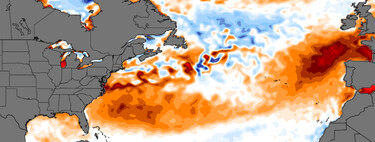
Unraveling the Mystery of the Atlantic’s Cold Stain
In the Northern Atlantic , a section has long puzzled experts in oceanography and meteorology . Dubbed the “cold stain,” this unique area represents a deviation from the warming trend seen across most of the world’s oceans. Recent studies have finally shed light on this intriguing phenomenon, bringing us closer to understanding its underlying dynamics.
The Impact of Recent Research
Two significant studies published in prestigious journals shed new light on the cold stain. The first appeared in Communications Earth & Environment, while the second made its debut in Science Advances. Both pieces of research converge around the importance of the Atlantic Meridional Overturning Circulation (AMOC), a crucial current that plays a significant role in the global climate system.
Examining the Cold Stain
The cold stain refers to a relatively small region of the North Atlantic Ocean where the surface temperature has decreased by approximately 0.3º Celsius . This stands in stark contrast to the general warming trend that has affected ocean waters worldwide. Located south of Greenland and in proximity to the Newfoundland coast, this cold spot is notably near the Arctic Ocean waters.
Understanding the AMOC
The studies directly link the AMOC with the peculiar cooling phenomenon. But what is the AMOC? This circulation is linked to the thermohaline circulation that effectively transports water masses across the Atlantic from warmer tropical regions to the colder northern latitudes. When the warm waters reach these higher latitudes, they cool down, sink to the deeper layers of the ocean, and eventually flow back towards the South Atlantic.
Temperature and Salinity Dynamics
The AMOC plays a vital role not only in temperature distribution but also in the salinity of ocean waters. Tropical waters are generally warmer and saltier compared to the colder waters found near the Arctic. This differential is crucial for maintaining the ocean’s thermal balance and, by extension, the global climate.
The Findings of the First Study
The first study emphasizes the weakening of the AMOC observed over recent years. By analyzing data over a span of two decades combined with indirect measurements from the last century, the research team was able to reconstruct the changes within this significant current. Their analysis highlighted a correlation between a weakened AMOC and the observed cooling of the cold stain.
Research Validation
Co-author Yuan Li stated, “It’s a very robust correlation. If you look at the observations and compare them with all simulations, only a weakened AMOC scenario reproduces the cooling in this unique region.” This finding underscores the pivotal role of this ocean current in influencing local climates.
Additional Insights from the Second Study
Conversely, the second study suggests that a weakened AMOC may not be the sole explanation for the cold stain. It posits that the initial weakening led to reduced evaporation and moisture levels in the atmosphere, contributing to regional cooling as well. Given that water vapor acts as a greenhouse gas , this change would subsequently reduce the greenhouse effect, thereby amplifying the cold anomaly.
Co-author Yifei Fan elaborated, “Reducing the greenhouse effect will feed back to the surface and amplify the existing cold anomaly.” This statement emphasizes the complex interplay between oceanic and atmospheric conditions in this region of the Atlantic.
The Broader Implications of This Research
This research has far-reaching implications for our understanding of climate change and its impacts on ocean dynamics. Understanding how the cold stain functions can provide crucial insights into the broader effects of global warming on both marine and atmospheric systems. If the AMOC continues to weaken, it could signal even more dramatic shifts in weather patterns and marine ecosystems.
In conclusion, the cold stain of the Atlantic presents a fascinating case for oceanographers. The recent studies not only deepen our understanding of the AMOC and its vital role in climate regulation but also highlight the intricate interconnections between ocean dynamics and atmospheric moisture levels. As our planet continues to experience the repercussions of climate change, the exploration of such enigmas will be critical in predicting future environmental conditions.