

I recognize that I am the type of person who, between allowing access to the entire photo reel or only a few, I usually choose the first, especially in apps that I use a lot like Instagram. Being able to access the whole reel and not having to sift through photos one by one is much more comfortable. After all, if I don’t upload the photos, nobody can see them, right? It’s not so clear.
Meta Wants the Photos That We Do Not Publish
The news comes from TechCrunch, where recent reports indicate that Facebook has begun to ask users for “cloud processing to obtain creative ideas made for you from your photo reel.” To create these ideas, the app chooses photos from your reel and uploads them to their cloud. By agreeing, users also accept the terms of Meta’s AI, which includes the analysis of both photos and videos, including the facial characteristics of everyone who appears in them.
In a follow-up, The Verge reached out to Meta to ask a pressing question: are they using those unpublished photos to train their AI? Meta claims they are not doing so at the moment, but they do not deny the possibility of doing it in the future. Although this feature currently affects only users in the United States, it could easily expand to other countries, so it’s better to be prepared.
Access Yes, But Better in Small Portions
Many apps request access to our photos and videos, leaving it in our hands to decide whether we grant that access. Both iOS and Android allow users to choose which images they want to share with each app. In the case of iOS, it even periodically reminds us if we want to continue sharing our entire photo reel with certain applications. I am someone who tends to ignore these warnings. Experiences like the one with Meta make it clear that this behavior is a poor choice.
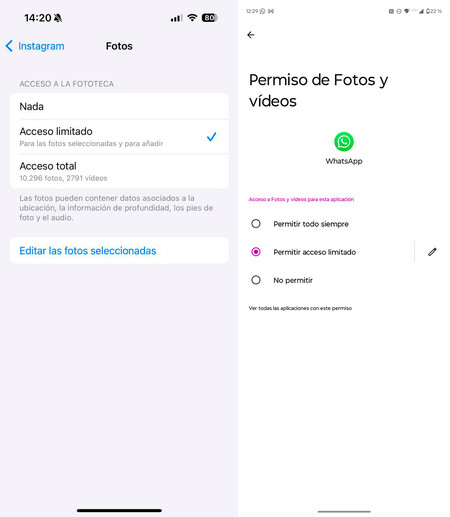
The option to limit access to photos in iOS (left) and Android (right).
I have started to limit access in apps I use daily, like Instagram, and the truth is that it isn’t as tedious as I initially thought. When I want to upload something, I just need to select that specific item, and that’s it. Yes, it adds another step, but it can be done quickly. To do so, simply go into settings, select the app (for example, Instagram), and adjust the permissions to ‘limited access’.
The Importance of Reading the Fine Print in the AI Era
While we are often careful about the photos and videos we share, we rarely think about what happens to everything we do not upload. It’s natural to assume that if you don’t click ‘Share’, then no one but you will have access to that photo. This case illustrates the significance of reading the fine print of apps, something that, let’s be honest, very few people do.
Previously, this might not have been a cause for concern, but in the current landscape with so many data models, the situation has changed. Training these models requires a substantial amount of content. Numerous controversies have arisen around this issue: the unauthorized use of copyrighted content, LinkedIn training its AI with user data without sufficient notice, and AI models using content drawn from platforms like Reddit. There are even reports of models training with photos of minors. With these developments, being cautious is more crucial now than ever.
Image | Own in mockup of Freepik
In conclusion, as users of various digital platforms, it is essential to remain vigilant about the access we grant to our personal data. Meta’s recent disclosures highlight the necessity of understanding how our unpublished data can potentially be used. With the rapid evolution of AI and its interactions with social media, caution is not just advisable; it is imperative. Taking the time to read terms and conditions, being mindful of the information shared, and advocating for our privacy can make a significant difference in how our digital footprints are handled.