
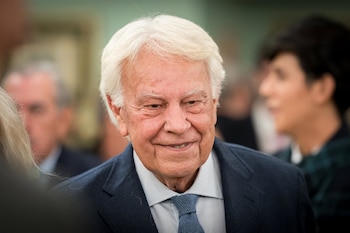
The Political Landscape in Spain: Felipe González’s Stand Against the Amnesty Law
In a significant political development in Spain, former Prime Minister Felipe González has openly criticized the Socialist Workers’ Party (PSOE) for its support of the controversial amnesty law . This law, which is poised to be endorsed by the Constitutional Court (TC) , has ignited widespread debate and division within Spanish society. González, a prominent figure in Spanish politics, has described the norm as a “barrabasada” —a term denoting nonsense or foolishness—and a “shame” for any self-respecting democrat. This article offers an in-depth look at González’s remarks and the implications for Spain’s political future.
González’s disapproval of the amnesty law stems from his belief that it represents a betrayal of democratic values . In a recent interview, he expressed that if the endorsement of the law proceeds as the current government under Pedro Sánchez has predicted, he would refuse to support any party involved in the process. Specifically, he stated, “With me, he will never have anyone who has participated in this, which is to apologize to those who have made the barrabasada.” His comments reflect a growing sentiment among many Spanish citizens who feel disenchanted with their political leaders.
The amnesty law aims to provide legal protection to certain individuals involved in significant past political issues, such as Catalonian independence. Critics argue that this law operates on the principle of forgiving wrongdoing, effectively absolving those who have committed potentially serious offenses. González’s argument against the law emphasizes the need for accountability, asserting that apologizing is not equivalent to forgiving; it trivializes the seriousness of past actions, he insists.
When asked if he would support other parties that back this legislation, González confirmed his non-support for the PSOE as well as any other political entity endorsing the amnesty. This places him in a precarious position, as he simultaneously rejects the People’s Party (PP) , labeling their policies as lacking a clear vision for the future. His critical stance towards Feijóo, who leads the PP, highlights the fragmentation of Spain’s political landscape . Gonzalez referenced Feijóo’s partnerships within the PP, saying, “I see Feijóo making figures with Mazón or with Abascal himself yesterday,” portraying a sense of disarray and lack of coherent policy direction within the opposition.
The implications of González’s rejection are multifaceted. Firstly, it signifies a potential realignment of political allegiances among disillusioned voters. His strong words imply that many may now reconsider their allegiances to traditional parties. This erosion of support could pave the way for emerging political factions to gain traction. As the political climate in Spain evolves, it remains to be seen how these tensions will manifest in upcoming elections.
Moreover, González’s criticism also underscores the generational divide in Spanish politics. While older political figures, such as González himself, emphasize accountability and a strict interpretation of justice, younger politicians often lean towards more progressive views, suggesting that reconciliation may be necessary for Spain’s continued stability. This generational conflict could lead to a broader dialogue on what constitutes democratic values in a modern context.
As public sentiment continues to fluctuate, it is essential for policymakers to recognize these shifting opinions. The ongoing discussions regarding the amnesty law and González’s poignant remarks signal a fundamental unease among the populace. As Spain grapples with its past, it also faces an uncertain future, where decisions made today will have lasting impacts on its democratic framework.
The conclusion of these discussions cannot become merely a litmus test for parties. Instead, it must be seen as an opportunity for reevaluation of shared values, where democracy is grounded in accountability and collective responsibility. As the political scene continues to evolve, the voices of both established leaders and emerging challengers must be considered, weaving together a more cohesive narrative for the future of Spain.