
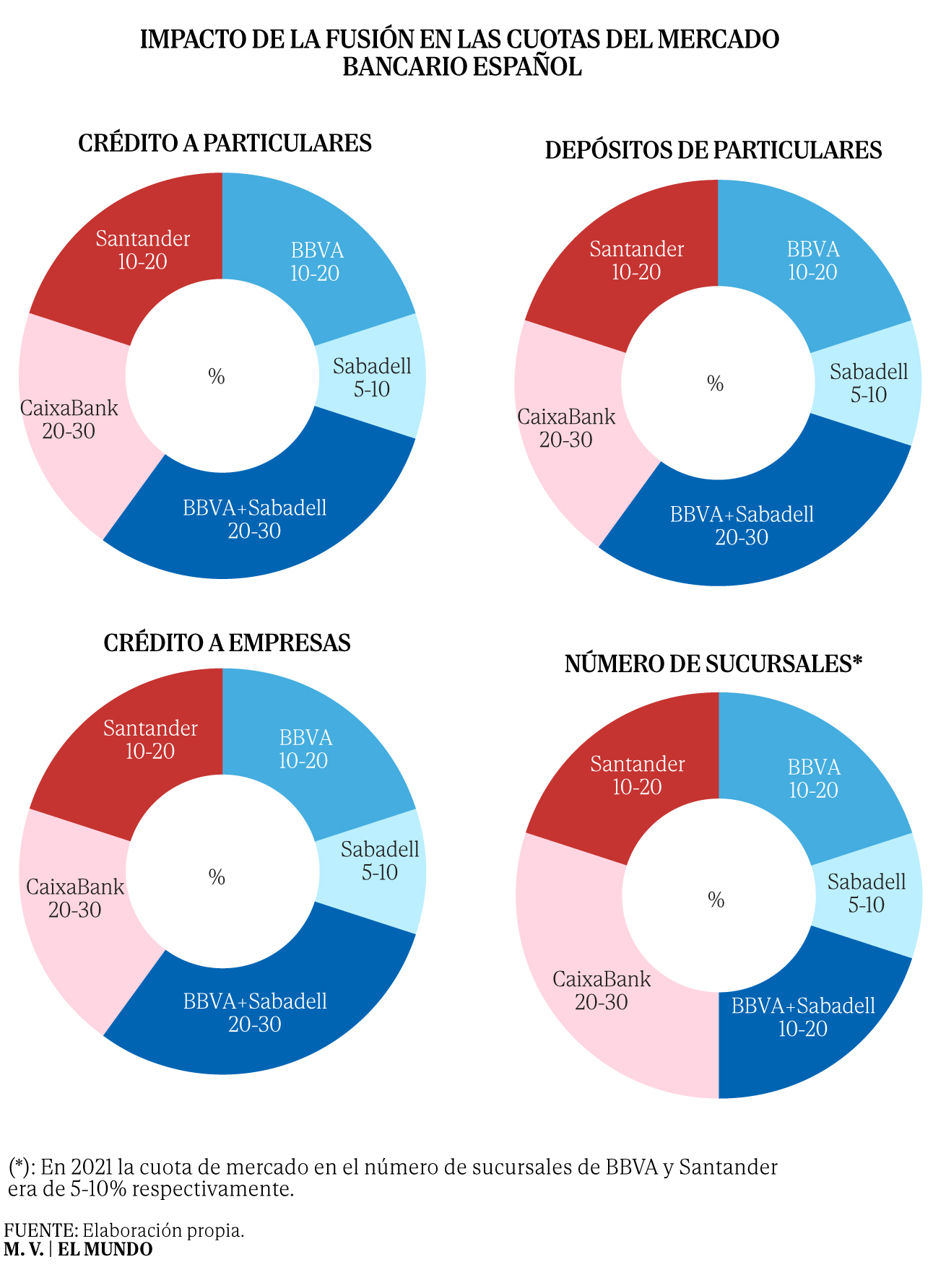
The Spanish government has issued its final word regarding the BBVA takeover bid for Banco Sabadell . Since the announcement of this operation, it has been clear that the government could not legally prohibit the bid, but it certainly has the power to restrict the merger . This is precisely what it has done, at least for now, imposing a separation period of three to five years . Moncloa has given the green light to the purchase offer but mandates that both entities operate separately without any integration during this time. This decision forces BBVA to reassess the impact of synergy evaluations it had initially proposed. The possibility of a bid without a merger was one of the scenarios considered by BBVA’s president, Carlos Torres ; however, government intervention now compels the bank to find ways to circumvent potential governmental resistance if it wishes to proceed with the buyout.
This brings forward a key question: what happens next? So far, BBVA has only confirmed that it is “evaluating” the new conditions announced by Economy Minister Carlos Cuerpo following a cabinet meeting. Cuerpo outlined that both banks are required to maintain their legal identities , asset bases, and operational autonomy. Practically, this means they will function as independent banks for a minimum of three years. After this period, the government will re-evaluate the situation, and if it finds noncompliance, it could extend the separation for an additional two years. Only after this timeframe can the entities involved apply for merger approval from the then-current governance.
The government’s intervention has become a pivotal factor in this operation’s eventual outcome, prompting Catalonia’s President Salvador Illa to declare the takeover bid a failure, attributing this to government action. The looming threat from Brussels , which has insisted it will use its “power” to “eliminate unjustified restrictions,” doesn’t appear to have influenced the government’s decision to impose conditions on the operation. However, it does complicate the justification that Cuerpo used to explain the government’s chagrin with the merger bid. Spain risks facing sanctions from the European Commission for its actions in this instance, or even a public reprimand on a regional level.
To justify its intervention and hedge against legal risks, the government has pointed to the protection of five criteria of general interest , which are separate from competition laws set by Spanish regulations. Cuerpo stated that the aims include ensuring compliance with regulatory objectives related to business financing, territorial cohesion , social policy goals associated with the social work of foundations, consumer financial protection, and affordable housing. This translates into the stipulation that there can be no layoffs or branch closures in either bank due to this takeover bid during the three-year trial phase. It’s also unclear whether the two banks can integrate their technological platforms , a key aspect upon which BBVA based a significant portion of its synergy calculations to propose the takeover to impress shareholders.
Judicial Recourse
Carlos Torres warned earlier in the week in Santander that if the government’s conditions were excessively stringent, they could legally withdraw the offer. The executive had previously indicated that initiating a bid without a merger was also among its possibilities, though it was not the baseline scenario. Moreover, Torres mentioned that the bank reserves the right to pursue legal action if deemed necessary. In this regard, BBVA can appeal the cabinet’s ruling to the Supreme Court . Specifically, BBVA has up to two months to file a legal challenge against the government’s decision, outlining exact reasons for objection.
The government has allowed some leeway to BBVA concerning the appointment of board members for Banco Sabadell, stipulating that they must work to maximize the value of each bank independently.
Analyst Perspectives
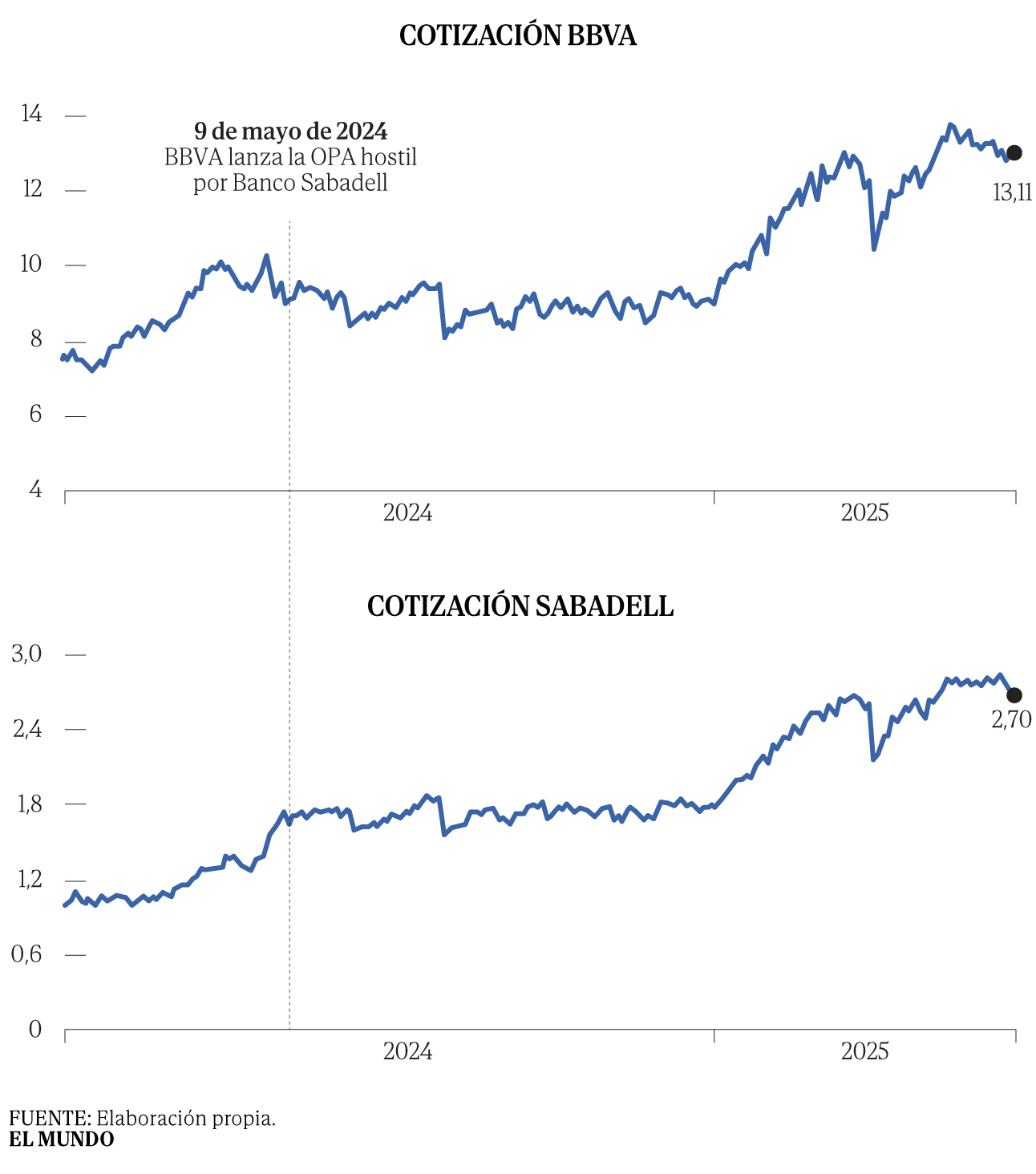
From the viewpoint of analysts and market observers, the cabinet’s ruling indicates a tightening of conditions, although interpretations of its impact vary. Analysts from XTB assert that the three-year ban on merging constitutes “a significant setback for the Basque entity,” reducing the feasibility of the process and, consequently, the appeal of the operation. Given the potential for this timeframe to extend by an additional two years, it drastically alters BBVA’s initial plans. In such a scenario, they anticipate likelihoods of either BBVA abandoning the bid or challenging the government’s conditions through the Supreme Court.
Conversely, Filippo Alloatti , head of Research for Federated Hermes , claims that while the condition mandating BBVA and Sabadell to remain legally independent for a maximum of five years is strict, it is not unexpected. Although this adds operational complexity, it does not undermine the fundamental rationale behind the operation. Analysts from Kepler-Cheuvreux share this sentiment, noting that the merge delay does not compromise BBVA’s financial commitments. Even factoring in a 50%-70% discount on anticipated synergies, the initiative still maintains a 14% ROI (return on investment) . The separation is manageable and largely codifies what BBVA’s position would have been without complete control.
Overall, the unfolding of this scenario will continue to be closely monitored, as both BBVA and Banco Sabadell navigate through this complex landscape shaped by regulatory scrutiny and market expectations.