
In Atapuerca, there are animals; in Irulegi, a hand; and in Lake Mälaren, in central-eastern Sweden, there are feet. Thousands of footprints carved into rock, dating between 2,500 and 3,700 years old, were once believed to represent symbolic or religious art. However, recent studies suggest they served a far more practical purpose: they were contracts engraved in stone.
Understanding the Footprints
Take off your shoes and sign here. Fredrik Fahlander, an archaeologist at Stockholm University, has meticulously examined hundreds of these footprints carved into rock surfaces along the southern coasts of the Scandinavian peninsula. His findings indicate that these petroglyphs are not randomly placed nor are they made by the same person, akin to playing around with fresh cement.
These engravings symbolize lasting commitments, akin to contracts. When two individuals sought to solidify an agreement, be it a friendship or a marriage, they would carve their footprints together on the rock. The permanence of stone serves as a testament to their verbal promises.
The Significance of These Findings
Why is this important? This discovery offers a fresh perspective on prehistoric societies. Traditionally, formal pacts were thought to be exclusive to cultures with writing systems. However, this study indicates that peoples without written language could also formalize commitments using their physical environment.
It is equally crucial to discern what these footprints were not. In the Scandinavian Bronze Age, sacred and symbolic items were typically engraved in bronze and interred in tombs. The footprints, in contrast, are found only on exposed rock surfaces, suggesting they were linked to the living rather than the realm of the dead or spiritual symbolism.
Contextual Background
The Nordic Bronze Age, spanning approximately from 1700 to 500 BC, saw Scandinavian cultures leave behind countless rock carvings featuring a range of motifs, including ships, animals, human figures, and geometric shapes. Among these, the category of footprints is notably rare; they are life-sized and intricately detailed, even capturing features like the straps of sandals.
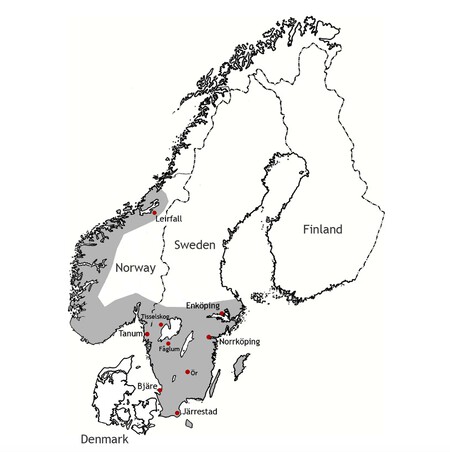
The primary site of study is the Mälaren region, which during the Bronze Age was a bay of the Baltic Sea. Post-Ice Age land uplift has enabled the chronological dating of these engravings, with those at higher altitudes being older.
Detailed Examination of Findings
In the Mälaren region alone, 627 carved footprints have been documented across 140 sites. This phenomenon is not restricted to that area; similar carvings can be found throughout the province of Småland and on the Bjäre Peninsula. Notably, these footprints are intentionally positioned around water sources and natural depressions where rainwater would collect, revealing a deeper connection to the landscape.
A pattern emerges where most sites feature a single footprint or an odd number. When two footprints are discovered, they tend to differ in size and shape, indicating they belong to different individuals. Fahlander suggests that the first print invites a connection, while the second confirms it. When documented simultaneously, these prints symbolize a mutual commitment.
Hypotheses and Limitations
Yes, but. While Fahlander’s hypothesis is coherent and well-supported, it remains a theory. As he explains, these footprints likely carried multiple meanings or purposes. Lacking written records from that era, definitive conclusions remain elusive.
In conclusion, the footprints of Sweden’s Bronze Age present a fascinating glimpse into the past, illustrating that even in societies without a written language, the need for formal agreements found creative expression. As we continue to explore these ancient engravings, we discover new insights into the cultural norms and values of our ancestors.
For further reading, check out Fahlander, F. (2026). “A Step in Stone: Ontologies of Podomorphic Petroglyphs in Southern Scandinavian Bronze Age.”