
The B-2 Spirit has once again been deployed in a conflict scenario, this time as part of a U.S. operation against nuclear facilities in Iran. Information about its deployment is often scarce, but this mission has been publicly confirmed. The details that have emerged provide insight into how an aircraft designed to leave no trace operates.
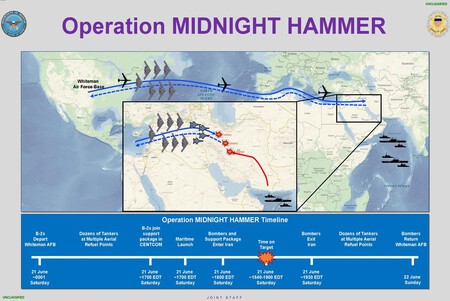
The mission, dubbed Operation Midnight Hammer, was executed under direct orders from the U.S. President. The objective: to attack three Iranian nuclear infrastructures in a coordinated, swift manner with minimal margin for error. According to General Dan Caine at a press conference, the main deployment consisted of seven B-2 bombers, which took off from American soil and flew for over 18 hours to reach their target (about 37 hours in total).
Official Pentagon diagram showing the B-2’s route in Operation Midnight Hammer against Iran
During this journey, the aircraft refueled multiple times in-flight, presumably utilizing KC-135 Stratotankers, with the support of units coordinating operations across various domains: land, air, space, and cyber. The logistical complexity was so high that some bombers were diverted towards the Pacific as decoys, a ruse known only to a handful of military commanders.
Entering and Exiting Undetected
The main formation crossed Iranian airspace in complete radio silence, escorted by fourth and fifth-generation fighters, who quickly cleared the corridor. The maneuver was backed by various commands—including US Strategic Command and Space Command—and was timed down to the second. According to the Pentagon, there were no enemy fire incidents during the approach.
Once on target, the B-2s attacked Fordow and Natanz, two of the most sensitive sites in Iran’s nuclear program. Minutes earlier, a U.S. submarine had launched over two dozen Tomahawk missiles to neutralize other surface defenses and structures.
However, piloting a B-2 on a mission like this requires more than skill; it demands endurance. There are only two crew members aboard, in a cockpit that—although more spacious than others—is not designed for comfort. They wear suits, helmets, and oxygen masks and sit in ejection seats that have been described as “remarkably uncomfortable” by those who have flown in them.
Rest periods are accounted for: there are moments when one can pilot while the other sleeps. Naveed Jamali, a journalist and veteran who witnessed one of the training exercises, explained that pilots must complete simulations lasting up to 24 hours to be authorized for participation. The aircraft is equipped with a toilet, but lacks a full bathroom.
Four Key Reasons
During a visit to Whiteman Air Force Base, the same journalist interviewed one of the unit’s leaders. When asked what makes the B-2 unique, the answer was clear: “range, payload, precision, and stealth.” This combination, they claimed, is not offered by any other aircraft in the world, making it a critical tool for such operations.
Range, payload, precision, and stealth are the four qualities that make the B-2 a virtually unmatched bomber.
The B-2 can travel over 9,600 kilometers without refueling. It can carry up to 20 tons of ordinance—conventional or nuclear—and is designed to evade even the most advanced air defense systems. It has no direct rivals, and only 20 units are operational today.
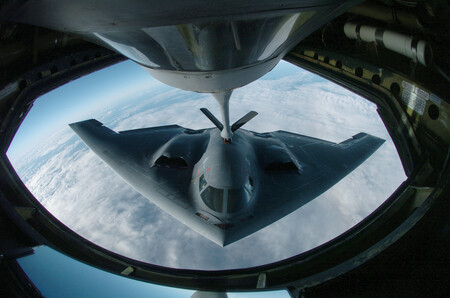
Image of the B-2 refueling mid-flight
It is noteworthy that the B-2 is also among the most expensive to operate. Each unit surpassed $900 million in 1997 (about $1.8 billion in 2025), considering only acquisition costs with parts and support. Including total program expenses—development, maintenance, training, and infrastructure—the figure rose to about $2.13 billion per aircraft by the late 1990s, according to the U.S. Government Accountability Office (GAO).
The project’s origins trace back to the late 1970s. Initially, 132 units were planned. Following the Cold War’s end and the dissolution of the USSR, that number was reduced. In 1992, President George H. W. Bush limited production to 20 operational units. Years later, the Clinton administration approved converting one additional prototype—the 21st—into a fully functional aircraft.
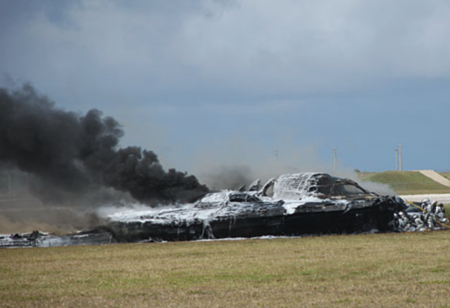
The B-2 after the incident that occurred in Guam in 2008
Today, however, only 20 operational units remain. One was lost in an accident in 2008 shortly after taking off from Andersen Air Force Base in Guam. The crash was due to a pressure sensor anomaly, according to a report by the Air Force Safety Center. It marked the first accident of a B-2, with its loss remaining unreplaced.
The B-2 also possesses another unique quality: its ability to carry the Massive Ordnance Penetrator (MOP), one of the most powerful bombs ever built. Weighing over 13,000 kilograms, it is designed to penetrate the surface before detonating.
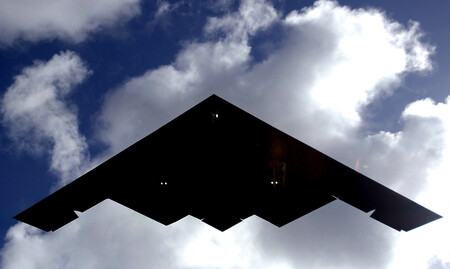
Bottom view of the B-2: its flying wing design is no accident
In this operation, that capability was crucial. Defense Secretary Pete Hegseth confirmed that it was the first time the MOP was used in a real-world scenario, and its role was essential for striking deeply buried facilities like Fordow. While we will have to wait to ascertain the actual damage from the operation.
It has been over 25 years since its entry into service, yet the B-2 remains an unrivaled tool—both for its destructive capability and for what it represents: an aircraft capable of crossing half the planet, evading defenses, and executing a surgical strike without leaving a trace.
Images | Northrop Grumman | DOD Rapid Response | U.S. Department of Defense | U.S. Air Force (1, 2, 3, 4)