
The Journey of Browsers: From Arc to Dia
The story begins almost three years ago, in July 2022. That day, I discovered Arc, a browser that was little more than a pretty idea with exclusive invitations. I tried it, but it did not convince me. It felt too different, perhaps too pretentious. I returned to Safari without looking back.
One year later, I found myself giving Arc a second chance, but the conclusion was the same. It still felt like an application trying to teach me how to navigate when I already knew perfectly well how to do it.
Fast forward to the summer of 2024, a profound change occurred. Arc not only convinced me; it fascinated me. It transformed from a mere browser into a tool of productivity.
- Vertical tabs.
- Split panels.
- Spaces for organization.
- The versatile elegance of its interface.
- The way it organized my digital day.
Arc didn’t just browse web pages; it constructed my workflow.
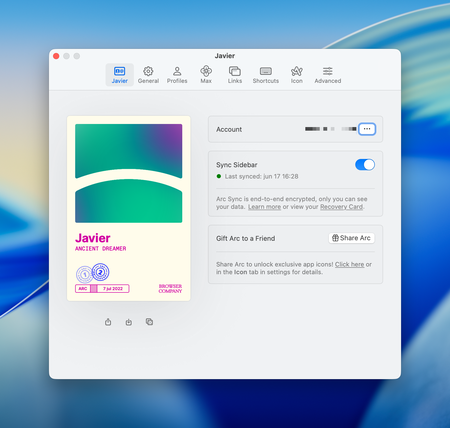
In Arc’s settings, you can find registration dates. Almost three years since my first trial. Image: Xataka.
Then December rolled around. It was six months ago when Josh Miller released a video on YouTube, stating, "We are building something new." This new endeavor was named Dia, marketed as the future of navigation. Arc would, of course, continue to exist but with "minimal maintenance." This corporate phrase typically suggests a slow abandonment without explicitly stating so.
The Arc community erupted in disappointment; understandably so. They had built something beautiful, developed a passionate user base, and suddenly decided to start from scratch in pursuit of the elusive AI dream.
A week ago, I had the chance to try Dia. While still in its beta phase, my expectations were low, but my curiosity was piqued.
When you open Dia, you see what resembles Chrome, but with a polished finish. It feels like a more refined version of Chrome, more animated, yet at its core, it remains essentially Chrome—or Chromium, to be precise.
- Traditional horizontal interface.
- Address bar at the top.
- Tabs where they’ve always been.
- No signs of split tabs.
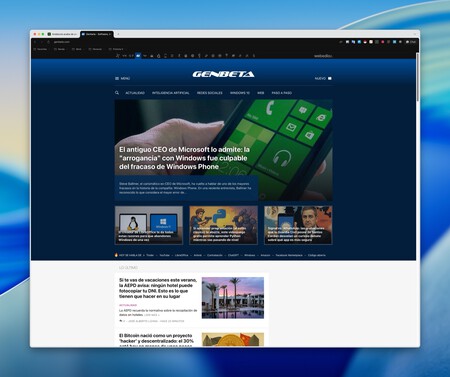
Here’s Dia with all the elements in their traditional spots, absent of Arc’s unique features. Image: Xataka.
Everything that Arc had revolutionized seems to have returned to conventional design. The sole notable difference is the integrated chatbot on the right sidebar. This conversational interface can "see" what you are viewing, read your tabs, and supposedly understand your context. It’s like ChatGPT, but with access to your browser.
Imagine asking your browser to explain the meaning of a complex graph you are viewing or to summarize five articles you have open, or help you draft a response based on the information you’ve been reading. This perfect context for perfect assistance is what we’ve seen in other browsers, but this time, it’s built from the ground up rather than being an add-on.
However, the reality turned out to be more mundane. When I inquired about the content on the tab displayed, Dia offered a suggestion that made little sense. I even provided a screenshot to add context, yet it generated advice that was equally confusing.
Despite my expectations, its performance fell short. Summarizing articles featuring text embedded in images was impossible for it. It resorted to fabricating plausible but inaccurate responses, an all-too-common occurrence from AI tools when they lack accurate information.
When they don’t know something, they don’t simply say "I don’t know." Instead, they improvise. If you’re an expert in a subject, you’ll catch the deception; if you’re not, you might be easily misled.
Then there’s the worst part: what’s missing. There are no vertical tabs, no spaces for organizing projects, and hardly any of the features that elevated Arc to greatness. One can only hope these essentials are integrated later, but the initial experience feels like a cold shower.
Dia is conventional, a departure from the unique identity of Arc. The business logic behind this shift is understandable: Arc was too sophisticated for the average user, with a steep learning curve. Its best features remained underutilized by the minority of users. The mass market favors Chrome for its simplicity and predictability.
Dia aims to be a browser that anyone can use from day one, but with integrated AI. The strategy seems to be capturing users who wouldn’t have bothered to learn Arc, yet would utilize a Chrome enhanced by native AI functionalities.
However, the problem lies in the fact that enhanced AI capabilities already exist. Chrome is integrating Gemini, Edge has its Copilot, and Opera is integrating both in-house and external AI tools. Dia enters an already packed market, and its proposal doesn’t feel as distinct as Arc’s.
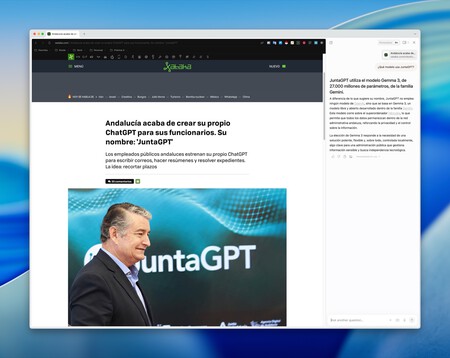
Dia answering effectively on complex pages. Its strongest points lie in lengthy documents, but this assumes it is not possible elsewhere. Image: Xataka.
When stripped of its polished marketing and elegant presentations, Dia is just a standard Chromium with a chatbot in the sidebar. That’s it. The only thing that sets it apart is the AI, but this AI is not exceptional; it’s essentially GPT summarizing your tabs. You can even invoke multiple tabs simultaneously—useful, without a doubt—but not groundbreaking.
Meanwhile, Arc is withering away, now officially labeled as "maintained." No new features, no evolution for those of us who fell in love with its unique value proposition; we have been left behind in pursuit of a possibly nonexistent market.
This reflects the shiny-object syndrome taken to the extreme in the business world. Arc had its flaws; the Windows version was inferior, mobile sync was severely limited, and bugs were still common. But it possessed a clear identity and unique value proposition. It was, and is, different for solid reasons.
Dia is merely different for the sake of it. Presently, its AI is its sole card to play. In fact, its tutorial revolves around using the chatbot and nothing else. The strength of that offering seems questionable, especially with OpenAI reportedly developing its own browser, while Perplexity already has one in the works.
Additionally, it’s critical to understand that Dia remains in beta. It would be unfair to judge it definitively at this stage. However, we can analyze the underlying decisions, vision, and strategy. My impression is that The Browser Company has traded a unique, defensible value proposition for a much lighter bet on a crowded market.
They’ve opted to compete in AI rather than navigation, prioritizing broad appeal over serving a passionate niche.
Perhaps they are correct; maybe the future belongs to navigating through conversations with AI instead of clicks and URLs, rendering Arc’s legacy insignificant. There’s potential for Dia to evolve into something transformative. I could be overly nostalgic about Arc and overly skeptical about Dia.
Nonetheless, as of June 2025, Dia feels like a concession—as if a company decided it’s easier to improve on what everyone else is doing than to continue innovating.
Arc showed me that browsers could offer more than just access to the Internet; they could be work environments that adapt to users rather than forcing them to adapt. They could be personal.
Dia serves as a reminder that companies often choose the safer path.
I will continue to experiment with Dia, hoping it evolves and reintroduces the qualities that made Arc shine rather than disregard them. I want it to prove me wrong—and it would be fantastic if it does. But today, for the first time in a long while, I find myself considering a return to Safari or Chrome, particularly given that Arc may soon fade into obscurity.
This is the story of when I tried the future, but it tasted like the past.