
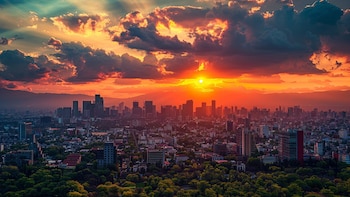
The Importance of Weather Forecasting: A Detailed Overview
Weather forecasting, based on observation and mathematical models, helps predict atmospheric conditions at any given time and location by analyzing records such as temperature, humidity, atmospheric pressure, precipitation, and wind. This practice has been ongoing for centuries, dating back even before the Christian era, relying initially on the observation of cloud patterns, wind, and the season of the year. However, these forecasts were often inaccurate.
It wasn’t until the advent of new technologies, such as computers, that mathematical models began to be utilized, leading to more accurate predictions. This advancement has become a crucial factor for transportation (land, maritime, or air), agriculture, tourism, disaster prevention, public health, and even military operations, far beyond merely deciding whether to carry an umbrella or what outfit to wear.
For instance, the weather outlook for Guadalajara this Sunday includes a 40% chance of rain, with a maximum temperature of 25 degrees Celsius and a minimum of 18 degrees. Cloud cover is anticipated at 98%, and there’s a 42% likelihood of rain in the evening.

Guadalajara, a significant capital of Mexico, experiences a semi-humid subtropical climate that is distinctly marked by two primary seasons, mainly differentiated by humidity and dryness. During the spring, the weather is drier and warmer, with May and June being the hottest months in the city, recording maximum temperatures around 35 degrees and minimums of 13 degrees.
The rainy season typically occurs during the summer months (June to October) when thunderstorms, strong winds, and hailstorms are common. This often leads temperatures to drop to an average of 26.5 degrees. July is known for being the rainiest month, featuring the highest number of cloudy days.
As autumn arrives, rainfall decreases, although sunny days prevail, characterized by chilly winds. Winter temperatures average around 5 degrees, occasionally dipping lower due to frost. Historical records indicate that the highest temperature recorded was on May 6, 1994, at 38.7 degrees, while the lowest occurred on December 14, 1997, reaching -7.0 degrees. This resulted in the city experiencing its second-ever snowfall since the first occurrence on February 8, 1881.

Mexico is a climate-rich country due to its geographical position, bordering the Caribbean Sea and the Pacific Ocean, and being bisected by the Tropic of Cancer. This positioning has resulted in a megadiverse region, home to at least 12% of the world’s species, including approximately 12,000 endemic species. Although the Tropic of Cancer divides the country into two climatic zones—one temperate and the other tropical—the altitude, latitude, and land-water distribution result in seven distinct climate types: warm sub-humid, dry, semi-arid, desert, warm humid, temperate sub-humid, and temperate humid.
In this context, it’s not surprising that areas in Chihuahua experience temperatures as low as -30 degrees Celsius while the Mexicali desert region records scorching highs of 50 degrees Celsius. According to the National Meteorological Service, the country’s average annual temperature is 19 degrees, yet cities like Mexicali, Culiacán, Ciudad Juárez, Hermosillo, Torreón, Saltillo, and Monterrey often experience extreme highs. Specifically, San Luis Río Colorado is notable for holding the record for the highest temperature ever recorded in the country, which hit 58.5 degrees Celsius on July 6, 1966.
Conversely, the lowest temperature ever recorded was on December 27, 1997, when temperatures plunged to -25 degrees in Madero, Chihuahua. Unfortunately, this variety of climates has been under threat in recent years due to climate change. Experts foresee a bleak future for the country, predicting a significant reduction in annual rainfall and a considerable rise in temperatures. The impacts have already begun, affecting farmers and ranchers due to droughts and severe flooding, while urban areas face increased environmental contingencies during hot seasons, particularly in Mexico City.