
Political Turmoil: The Impact of Cristina Fernández de Kirchner’s Conviction
Cristina Fernández de Kirchner has dramatically influenced the political landscape amidst a significant moment of uncertainty. The confirmation of her conviction in the Vialidad case has left a profound mark on the immediate electoral calculations and poses the larger question: Could this signal the end of an era? The Peronist coalition—not just the Kirchnerist core—along with the Olivos circle and the political sphere in general, are keenly observing her next moves while bracing for the initial wave of reactions. The upcoming election in Buenos Aires, set for September, will serve as the first significant test for all involved parties. It’s become evident that plans are shifting and adapting as the Peronist bastion re-evaluates its strategies, fusing both anxiety and uncertainty within the Milei camp.
On the surface, contradictions and questions abound as it is challenging to assess the social impact of the conviction and her disqualification as a candidate. This complicated analysis is being undertaken by various consultants, as public sentiment cannot be reduced to mere levels of agreement or disagreement with the judicial verdict. Clearly, there are divided opinions regarding the former president, the role of the judiciary, and serious issues like corruption in power, which the Vialidad case brings to light. These intertwined sentiments cannot be directly translated into electoral projections or voting intentions. Does the case polarize public opinion? Does it spark interest or apathy? Patterns emerging from recent provincial elections reveal a disturbing drop in voter participation.
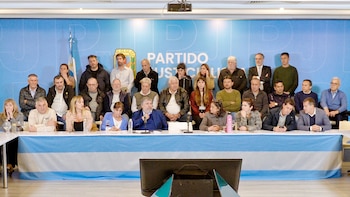
The Peronist factions—whether enthusiastic or apathetic—can be seen rallying against the Supreme Court ruling. They are now formulating a strategy for Buenos Aires that, while still recognizing CFK as a victim of “proscription,” emphasizes individual electoral battles, mobilizing the strong backing of local mayors and traditional political structures.
On the other side, Javier Milei and his circle are grappling with internal tensions within his coalition, especially between Karina Milei and Santiago Caputo. A critical issue is how to position themselves in the Buenos Aires political arena now that they lack a direct counterpoint against the former president. It’s clear that Olivos is not pleased with the Court’s decision. This is not mere speculation; it’s a sentiment circulating within government and congressional circles. So far, reactions have been cautious, albeit there have been outbursts, including comments from José Luis Espert.
Milei has been particularly restrained in his response. He has avoided bombastic statements and, consistently aligning himself, declared himself the “first president who does not intervene in the Judiciary.” This is an attempt to mitigate the impact of rumors suggesting that the government wished for a ruling that excluded the former president from the race. This situation is compounded by the shadows of the “Clean Record” controversy.
His declarations regarding non-interference in judicial matters have been accompanied by measured responses to the firm conviction of CFK. The ongoing situation is expected to develop further. For now, however, this moment represents a pause that, despite underlying suspicions, displays the necessity to rethink campaign strategies and engage in discussions about candidate profiles specific to each electoral district, not merely focusing on the third district, where there is no longer direct competition with the former president. Nevertheless, the government needs her political stature to create a polarized environment, an alternative strategy that might center the conflict around Axel Kicilof. The pressing question is whether this will suffice to frame the provincial election as a decisive confrontation between the libertarian brand and Kirchnerism.

The challenge for the Peronist faction is intensifying. The internal struggle between the Kirchnerist core and the governor remains unresolved, especially now that CFK is sidelined as a candidate. The backlash against the Supreme Court’s decision does not close the door on internal disputes either. This might alleviate some of the tensions relating to the provincial deputies and senator lists but undoubtedly modifies the campaign focus.
It is crucial for the provincial Peronists—intended for every mayor and local platform—to secure seats in both legislative chambers. The challenge lies in how to localize their messaging without distancing themselves from CFK. This is not just about solidarity; it is also about acknowledging the significant voting base she continues to command, albeit reduced over the years, which persists beyond the traditional PJ brand.
Election dates are rapidly approaching amidst the dizzying fallout from the Court’s ruling. Less than a month remains before candidates are finalized for the September elections. In the immediate future, public demonstrations are on the horizon, the most significant of which will occur next week coinciding with the formal start of her house arrest. Potential actions could include protests at federal courts or directly in the streets.
The Kirchnerists have had to embrace varying degrees of commitment within the Peronist ranks to unify public support. This solidarity was evidenced by the actions of Axel Kicillof and the presence of Sergio Massa. The uneven commitment from provincial leaders has also been noted, alongside invitations to organizations capable of mobilization, which reveal fractures predominantly among trade union leaders. Upcoming days will see the responsibilities shift to local mayors.
The critical question remains: Where does the movement go from here? CFK must maintain, in some capacity, a central role within Peronism and, if possible, emerge as a counterfigure to Milei. This need must be reciprocated by the national government, which is reevaluating its campaign strategy. However, it is unlikely they will completely distill the contentious discourse surrounding the Kirchnerists. The Peronist faction cannot afford to disregard the political capital represented by the former president.
Time is of the essence. Initially, the outpouring of reactions must pass. Subsequently, adjustments will be indispensable as both players gear up for the critical provincial confrontation and the national elections in October.
General News – 2