

The Unfolding Drama of Inter-Korean Relations
The history between North and South Korea has been riddled with conflicts and misunderstandings. Take, for instance, the past twelve months: South Korea faced a barrage of balloons filled with trash sent from the North, leading to a series of retaliatory drone deployments and propaganda messages. In response, North Korea marked the South as an enemy in its constitution. This tit-for-tat scenario was met with a cacophony of noises from the North and an endless playlist of K-Pop from the South.
And suddenly, one party has lifted the white flag, and the other has followed suit.
Silence on the Border. In what could be considered a historic development, a symbolic and strategic turn towards reconciliation, South Korea has turned off the loudspeakers that for the past year blared K-Pop songs along with news and ideological messages across the border into North Korea. This decision, made by the newly elected South Korean President Lee Jae-myung, marks one of his first concrete steps to lower tensions between Seoul and Pyongyang, following years of deterioration under his predecessor, Yoon Suk Yeol.
The measure aims to restore channels of trust and dialogue in a peninsula that has remained technically at war since 1953. According to the spokesperson, the suspension seeks to “restore trust in inter-Korean relations and build peace on the Korean Peninsula.”
The Sound War. As mentioned earlier, previous policies had led to a peculiar yet intense escalation: while South Korea used powerful speakers to broadcast pop music and news aimed at soldiers and civilians in the North, Pyongyang responded with its own sound equipment, creating disturbing noises that affected the daily lives of residents in border towns.
The New York Times reported that many residents installed double-glazed windows and soundproofing systems to protect against the noise. The conflict also took to the skies, with South Korean activists, many of whom were defectors from the North, sending balloons loaded with critical pamphlets toward Pyongyang, to which the North Korean regime retaliated with balloons filled with cigarette butts and garbage. This cycle of mutual retaliation worsened an already strained relationship marked by hostility and distrust.
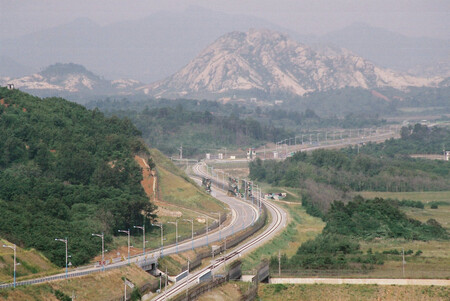
The Donghae Bukbu Line along Korea’s east coast. This road and rail connection was built for South Koreans visiting the tourist region of Mount Kumgang in the North.
A Change of Course. Former President Yoon Suk Yeol, ousted after briefly imposing martial law in December and accused of escalating the conflict with North Korea, had advocated the use of propaganda as a means to undermine Kim Jong-un’s informational control. His government not only defended the loudspeakers but also encouraged the sending of balloons as part of an ideological offensive in the name of freedom of expression .
In contrast, Lee Jae-myung, elected partially due to his promise to reduce tensions, has urged activists to cease the release of pamphlets, arguing that such actions do not improve North Koreans’ access to external information but rather escalate the risk of armed reprisals and endanger South Korean border communities.
Strategic Pragmatism. On the other hand, human rights organizations and activists have fiercely criticized the new government’s decisions, accusing it of yielding to Pyongyang and limiting freedom of expression in South Korea. They argue that by interrupting the loudspeakers and discouraging balloons, North Korean citizens are deprived of one of their few accesses to external information.
The South Korean government has indicated that it might resort to aviation laws and public safety regulations to curb these practices, citing that they heighten the risk of direct confrontation and endanger local inhabitants, who in many cases have expressed relief over the recent sonic calm at the border.
A Fragile Truce. The North’s reaction to this gesture of détente has not been immediate; however, the day after South Korea’s announcement, Pyongyang also halted its own loudspeaker transmissions, suggesting a momentarily positive response.
Nonetheless, the overall context remains tense. Under Kim Jong-un’s leadership, the regime has hardened its stance towards the South, proclaiming that it no longer seeks reunification and will treat South Korea as an enemy to be defeated in case of war. In addition to cutting all land ties between the two countries, North Korea has intensified its nuclear missile tests and has rejected all forms of dialogue with Seoul and Washington.

A New Attempt. What remains evident is that while turning off the loudspeakers will not resolve the myriad of issues plaguing inter-Korean relations, it does represent a significant gesture amid a prolonged cycle of confrontational noise and symbolism. By unilaterally suspending these actions, Lee Jae-myung aims to lay the groundwork for a new political narrative focused on reducing tensions and reconstructing diplomatic channels.
The balance between democratic principles, national security, and geopolitical realism continues to be delicate. Yet for now, silence reigns on the border, and the future of this truce may hinge on whether the North or South will reignite the decibels of their loudspeakers.
Image | Driedprawns
In Xataka | The day the U.S. invaded Panama with rock music. It spent three days “bombarding” the Vatican Embassy.
In Xataka | North Korea has deployed a new psychological weapon against South Korea: unbearable noise.