
China’s Strategic Maneuvers in the Rare Earths Sector
China has recently gained the upper hand in the rare earth metals game against the United States by issuing limited licenses for their export. This development has been celebrated by former President Donald Trump as a diplomatic victory, with the United States proud of securing its supply of critical raw materials. However, while the U.S. focuses on immediate negotiations, China is using these concessions as a façade for a broader strategy: to consolidate a parallel financial system that can challenge the dominance of the U.S. dollar, particularly across three key regions.
The Importance of Rare Earths
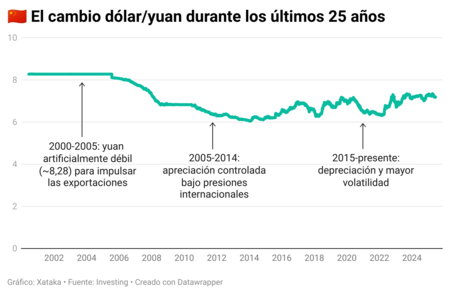
The numbers reveal what negotiations often obscure: China is artificially keeping the yuan strong against the dollar through discreet interventions from the central bank. As of today, the exchange rate is 1 dollar to 7.19 yuan. Meanwhile, China’s trade with Africa has reached new heights, amounting to $295.6 billion in 2024.
At the same time, China is deploying its digital yuan infrastructure in 16 countries across Asia and the Middle East, all part of a calculated geostrategic move.
Understanding the Context
Rare earth metals act as a decoy. China currently dominates 85% of the supply chain for these minerals, which are essential in technology and defense. Each negotiation regarding these materials generates media headlines and public concern. However, China is primarily betting on financial systems that enable its currency to circulate globally without reliance on the dollar.
While the United States concentrates on tariffs and trade balances, China is constructing the financial rails that will allow its currency to flow internationally, free from the dollar’s influence.
Facts to Consider
China has successfully connected its Cross-Border Interbank Payment System (CIPS) with 170 banks in 119 countries. The digital yuan currently processes transactions exceeding 7 trillion yuan annually and is expanding its influence across Asia-Pacific and the Middle East.
In Africa, where trade with China surged to 5% in 2024, it is becoming the next focal point. Rather than just looking at isolated figures, it’s about creating a financial ecosystem that allows for trade without passing through the dollar-centric system.

What’s Happening
China’s strategy follows Deng Xiaoping’s principle of "hiding brightness and nourishing obscurity." By avoiding direct confrontation, China builds robust alternatives. Each step taken is like a brick in another financial architecture that runs parallel to the current global system.
Hidden Gains
China’s concessions on rare earths come with calculated benefits:
- Easing trade tensions that might trigger premature retaliation against its financial infrastructure.
- Projecting an image of reliability to countries seeking alternatives to the dollar-dominated system.
With every geopolitical crisis that slightly erodes confidence in the dollar—be it sanctions or default threats—nations accelerate their search for options. In this landscape, China emerges as a viable answer.
The U.S. Dilemma
However, the dollar retains significant structural advantages. As of today, the yuan accounts for just 4% of global payments and suffers from limitations such as China’s capital controls. While transformation is in progress, it will not happen overnight.
The Underlying Threat
Thus, the risk for the United States is not an abrupt replacement of the dollar but rather a gradual erosion of its supremacy. If, in a few decades, 20% to 30% of global trade migrates to alternative systems, the U.S. will lose a critical privilege: the ability to finance itself “cheaply” and exert geopolitical power through sanctions.
A world bifurcated by two financial circuits—one centered on the dollar and another on China’s yuan—would substantially diminish the United States’ capability to isolate its adversaries.
<– BREAK 5 –>
The Turning Point
China’s approach is in its DNA: it seeks to replace without confrontation. Negotiations over rare earths project cooperation, but concurrently, China solidifies the infrastructure that could reshape the global monetary map.
This strategy is quintessentially Chinese—a decades-long tactic aimed at positioning the yuan to seize opportunities when the dollar’s credibility wavers. China exemplifies the patience that is characteristic of its long-term vision.
In sum, while the U.S. may perceive China’s moves as simply tactical, they reflect a deeper, strategic evolution in global finance. The implications are profound and far-reaching as the balance of power continues to shift in this complex geopolitical chess game.