
U.S.-China Semiconductor Tensions: A Closer Look
In light of the recent agreement between the United States and China , where the Xi Jinping-led nation has loosened restrictions on rare earth export licenses, the tensions between these two global powers continue to escalate. The conflict, rooted in a trade war , has deep implications for the semiconductor industry, a cornerstone of modern technological advancement.
On May 29 , the U.S. Department of Commerce’s Bureau of Industry and Security delivered a clear directive to domestic Electronic Design Automation (EDA) software companies: they were to cease selling their advanced solutions to Chinese entities. This has led to swift and strategic responses from China, marking a significant development in this ongoing technological battle.
The Context of the Trade War
The U.S.-China trade war has been marked by significant restrictions aimed at curtailing China’s access to cutting-edge technology. This strategy has been heavily focused on semiconductors, with the U.S. government curtailing Chinese access to the most advanced technologies required for chip development. The U.S. ‘s recent move to impose restrictions on EDA software represents a bold escalation in this long-standing conflict. EDA software is essential for key processes in semiconductor manufacturing , such as logical design, problem assessment, validation, and simulation. Without this software, the entire semiconductor production process is jeopardized.
China’s Counterattack
In response to the U.S.’s restrictions, China has executed a significant counter-strike by blocking a $35 billion merger. The State Administration for Market Regulation (SAMR) in China has postponed the approval of a merger between Synopsys , a leading U.S. EDA giant, and Ansys , a company known for its excellence in multi-physical simulation processes including thermal and electromagnetic interactions.
Synopsys provides simulation tools but lacks the capabilities of Ansys. While Synopsys specializes in silicon-level simulation within the chip, Ansys takes those results and simulates interactions with physical environments at a much larger scale. This merger is crucial for the U.S. to maintain its competitive edge in this technology sector, and it had already received approvals from both U.S. and European authorities.
The Logic Behind China’s Block
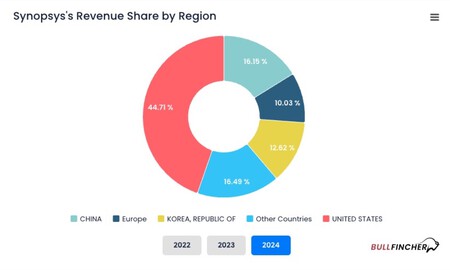
Given that both Synopsys and Ansys are American companies, one might wonder why the approval is required from China. Though their merger is a U.S.-based deal, its impact is directly felt in the Chinese market, thus necessitating SAMR’s approval. Mergers of this size must receive clearance in all major markets where the companies operate or have clients, which highlights the intricate dynamics of global trade and regulation.
China’s negotiating power extends far beyond just rare earth elements. Blocking a $35 billion merger sends a strong message to the U.S.: if the restrictions on automation software do not ease, further advancements in this field may be hindered.
China’s Technological Progress
This week, China took further action by uploading an academic document on GitHub showcasing its advancements in EDA software. QiMeng , a project classified as Open-Source, takes an innovative approach that contradicts the closed nature of conventional EDA software. It has already shown the ability to design advanced chips in record time, demonstrating China’s determination to innovate rather than merely replicate existing technologies.
Leaders from China’s top three EDA companies, including Technology, Primarius Technologies , and Semitronix , are optimistic about the situation. Yang Lianfeng, president of Primarius , described the U.S. restrictions as “the best development opportunity in history.” China’s strategy in this trade war diverges significantly from its historical tendency to imitate; instead, they aim to develop superior technologies should they be deprived of existing ones.
In summary, the ongoing U.S.-China trade conflict continues to take on new dimensions as both nations strive to secure their technological futures. While the U.S. imposes restrictions to maintain its competitive edge, China’s responses demonstrate its resilience and innovative capabilities, signaling a new era in global technology dynamics.