
| IN BRIEF |
|
Ultra-refractory ceramics are materials capable of withstanding temperatures exceeding 2,000 degrees Celsius. These materials are essential for manufacturing components in nuclear reactors, thermal shields for spacecraft, and hypersonic vehicles. However, producing these ceramics has traditionally been a time-consuming and energy-intensive process, requiring massive furnaces that can reach at least 2,200 degrees Celsius. Recently, researchers have developed a revolutionary method using lasers to create these ceramics in just a few minutes, paving the way for more efficient and sustainable industrial applications.
A Technological Breakthrough with Laser Sintering
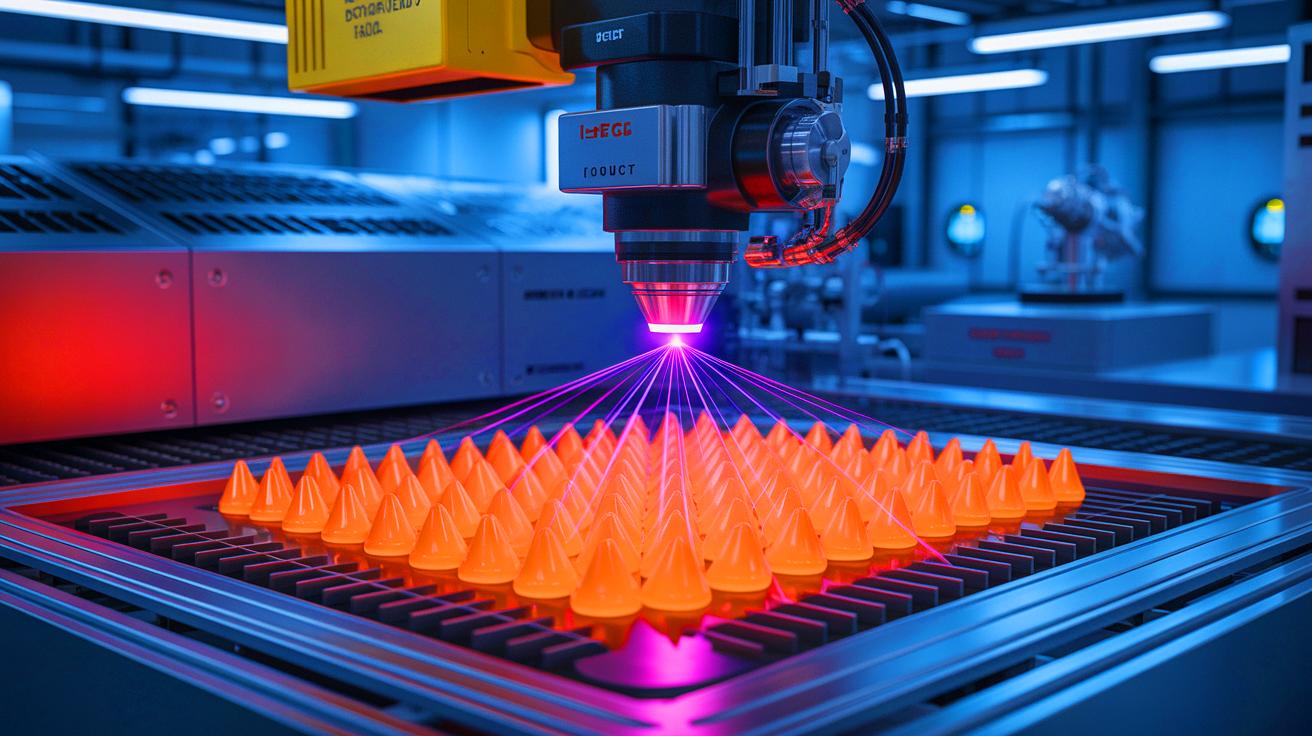
Researchers from North Carolina State University have developed an innovative technique using a 120-watt laser to transform a liquid polymer precursor into hafnium carbide (HfC). This material is one of the most heat-resistant known to date. The process begins in an inert environment, such as a vacuum chamber filled with argon, where the laser is applied to the liquid precursor. This solution includes all the chemical elements necessary to form the final ceramic: hafnium and carbon. As the laser penetrates the precursor, thermal energy converts the liquid into a solid, which then directly transforms into ceramic. This process, known as sintering, is so rapid that researchers consider it a single-step process.
Two methods for applying laser sintering exist. The first involves applying the liquid precursor as a coating on existing objects or materials, followed by sintering. This creates protective ceramic layers without exposing the entire structure to furnace heat. The second method integrates laser sintering with 3D printing systems, similar to stereolithography. The laser, mounted on a mobile platform, traces the design in the precursor layer by layer, allowing for precise and controlled construction of a 3D ceramic object.
Superior Yield and Increased Efficiency
By utilizing their laser sintering method, the researchers successfully produced pure HfC as proof of concept. They found that this method offered a yield superior to conventional techniques. Laser sintering enabled the conversion of at least 50% of the precursor mass into ceramic, compared to 20% to 40% for traditional methods. This increased yield translates to reduced waste and better resource efficiency. The researchers also observed excellent adhesion of the HfC coatings on reinforced carbon fiber composites. These coatings uniformly covered the surface and adhered firmly to the underlying structure.
Professor Cheryl Xu, a co-author of the study, stated in a press release: “This is the first time, to our knowledge, that anyone has been able to create HfC of this quality from a liquid polymer precursor.” While this method is more portable than traditional furnace-based techniques, it still requires a vacuum chamber. The study’s results were published in the Journal of the American Ceramic Society, underscoring the significance of this technological advancement.
Potential Applications and Industrial Implications
The implications of this new laser sintering method are vast and promising. By significantly reducing the time and energy required for producing ultra-refractory ceramics, this technique could revolutionize entire industrial sectors. For example, manufacturing components for nuclear reactors could become more economical and resource-efficient. Similarly, the production of thermal shields for spacecraft could benefit from this rapid and efficient method.
Additionally, integrating laser sintering with 3D printing opens the door to more complex and customized designs of ceramic components. This capability to create 3D objects with enhanced precision could foster innovation in aerospace, where materials often need to be tailored to meet specific requirements. The automotive and military industries could also capitalize on these advancements to develop new high-performance materials.
Towards a Sustainable Future with Advanced Materials
Beyond its immediate industrial applications, the new laser sintering method could significantly impact environmental sustainability. By improving resource efficiency and reducing waste, this technique contributes to a more responsible use of advanced materials. This is particularly relevant in a global context where natural resources are becoming scarce and the pressure to reduce carbon footprints is intensifying.
As we head towards a future focused on technological innovation and sustainability, how will this breakthrough in manufacturing ultra-refractory ceramics influence the evolution of advanced materials in the coming decades? Will industries be able to fully leverage these new opportunities to transform their practices and contribute to a more sustainable world?
The author utilized artificial intelligence to enrich this article.
Did you enjoy this? 4.5/5 (26)