
Understanding Lunar Magnetization: Insights from MIT Research
The moon, Earth’s natural satellite, has captivated scientists for centuries, yet many of its mysteries remain unsolved. One such enigma is the unexpected magnetization of certain lunar rocks, particularly those found near the south pole. While the moon lacks a global magnetic field, the presence of magnetized rocks raises questions about how these phenomena occur. Recent research conducted by the Massachusetts Institute of Technology (MIT) sheds light on this puzzle, suggesting that a significant asteroid impact may have temporarily strengthened the moon’s magnetic field. This theory not only clarifies aspects of lunar history but also opens new avenues for understanding magnetism in other celestial bodies.
The Mysteries of Lunar Magnetism
Since the iconic Apollo missions, lunar rock samples returned to Earth have revealed surprising magnetic signatures. Observations from various space probes corroborate these findings, revealing that the moon’s surface is mystifyingly magnetized. The traditional explanation for planetary magnetism involves the dynamo theory, which suggests that the movement of molten, electrically conducting materials in a planetary core generates a magnetic field. However, the moon’s small, cold core is insufficient to produce such a dynamo, leading researchers to seek alternative explanations.
Previous theories speculated that solar magnetic fields might influence lunar rocks during an asteroid impact. However, simulations conducted in 2020 indicated that solar fields were too weak to account for the observed magnetization. MIT researchers proposed a different hypothesis: the moon may have once possessed a weak magnetic field generated by a nascent internal dynamo capable of producing magnetic strengths around one microtesla—approximately 50 times weaker than Earth’s magnetic field. A massive asteroid impact, such as that which formed the Imbrium Basin, may have temporarily amplified this weak field, allowing for the magnetization of lunar rocks.
Untangling the Mystery Behind Lunar Magnetization
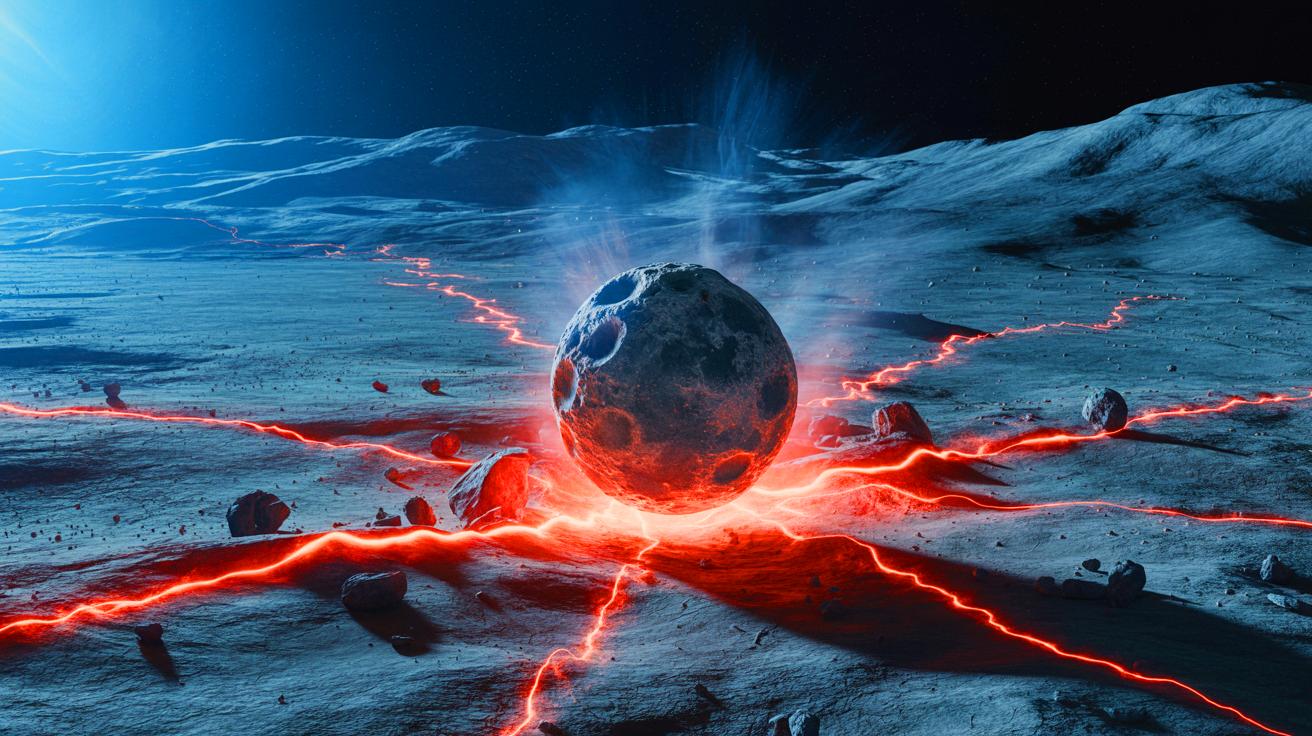
Utilizing advanced simulations on MIT’s SuperCloud platform, researchers explored the hypothetical scenario of an asteroid impact. They discovered that such an event would vaporize surface materials, creating a concentrated plasma cloud predominantly on the moon’s far side, where highly magnetized rocks are located. This plasma would compress the moon’s weak magnetic field, temporarily increasing its strength.
Although this increase in magnetic strength would last only about 40 minutes, a crucial question remains: How could rocks retain such a robust magnetic signature over time? Researchers suggest that the impact generated powerful seismic waves traversing the lunar surface. At the peak of magnetic strength, these waves would align the electrons in the rocks with the temporary magnetic field. Once the magnetic field dissipated, the electrons would remain "frozen" in this arrangement, retaining a lasting magnetic memory.
Implications for Other Celestial Bodies
This MIT study not only addresses a lunar mystery but also provides insight into the magnetic dynamics of other celestial bodies. It posits that even in the absence of a strong, sustained magnetic field, a planet or moon can acquire magnetized regions if a weak dynamo coincides with a massive impact. This theory could apply to other planets, such as Mars and Mercury, which exhibit scattered magnetic fields without currently active dynamos. By applying this understanding, scientists may gain deeper insights into the violent pasts and internal structures of these celestial bodies.
However, these findings are currently based on simulations. To test and validate their theories, researchers need concrete rock samples from the moon’s far side—samples that future missions, such as NASA’s Artemis program, could potentially deliver.
Towards a Better Understanding of the Moon
MIT’s recent discoveries illuminate the moon’s magnetic past, offering plausible explanations for its otherwise inexplicable magnetized rocks. By leveraging advanced simulations and innovative hypotheses, the researchers suggest a comprehensive narrative around lunar magnetization. As future space missions endeavor to confirm these theories, they inspire us to rethink our approach to understanding magnetic processes across the cosmos. What other mysteries lie in wait, either on the moon or other celestial bodies, awaiting discovery by the next generation of scientists?
The quest to unveil the secrets of our universe continues, fostering a deeper appreciation for the intricate processes shaping not only our moon but also the broader universe that surrounds us.
| EN BREF |
|
The moon, Earth’s natural satellite, has always fascinated scientists and curious minds alike. Although lacking a global magnetic field, it exhibits strangely magnetized rocks, especially near its south pole. This anomaly has long puzzled researchers, but a recent study from the Massachusetts Institute of Technology (MIT) proposes a captivating theory. Employing a combination of advanced computer simulations and new hypotheses, researchers believe they have unraveled this lunar enigma, thus opening new perspectives on our understanding of the moon and other celestial bodies.