
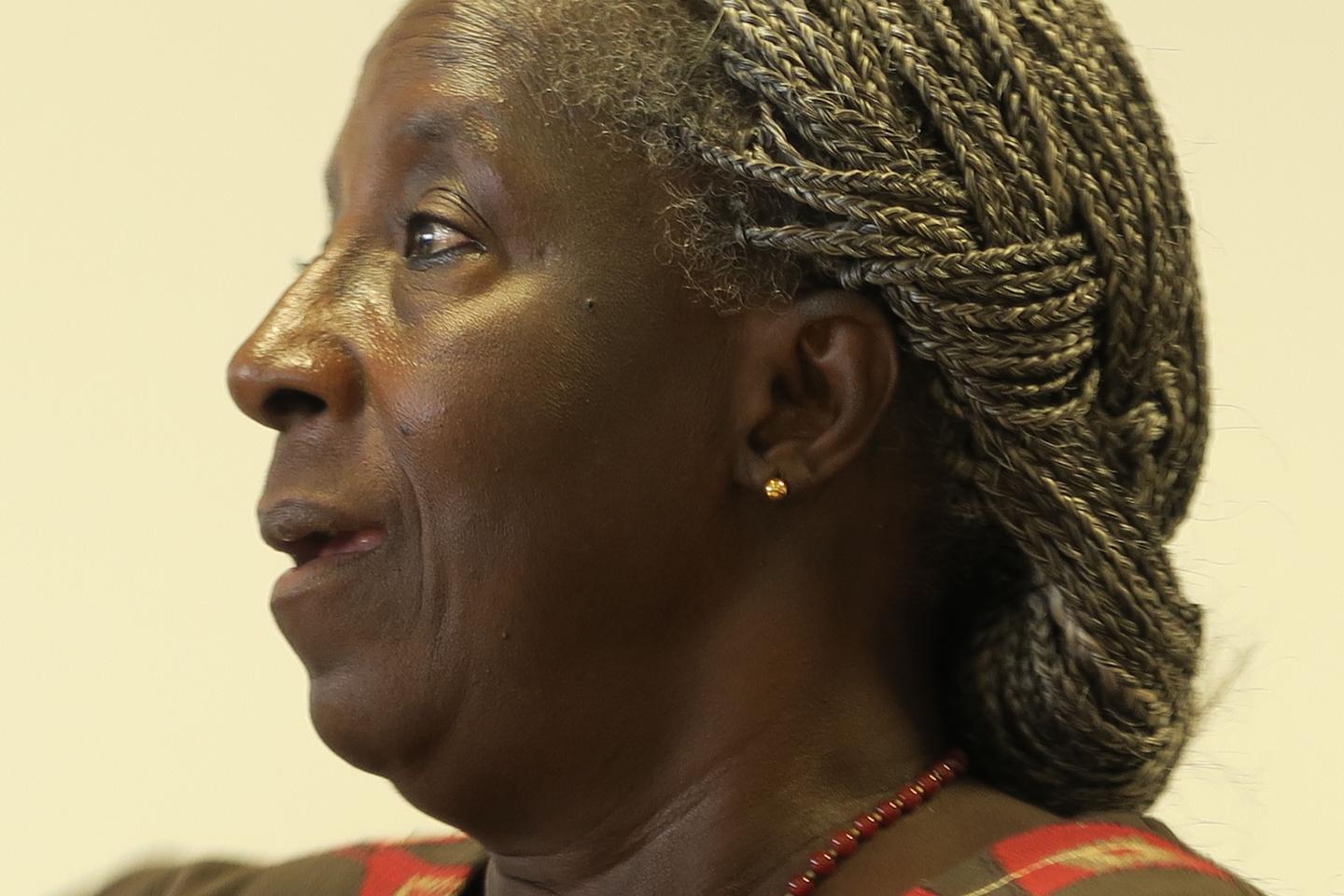

In **Senegal**, the coming to power, in March 2024, of a new management team which promised a break with past practices, did not improve the **representativeness** of women in the highest bodies of the country. Thus, the government of **Ousmane Sonko** has only four women (**13%**). The sign of a “Lack of political will”, According to sociologist **Fatou Sow**, “While Senegalese women prove their skills in all other areas of society”. At **84**, the Senegalese feminist, a long teacher-researcher at **Paris-Diderot University** and at **Cheikh-Anta-Diop University** in Dakar, was honored on Thursday, May 15 in **Dakar**, during a symposium on “female democracy”.
Why, fifteen years after the establishment of parity in Senegal, are women still widely excluded from the political game?
After the establishment of this law on “absolute parity” between the sexes in all **elective institutions**, voted under the chairmanship of **Abdoulaye Wade** [2000-2012], we reached **44%** of women elected to Parliament in 2022, compared to **40%** in the last legislative elections, in November 2024. While we had won some battles, we see that everything moves back. Who could have imagined that with so young leaders [the president **Bassirou Diomaye Faye** is **45 years old**, the prime minister **50 years old**], would we have so few women in government?
What is braking, do you think?
It is a question of **political will**. Today, under the pressure of this law on parity, it is difficult for the power not to name women. So we sprinkle the government and the public institutions with a few women, but the bulk of power always goes to men. Women, there are fewer and fewer in the places where decisions are made, because there is a very strong **patriarchal system**, heavily influenced by **Muslim** and **Christian religions**.
However, it should be noted that in all other technical positions, whether it be **medicine**, **engineering** and even the **army**, we see more and more women in positions of responsibility, not thanks to a law on parity but because they have demonstrated their **skills**.
Bassirou Diomaye Faye and Ousmane Sonko are the first openly polygamous Senegalese leaders. What does this reflect developments in Senegalese society?
It must first be said that in Senegal, the middle class and the popular class do not question **polygamy** because it is part of the reality of Senegalese culture and **Islamic culture**. Like **Bassirou Diomaye Faye** and **Ousmane Sonko**, it appears that many men with a level of extensive studies and who today occupy key positions at university, in politics or in economic circles, embrace **polygamy**, while it was previously perceived as retrograde by the first elites of the post-independence country.
Today, only women of the elite question **polygamy** and consider that **monogamy** is a model towards which society should tend, as we have built different social relationships, with different ambitions. However, since Senegalese women desire to be married, because marriage grants **social status**, they find themselves compelled to accept polygamous arrangements. Yet, the endorsement of women does not translate into an **egalitarian** society. Senegalese society remains hierarchical, defined by sex, age, and ethnicity.
The feminist manifesto of Senegalese anthropologist Awa Thiam, *Speech to Negresses*, released in 1978, was reissued in 2024. There is a question of genital mutilation, polygamy, or even forced marriages. Despite advances, these practices always find an echo in Senegal …
These practices still exist in **2025** and continue to generate significant suffering for the bodies of women. **Excision**, for example, in the regions where it is practiced, is presented as a **cultural initiatory practice**, a marker of femininity and identity. If these practices persist despite the **1999 law** against gender-based violence, it is due to the lack of political will to confront the **religious institutions** that uphold them.
What do you answer to those who denounce feminism as the product of Western society, in contradiction with “African values”?
Feminism is a multifaceted struggle for women against **oppression**. The African intellectual that I may be accused of Westernism as soon as I deviate from a pre-established order of thought, since it disrupts and challenges. It is truly insulting to hear African men claim that African feminists are simply imitating Westerners, while they can openly discuss **Marx** and **Bourdieu** without facing accusations of Western influence.
The global conservative offensive meets an echo in Africa. Has the feminist movement, which had won victories in reproductive rights, family planning, or even parity in politics, been only a parenthesis?
It has indeed been a parenthesis for an extended period, as there exists a **backlash**. We must remember the law passed under **Ronald Reagan** in 1984, the **Global Gag Rule**, which prohibited foreign NGOs from receiving funds from the United States government if they worked directly or indirectly on **abortion** issues. Every Republican president has reinstated this rule, and this continuous offensive culminated in efforts under **Donald Trump** to dismantle the **USAID** agency and withdraw from the **WHO**. Today, I assert that the rights championed by African feminists are as threatened as those in **America**.