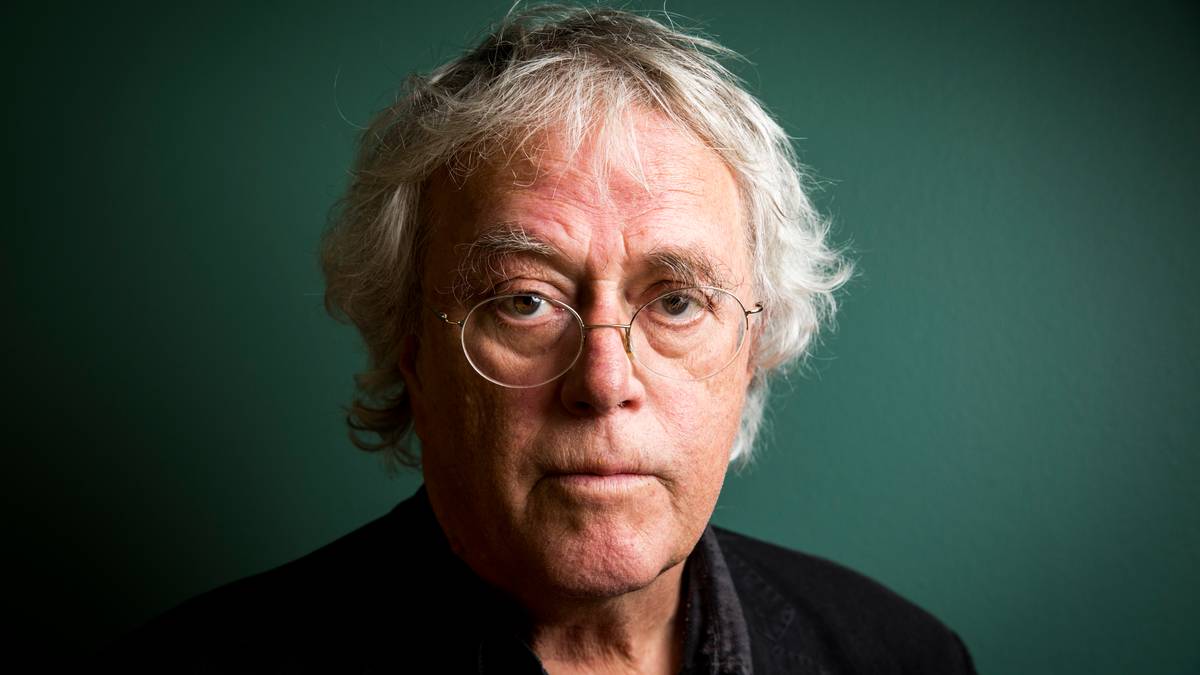
The first book I read of Dag Solstad was bright yellow, and had a mildly mysterious title: “Roman 1987”. I lay it on the couch in the kitchen in Absalon Beyers gate in Bergen. I went to high school and did not have the farthest bearing on what I was going to be when I grew up. The novel is about a young guy, not many years older than what I myself was at that time. It opens like this: “Under the specific condition that you want to look at me with greater understanding than I am used to, in the sense that you try to listen to, and take over what I tell, before you condemn me – make an effort!” Dag Solstad passed away March 14, 2025. Here he is pictured in 2011. Photo: Berit Roald / NTB I made an attempt and I was lying on the couch until the book was finished. “Roman 1987” is about a young man coming to the cloud station at Lillehammer. He drags on two heavy suitcases, on his way to the newspaper Dagningen, where he will start in his first job as a journalist in the newspaper. Was it there and when I made an inner decision that I would become a journalist myself? Possible. Since then, I have, and many with me, followed this authorship in thick and thin. Solstad is the Norwegian Literature’s answer to jazz trumpet Miles Davis. At the threshold of each new decade, it was as if he had to change the style of writing and invent something new. On the cover of “Roman 1987”, Solstad stares curiously at me through thick square horn glasses, with a rich bucks. The novels he wrote during this period were correspondingly full. Dag Solstad in 1982. Photo: Bjørn Sigurdsøn / NTB The story of his time in the Communist Party AKP (ML) he wrote just as well twice, in “Roman 1987” and in “Gymnasium Teacher Pedersen. The story of the political revival that has haunted our country. ” To say that I know these novels by heart is to take in. But it is at least undoubtedly so that over the years I have reproduced individual scenes in conversation at other Solstad lovers countless times over the years. In high school teacher Pedersen, the young Maoists decide that they cannot wait for the next ferry when they are going over to the island where the party will arrange a summer camp. It is also not necessary, because they can cycle on the water! Dag Solstad in 1971, during an annual meeting of the Writers’ Association. Behind the picture of Bob Dylan is Jan Erik Vold, with Ane Borgen next door. Photo: Sverre A. Børretzen / NTB In the 1990s, the goat herd was gone. So were the thick horn glasses. Now he had been shaved and with glasses with thin frames. The novels from the next decade were all correspondingly thin, on about 144 pages. Central to a slightly discharged teacher, professor or librarian, who felt alienated to society and himself. “Eleventh novel, book eighte” (1992), “Genance and Dignity” (1994), “Professor Andersen’s Night” (1996 and “T. Singer” are all highlights of the writing. Also based on these books are the memories of individual scenes closest in queue. Whoever has read about how Bjørn Hansen’s self -relieved “is still a strike, the book is a stranger. Into the margin, what does it help to have a genuine relationship with world literature? Is on his way to Germany in a plane. Solstad released the biography “Unwritten memoirs” in 2013. Photo: Håkon Mosvold Larsen / NTB But at the same time – and this must not be forgotten – he also wrote fantastic essays. His articles on literature, from 1966 to the present, also naturally belong to any furnished home bookcase. In recent years, Solstad has also made an international breakthrough. Japanese Haruki Murakami, who will soon be coming to the Norwegian Literature Festival in Lillehammer, has translated Solstad into Japanese. “He is a kind of surreal writer, very special novels, this is serious literature,” Murakami said. Yes, so you can say so too! A small surreal gem surprisingly came earlier this spring, with the release of “a true sting” in connection with the 150th anniversary of the Norwegian Travels Company. It is, like all Solstad’s books, a small piece of Norwegian history in miniature. In the bookshelf here at the cabin in Western Norway where I now sit and write this, I also find a first edition of “World Cup in Football 1982” a comrade borrowed that book before Christmas, but when I visited him last time I demanded it back. Solstad with Jon Michelet in 1986. Photo: Henrik Laurvik / NTB The story of when Solstad arrives at Bilbao – with two heavy suitcases – after a stubborn train journey, to unite with his colleague Jon Michelet, was the first world championship in football I myself was old enough to experience. That book, like the rest of the authorship, has its own space in my heart. I must have the books here in the bookshelf, so that with time and moments they can be discovered by my children and grandchildren. Published 15.03.2025, at. 16.54
ttn-69