

In July, a situation unfolded that could easily have been mistaken for a scene from an action film. In the early hours of a Monday, metro stations began filling up, but instead of typical commuters with backpacks and briefcases, the scene was dominated by military personnel —soldiers armed with anti-tank weapons . This unusual gathering suggested a looming reality that is becoming increasingly palpable: the situation in Taiwan .
This perception stems from alarming developments in China’s military strategy , with satellite images indicating that China is converting its coastline into a sprawling missile launch platform. According to a recent report by The New York Times, this transformation forms the backbone of Xi Jinping’s strategy aimed at coercing Taiwan into reunification while simultaneously challenging U.S. military presence in Asia.
The Pentagon estimates that the size of the Chinese missile arsenal has surged by 50% in just four years, climbing to an impressive 3,500 units . Although the precise number of missiles directly aimed at Taiwan remains undisclosed, satellite analyses reveal significant military enhancements—expanded bases, additional launch ramps, and upgraded facilities in crucial provinces such as Anhui and Jiangxi .
State-of-the-Art Missile Systems are also emerging as essential components of this strategy. Notable among them are the Dongfeng-17 , a hypersonic missile that boasts exceptional maneuverability and is hard to intercept, and the Dongfeng-26 —dubbed the “Guam Express” for its capability to target U.S. bases across the Pacific. These missiles, which can be armed with either conventional or nuclear warheads, are easily transportable by road, complicating detection and tracking by enemy intelligence.
The Pentagon estimates that Beijing has at least 500 DF-26 missiles , marking this platform as pivotal in their anti-access/area denial strategy , particularly against U.S. forces positioned in Guam and Japan .
Military Exercises and Strategic Messaging are also on the rise, particularly along China’s eastern coastline. These maneuvers include simulated launches from agricultural fields, concealed valleys, and even highways, highlighting Beijing’s commitment to integrating missiles into a flexible and diverse operation framework. The dual purpose of these drills is clear: operational readiness and political signaling. For Taiwan, the implicit message is that any act of resistance would be futile against such an overwhelming arsenal; for Washington, it’s a stark reminder that intervening could incur exorbitant costs.
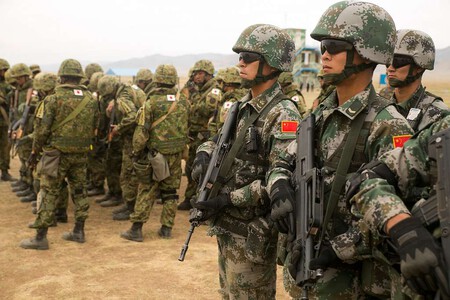
Expansion of Military Brigades is also taking shape, with Brigade 611 in Anhui reportedly doubling its size. Equipped with training facilities and as many as three dozen launch ramps, this concentration of resources underscores the significance of the area in Xi Jinping’s strategy, as he personally encouraged troops to cultivate a “crisis and combat mentality” during visits in 2024.
Further south, Brigade 616 in Jiangxi is being prepared to receive the DF-17 missile technology, with specially adapted hangars to accommodate this cutting-edge weapon. Such deployments illustrate the development of an extensive network of offensive capabilities aimed explicitly at overwhelming Taiwanese defenses and threatening U.S. installations within minutes.
In this context, the DF-26 missile serves as a manifestation of China’s strategic ambiguity, with the versatility to be equipped with either nuclear or conventional warheads. Experts warn that although American satellites can track the transfer of nuclear warheads from central storage to mobile platforms, the detection is not infallible and poses significant risks.
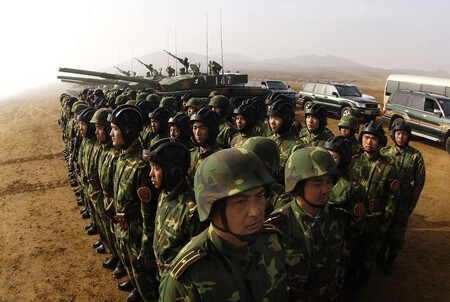
Military Drills and Preparations do not just stop at land-based scenarios. China is also engaged in creating target models of U.S. naval vessels in desert areas, further demonstrating that their missile preparation extends to maritime engagements as well. These simulations signal that Chinese forces are not only ready to operate within their territory but are also poised to confront the U.S. Navy in open seas.
Although China has made substantial advances, it faces challenges. Internal scandals and purges have rocked the missile force, raising concerns about the integrity of its nuclear infrastructure. Additionally, capabilities against moving maritime targets are unproven, leading to uncertainties in real combat scenarios.
Missiles as a Pillar of Power reflect Xi Jinping’s belief that the resolution of the Taiwanese question relies fundamentally on coercion and the threat of military force. The accumulation of thousands of missiles along the eastern coast witnesses deep-rooted convictions that any future resolution must involve intimidation tactics. Analysts have dubbed the missile force the “Crown Jewel” of the People’s Liberation Army, a tool that enhances China’s influence across the Western Pacific, complicating U.S. intervention strategies and perpetuating pressure on Taiwan.
However, this very strategy carries the peril of miscalculation that could lead to an unprecedented nuclear escalation , posing risks reminiscent of the Cold War. As geopolitical tensions mount, the world watches closely, acutely aware of the thin line between deterrence and disaster.
Image | Maxar Technologies, Nara