
Mistral Small 4: A New Era in AI Models
The artificial intelligence race is often portrayed as a fierce competition to develop the most powerful model or achieve the highest benchmarks. The French startup Mistral AI has entered this arena with its latest offering, Mistral Small 4. Rather than being a specialized model, it aims to consolidate multiple advanced functions into a single, versatile tool.
Understanding Small 4
Small 4 evolves from Mistral’s Small family, unifying capabilities that were previously part of separate lines such as Magistral, Pixtral, and Devstral. This integrative approach allows users to handle various tasks within one system, streamlining the user experience significantly.
Fewer Models, Greater Functionality
Mistral’s primary objective is to concentrate tasks that would typically necessitate multiple specialized tools. With Small 4, users can converse, analyze intricate information, work with images, and assist in programming—all without switching between systems. This centralized model simplifies workflows and enhances productivity.
Technical Specifications of Small 4
Small 4 is built on a Mixture of Experts architecture, which partitions processing among different submodels. This innovative design incorporates 128 experts, with only four of them active at any given time for each generated token. The model boasts 119 billion total parameters, enabling it to process data efficiently within a context window of up to 256,000 characters.
Target Audience
Mistral has clearly articulated the environments in which Small 4 is expected to excel:
- Developers: Automate programming tasks, explore code bases, and create code workflows.
- Businesses: Utilize it for conversational assistants, document understanding, and conduct multimodal analysis.
- Researchers: Use it in fields requiring complex analysis, mathematics, and reasoning tasks.
This flexibility allows Small 4 to adapt to various needs without necessitating a change in the operating system based on different tasks.
Performance Insights
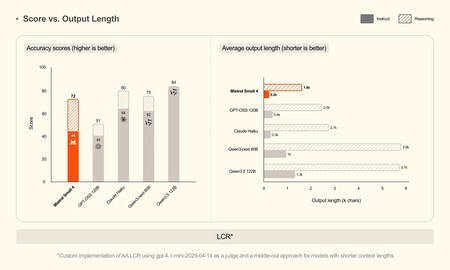
Mistral has provided several benchmark comparisons that highlight Small 4’s performance against other models. These comparisons not only reflect scores but also the average length of responses generated, framing how effectively models address tasks.
According to the AA LCR benchmark data:
- Mistral Small 4: 0.72 score with 1,600 characters
- GPT-OSS 120B: 0.51 with 2,500 characters
- Claude Haiku: 0.80 with 2,700 characters
- Qwen3-next 80B: 0.75 with 5,800 characters
- Qwen3.5 122B: 0.84 with 5,700 characters
Key Comparisons
While Small 4 does not claim the top score compared to models like Claude Haiku and Qwen, Mistral emphasizes the efficiency in response length. The model tends to produce less text while maintaining competitive performance. This ability translates to lower latency and reduced inference costs, which are valuable in optimizing computational resources.
The Short Answer Advantage
Generating shorter answers doesn’t automatically equate to quality. Mistral focuses on the premise that producing concise yet effective outputs can lead to quicker responses, resource efficiency, and lower inference costs. Thus, the strength of Small 4 lies in its capability to deliver useful results with minimal output.
Accessing Mistral Small 4
Mistral Small 4 is available through an API and AI Studio. It’s also an open model published under the Apache 2.0 license, enabling users to download, adjust, and deploy it in their environments. Users can explore its functionalities at build.nvidia.com and consider it for production through NVIDIA NIM.
In summary, Mistral AI’s Small 4 represents a significant leap in AI model development, moving beyond the conventional one-function-per-model approach to a more integrated, versatile solution.