
The New Face of Geopolitics in the South China Sea
For some time now, certain nations have demonstrated the capability to create land where there was previously only ocean, dramatically altering maps in a matter of years. These transformations, visible even from space, have a profound impact on trade routes, ecosystems, and regional balances without necessitating major confrontations. Often, the most significant changes begin not with conflict, but with development that goes unchecked.
A Conquest Without Shooting
While the world’s attention has been riveted on crises like those in the Middle East, China has quietly executed a highly strategic move in the South China Sea. As noted by Forbes, China has transformed a relatively inconspicuous reef into a vital piece of its maritime control network. This bold maneuver has taken advantage of global distractions and has been met with minimal immediate opposition. The slow, late responses from countries such as Vietnam and the initial silence from the international community allowed China to solidify its gains before debate or diplomatic responses could even emerge.
From Sandbank to Strategic Base in Months
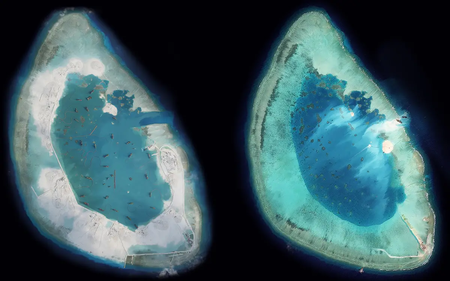
Satellite images reveal that the pace of construction at Antelope Reef illustrates China’s extraordinary industrial and logistical capabilities. Dozens of dredgers have been employed to create square kilometers of land in a matter of months. Once a mere sandbank, this area is now burgeoning with infrastructure and fortified perimeters, showcasing Beijing’s ambition and ability to alter the conflict’s physical landscape swiftly.
The image on the left corresponds to December 19, 2025. The image on the right corresponds to February 17, 2026.
Legality as a Tool, Not a Limitation
China’s expansion has been accompanied by a strategy that seeks to reinterpret international law, framing construction activities as domestic issues. According to the UN Convention on the Law of the Sea, such constructions do not confer new sovereign rights. Nevertheless, China’s use of a fait accompli approach combined with legal arguments enables it to advance without direct confrontations, shifting the conflict into a diplomatic and narrative battleground.
Militarization Without Concealment
Unlike previous stages when China denied the militarization of its artificial islands, current developments at Antelope Reef indicate a clear intent for military use from the outset. The newly created land allows for landing strips capable of supporting advanced fighter jets, in addition to future installations of radar systems, missile networks, and surveillance capabilities. This enclave emerges as a multifunctional node connecting ports, maritime militias, and intelligence operations, reinforcing China’s grip over a strategic maritime route.
A New Balance Under the Sea
This endeavor represents a subtle yet profound shift in regional power dynamics. Each new island enhances China’s capacity to monitor, deter, and project power without engaging in open confrontations. Cumulative and discrete movements enable the consolidation of strategic advantages that often become clear only when it is too late to reverse them.
As the world’s focus shifted to other conflicts, China has continued to reshape the Pacific map to its advantage. In modern geopolitics, it appears that victory is no longer defined by who fires the first shot, but rather by who builds and develops uninterrupted.