
Europe has entered a new era of rearmament . The Russian invasion of Ukraine reopened an arms race that many believed was behind us, prompting governments across the continent to urgently revisit their defense industries. In this landscape of revived military production, Spain has emerged as a significant player.
From Navantia to Indra , from ITP Aero to Escribano , Spain hosts a network of companies that design everything from frigates and radars to engines and intelligence systems for some of Europe’s most ambitious defense projects. This article aims to provide a comprehensive understanding of who these companies are, their impact, and the role they play in the rearmament of the continent.
Opportunities and challenges in European rearmament
A study prepared by PwC for the employers’ association TEDAE paints a clear picture of the industrial weight the defense sector holds in Spain. According to this report, published in 2024, the Defense, Security, Aeronautics , and Space industries contributed €21.9 billion to GDP (1.4% of national GDP) and created 260,000 direct, indirect, and induced jobs. While no rankings were established in the report, it is evident that the Spanish defense ecosystem is among the most diversified in Europe. Such findings reveal the magnitude of an industrial fabric that supports much of European rearmament.
However, the sector’s momentum does not come without challenges. In an interview with El País , the president of Indra, Ángel Escribano , acknowledged that Spain still lacks a defense giant akin to Rheinmetall , Thales , or Leonardo . “We need a greater dimension,” he stated, emphasizing that the goal is not to create a “national champion” but to build a cooperative fabric where companies share capabilities. This vision encapsulates both the aspirations and the internal tensions within the integration of Spain’s defense sector.
Industrial reactivation is not a standalone solution for sustainable defense. The Elcano Royal Institute warns that rearmament efforts cannot solely be evaluated by investment figures or signed contracts. Their recent analysis underscores that the revitalization of Spanish defense will remain sustainable only if it aligns with strategic and national security criteria. This requires a reinforcement of the so-called strategic culture , which involves a long-term vision that transcends industrial logic, clarifying the role Spain wishes to occupy within the European security framework.
With this cautionary note in mind, European rearmament is understood as a concrete exercise in capabilities. Every contract and European program is backed by factories, engineering, and shipyards that underpin the modernization efforts. Spain is not starting from scratch; it benefits from an established network of companies that have thrived on major NATO and EU projects. These organizations may be public or private, but they collectively form the ecosystem currently regaining prominence.
The names defining the new defense industry in Spain
Navantia stands as the cornerstone of Spain’s naval industry and is crucial for European rearmament. From its shipyards in Ferrol , Cartagena , and Cádiz , Navantia produces vessels for both the Spanish Navy and foreign navies, including the F-100 frigates and Avante corvettes . The company is currently focused on two strategic projects: the F-110 frigates , which have a contract worth €4.325 billion , and the S-80 submarines . The first unit of the F-110 series, Bonifaz , was launched on September 11, 2025, with the first delivery planned for 2028. On the submarine front, the S-82 , the second unit of the S-80 class, was sponsored on October 3, 2025.
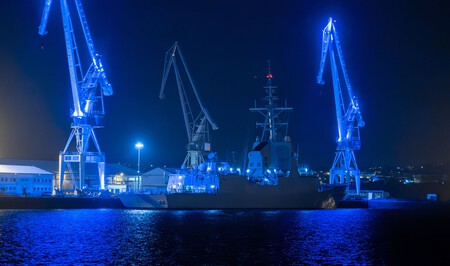
One of the frigates that bears the Navantia seal
Meanwhile, Indra serves as the technological backbone of Spanish defense by integrating C4ISR systems , radars, electronic warfare, and simulation technologies. The company is also the national coordinator of the FCAS program concerning sensor and combat cloud pillars. Indra’s legacy includes contributions to the Eurofighter in avionics and defensive aids, complemented by solid defense contracts. The company closed 2024 with €4.843 billion in income and has a portfolio reaching €7.245 billion .
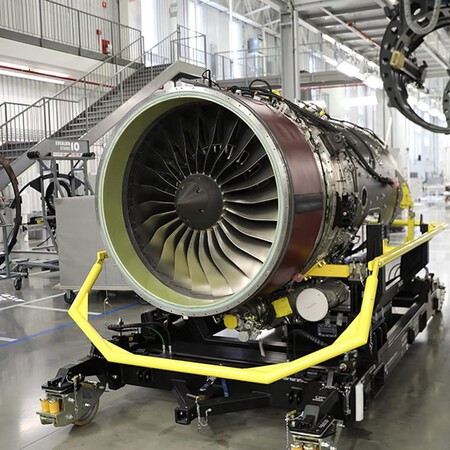
The PW800 engine is behind the first transatlantic flight powered by 100% sustainable aviation fuel
Another important player, ITP Aero , specializes in the design, manufacture, and maintenance of turbines and is involved in Europe’s cutting-edge programs, including the Eurofighter and the upcoming FCAS system . In 2024, the company allocated €102 million to R&D, a 55% increase from the previous year, achieving revenues of €1.612 billion . This financial growth underlines its strategic significance in NATO and the EU as a propulsion supplier .
SAPA has also emerged as a notable specialist, focusing on armored vehicle mobility and possessing the unique capability to develop next-generation transmissions. Their technology equips the 8×8 Dragon vehicle for the Army and has been selected by General Dynamics Land Systems for U.S. Army programs, marking a significant long-term agreement valued at up to €5 billion .
Escribano Mechanical & Engineering epitomizes the dynamic transformation of the Spanish defense industry. Specializing in remotely controlled weapon stations (RWS) and optronics, the company attained a turnover of €355 million in 2024 while investing €62 million in R&D. Its dedication to technological independence is evident in the opening of a new plant in Linares .
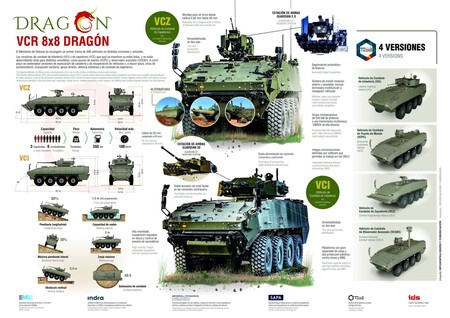
VCR 8×8 Dragon Infographic
Lastly, GMV has carved out a critical niche in command, control, and cyber defense systems, reporting a turnover of €454 million in 2024. GMV actively participates in multiple European Defense Fund projects and maintains contracts with the European Space Agency (EUSPA) , cementing its role as an essential player in cybersecurity and space.
Sener Aeroespacial , a subsidiary of the SENER group , stands out for its precision engineering in aerospace and defense. Participating in several projects under the European Defense Fund , Sener ended its last financial year with revenues reaching €710 million while accommodating a workforce of over 4,000 employees .
Tecnobit , a part of the Oesía Group , excels in optronics and secure communications systems and significantly contributes to programs such as FCAS . Its recent advancements in infrared sensors and artificial vision technologies reinforce its position in the market.
The Spanish defense sector is approaching a pivotal decade. The rising European defense budgets and programs present an unprecedented opportunity for growth, but they also compel the coordination of a still-fragmented ecosystem. As experts suggest, European technological autonomy cannot be achieved solely with increased investment; it requires a cohesive strategy that interrelates sovereignty, innovation, and industrial efficiency.
Images | Navantia | TESS Defense | ITP Aero