
Among all the rules that govern the universe, one of the most iconic and at the same time difficult to understand is the universal speed limit . The speed of light is not only an unwavering constant; it is also the link between matter and energy , as Albert Einstein described with the most famous formula in science: E = Mc². Though we can explore the foundations of our own existence, we cannot travel faster than “C”. Only light can traverse a light year in one year.
Let’s define constants: the speed of light
The speed of light is the cornerstone of Einstein’s equation. The “C” is not just a number; it serves as the conversion factor that unites mass (m) and energy (e). It is a constant that represents the speed of light in a vacuum , but also the maximum speed for the transmission of any type of information , signal , or material particle in the universe. In simpler terms, it is the limit of causality itself: an effect cannot occur before its cause, as it spreads at the maximum speed of “C”.
This speed applies universally, regardless of any observer’s state of motion. If you were traveling in a hypothetical spacecraft at 99% the speed of light and activated a flashlight, the light beam would move away from you at the speed of light, not at a fraction of it. This is one of the universal constants recognized by physics. Observations of the cosmic microwave background radiation, which is the remnant light from the Big Bang , confirm that this speed has remained constant for over 13.8 billion years.
So, what is the speed of light? Although it may seem strange, the speed of light in a vacuum has an exact and defined value: 299,792,458 meters per second . To offer a more tangible example, this is equivalent to almost one billion kilometers per hour . A photon of light could circle the Earth’s equator approximately 7.5 times in a single second. According to Einstein’s special relativity theory, this speed is the ultimate and unwavering limit of the universe.
An epic about measuring the above
Calculating the speed of light has been one of the great sagas of science. After the philosophical debates of ancient Greece and an ingenious yet unsuccessful attempt by Galileo to use lamps between distant hills, the first estimates emerged in 1676 . The Danish astronomer Ole Rømer observed that the eclipses of Io, one of Jupiter’s moons, had variable durations depending on the time of year. He realized this was due to the extra time taken for light to cross the Earth’s orbit as our planet moved away from Jupiter, estimating the speed of light to be around 220,000 km/s , astoundingly close for his time.
Half a century later, in 1728 , the English physicist James Bradley refined this measure using a different method known as the aberration of stellar light . He noted that the apparent positions of the stars shifted due to Earth’s motion in its orbit. He calculated a speed of 301,000 km/s , with an error margin of just 1% .

Michelson’s experiment. Image | Popular Science (1930)
It wasn’t until 1887 that scientists uncovered the most surprising aspect of the speed of light. Albert Michelson and Edward Morley aimed to detect the “luminous ether,” an invisible medium thought to fill space for the propagation of light. Their experiment sought to measure variations in the speed of light depending on whether it moved with or against the “ether wind” created by Earth’s motion. However, they found no variation whatsoever .
This scientific progress did not arise from discovering what was sought, but rather from accepting the evidence that challenged existing beliefs. This apparent *failure* became one of the most significant results in the history of physics, demonstrating that the speed of light remained constant regardless of the observer’s movement, debunking the ether theory and setting the stage for Einstein’s revolutionary ideas.
What is a light year and what is it used for?
Since 1983 , the speed of light is no longer merely measured with increasing precision. Its value has been so accurately defined that it now serves as the basis for the concept of the meter . One meter is defined as the length of the path traveled by light in a vacuum during an interval of 1/299792458 seconds .
This change reflects a profound truth: the constancy of the speed of light is a more fundamental characteristic of our universe than our own units of measurement. We no longer use meters to define the speed of light; instead, we use the speed of light to establish the meter. Thus, one of the most significant units of measurement we utilize originates from this understanding, crucial for grasping the enormous scales of the universe.
Although the term includes “year,” a light year measures distance , not time. In essence, it is the distance that light travels in a vacuum over one terrestrial year , or 365 days . Given the astonishing speed of light, this results in an astronomical distance of approximately 9.5 billion kilometers .
We use light years to quantify astronomical distances, as measuring them in kilometers would be impractical. For example, the closest exoplanet to Earth, Proxima Centauri B , is about 4.2 light years away. In kilometers, this distance translates to approximately 40 billion kilometers , a figure significantly more challenging to comprehend.
How a light year is calculated in kilometers
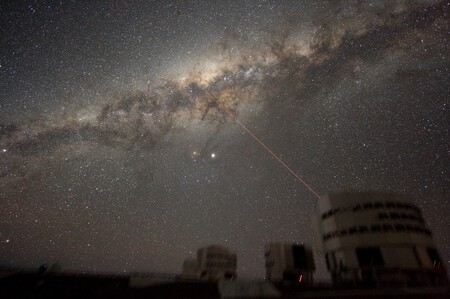
A laser indicates the center of the galaxy from the VLT telescope. Image | ESO
So how do we calculate a light year? If the speed of light is a universal constant, why specify that “C” is the speed of light in a vacuum ? Because light travels more slowly in other materials. For example, in water it moves at 225,000 km/s , and in glass , it travels at 200,000 km/s . This discrepancy occurs due to interactions of light with matter.
Light consists of massless particles known as photons . While photons always travel at 299,792 km/s , when light passes through a material medium, photons are continuously absorbed and re-emitted by the atoms, leading to tiny delays that accumulate, resulting in an effective speed slower than C.
Light is also an electromagnetic wave . When entering a medium, the electric field of light causes electrons in the atoms to oscillate, generating new electromagnetic waves that interfere with the original wave, effectively slowing it down. Nevertheless, light maintains a constant speed; the reduction is simply due to traversing a medium filled with atoms.
While space is mostly empty, it isn’t truly devoid of matter. There are particles such as free electrons , protons , and interstellar dust present. However, their density is so low that light travels through space at a speed remarkably close to C. Therefore, the light year is calculated based on the ideal vacuum reference.
A light year is simply the distance light travels in one year. To clarify, distance = speed × time . Hence, the distance equivalent to a light year is calculated by multiplying the speed of light by the duration of a terrestrial year:
- In rough terms, light travels at 300,000 km/S and a year consists of 365 days . Therefore, 365 days × 24 hours × 3600 seconds = 31.6 million seconds . Multiplying 300,000 km/s by 31,600,000 seconds results in a distance of around 9.5 billion kilometers .
- If we consider the exact speed of light ( 299,792,458 km/s ) and factor in leap years (365.25 days), the outcome is approximately 9,460,730,472,581 km .
How much is a light year in earthly terms
The light year measures vast distances that can be mind-boggling. For instance, light takes about eight minutes to travel the distance from the Sun to Earth . In that time, it travels 150 million kilometers . In an hour, it would cover that distance 11 times , and in a day, that distance would be multiplied by 24 . By the end of a year, it accumulates to nearly 9.5 billion kilometers .
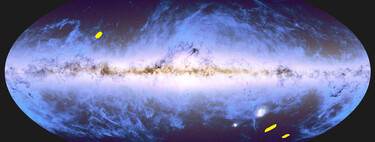
This vast journey is what we refer to as a light year. It indicates distance, not time. For measuring astronomical durations, we still use years , days , and seconds , while for extensive distances, light years or parsecs become more convenient units of measurement.
Simply gazing at the night sky illustrates the immensity of the cosmos . The brightest stars are located dozens of light years away. With minimal light pollution, we can see the Andromeda Galaxy with the naked eye, located approximately 2.5 million light years away from our Milky Way .
The light that reaches our eyes from Andromeda left millions of years ago, during the time when Australopithecines roamed the Earth. In this sense, stargazing can be considered a form of time travel . The farther we look, the further back in time we see, enabling us to witness events that occurred shortly after the Big Bang itself.
It is impossible to travel at the speed of light
The answer to this question rests upon one of the most fundamental theories in physics : Einstein’s special relativity . To understand it, we must revisit the iconic formula E = mc² , which connects the speed of light with fundamentally different concepts.
To move an object with mass, energy is required. As an object’s mass increases, so does the energy necessary to accelerate it. Einstein’s equivalence between mass and energy describes how these elements are intrinsically linked.
According to relativity, as a massive object accelerates and approaches the speed of light, its relativistic mass increases. To accelerate an object with infinite mass, one would need an infinite amount of energy—an impossibility. Thus, the speed of light acts as the ultimate cosmic speed limit .
Why is this so? Only massless particles like photons can achieve this speed. Without mass, they don’t face the infinite energy barrier that other objects do. Consequently, for all matter—be it the spacecraft we can construct or any entity with mass—the speed of light will remain an unattainable frontier. It represents the speed limit of our universe.
Image | Design Bits (Pexels)
In essence, the speed of light not only signifies a physical measure but also symbolizes the boundaries of our understanding of the universe. It serves as a constant reminder that while we strive to uncover the mysteries of outer space, there are limits to what can be achieved by beings made of matter.