
The Rise of 3D Printing in Weapon Development
Talking about 3D printing is no longer limited to prototypes or industrial environments. This technology has become an accessible tool for enthusiasts and creators, allowing individuals to design and manufacture complex objects from their homes. While this accessibility expands creative possibilities, it also raises crucial debates about the limits of 3D printing, especially when intertwined with weapons development. Following the emergence of 3D printed pistols, a recent project pushes this debate into even more sensitive territory—introducing a homemade guided missile.
The Disturbing Leap: A New Prototype
The catalyst for renewed focus on this controversial topic is a five-minute video by amateur inventor Alisher Khojayev. In it, he showcases a prototype reminiscent of portable anti-aircraft missile systems. The project comprises a launcher, a projectile, and several electronic systems designed for guidance, marking a significant milestone in DIY weapon technologies.
Components of the Guided Missile System
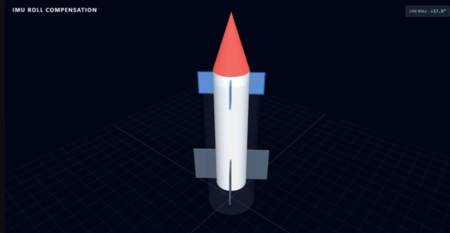
Khojayev’s prototype is a coordinated set consisting of three essential parts. The launcher serves as the base of the system, while the projectile incorporates a substantial number of 3D printed components. Additionally, an optional camera node can enhance tracking capabilities, adding another layer of sophistication to the home-built missile system.
The Technical Architecture
The architecture underlying Khojayev’s project integrates several devices over a wireless network to coordinate the flow of data. Initially, the launcher connects to a control computer via WiFi, which then analyzes incoming information to calculate the missile’s trajectory. In the second phase, the projectile joins this network, receiving instructions to adjust its orientation through moving surfaces. The system employs ESP32 microcontrollers alongside sensors like GPS, barometers, compasses, and inertial measurement units, enabling it to estimate variables such as speed and position accurately.
Cost Efficiency of Production
This project is not merely a technical demonstration; it also highlights a low-cost approach to weapon development. Khojayev claims that the entire system can be assembled for around $96, using commercially available components and 3D printed parts. While this low cost underscores the diminishing barriers in technology, it’s critical to note that such developments may be illegal in various regions, complicating the narrative around DIY military technology. This trend illustrates both the innovative potential and the ethical dilemmas posed by advances in 3D printing.
Images | Alisher Khojayev