

The U.S. Military Presence and Its Implications for Venezuela
The recent deployment of U.S. strategic bombers near Venezuela symbolizes more than just military posturing—it signifies a coordinated military campaign that dances along the fine line between subtlety and escalation. The ongoing air, sea, and territorial presence of the U.S., particularly in the Caribbean, sends a bold geopolitical message not just to Venezuela but also to other interested parties in the region.
The Visible Phase: The United States has again sent its B-1 Lancer bombers from Dyess Air Force Base in Texas to the periphery of Venezuela . These long-range bombers, known for their high payload capacity and supersonic speed , linger close enough to Venezuela to send an unmistakable signal regarding the U.S.’s military readiness. This action adds to previous showings that included B-52 and F-35B aircraft, illustrating a sustained military effort featuring eight warships, a submarine, P-8 maritime patrol aircraft, and a squadron of F-35 fighters already in the region. This new frequency of military presence indicates a shift from what was once merely an annual exercise into a continuous operational environment.
What the Bombers Reveal: Recent air traffic scans revealed the B-1 bombers flying alongside KC-135 refueling tankers, RC-135 Intelligence, Surveillance, and Reconnaissance (ISR) platforms, and E-11A BACN aircraft. This architecture is typical of complex military operations, aimed at maintaining command and communication over extended periods rather than a mere show of force.
The previous deployment of B-52s in the same vicinity has been described by the Pentagon itself as a “demonstration of attack,” reinforcing the interpretation that the U.S. is preparing an environment where it can strike from a distance without entering Venezuelan airspace. This formed a substantial operational capability from which the U.S. can execute targeted strikes, should the situation escalate.
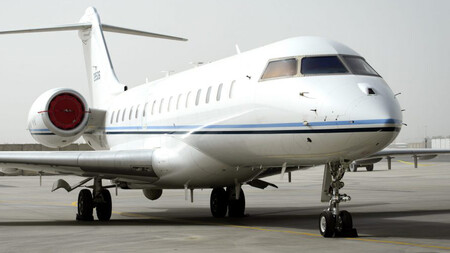
The E-11 BACN
The Bridge and Options: The ongoing campaign targeting suspicious marine vessels has inherent dual objectives: it aims to achieve immediate kinetic effects while simultaneously normalizing the lethal use of military force without explicit congressional authorization. Notably, former President Trump stated that following the maritime phase, operations could extend to land, targeting production or distribution facilities associated with drug trafficking . This action intentionally muddies the line between a campaign against drug cartels and the strategic coercion of the Venezuelan regime.
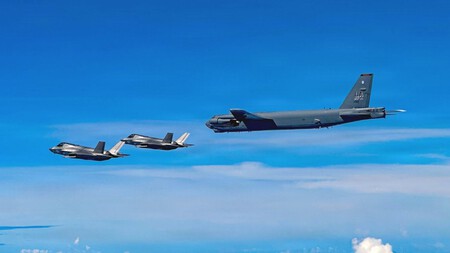
A B-52 and two F-35Bs seen flying together during the “bomber attack demonstration mission” last week
The Background: Before this latest deployment, Washington had undergone three unsuccessful strategies: imposing maximum sanctions , engaging in diplomatic negotiations, and recognizing a parallel government in Venezuela. These attempts have consistently failed to unseat Venezuelan President Nicolás Maduro , who remains bolstered by significant Cuban counterintelligence and alliances with nations like Russia and China.
The choice to exercise military coercion is reminiscent of historical U.S. interventions in Latin America, but here it possesses a calculated and ambiguous purpose. The Pentagon has resorted to sinking ships under the pretext of battling narcoterrorism , lacking specific congressional authority for actions that equate drug cartels with existential threats like al-Qaeda.
The Limits and Fragility: The recent history of U.S. nation-building post-military intervention has been fraught with challenges, and the Venezuelan context poses similar risks. Should a military confrontation lead to a power vacuum, it could be filled by either hardline factions within the current regime or even reinforce Maduro’s hold on power, should a failed operation present him with an opportunity for deeper repression.
With institutional continuity in question, the stakes could not be higher. The legitimate opposition remains fragmented or in exile, adding complexity to any potential conflicts. The belligerent posture against “narco-terrorists” risks crossing a point of no return, requiring a show of strength that could escalate tensions significantly.

The Strategy: The ongoing bomber flyover serves multiple purposes: it applies psychological pressure , establishes infrastructure for rapid military responses, and sends a message to regional adversaries supporting the Maduro regime. Now, with the emergence of this heavy wing , the U.S. has transitioned from mere rhetoric to laying the groundwork for real military action.
The legal flexibility surrounding the anti-drug framework allows the U.S. to navigate the complex barriers to military engagement without formally declaring war. However, diversifying tactics may still expose potential vulnerabilities and could make the U.S. more dependent on coercive measures having far-reaching implications for long-term stability in the region.
In summary, the U.S. military presence off the coast of Venezuela is not a passing moment; it represents a strategic maneuver that may pave the way for escalated actions. The intricate web of military, political, and social factors will undoubtedly shape the outcomes of this extended confrontation.