
Understanding Modern Marriage: Trends and Insights
Over the past few decades, the landscape of marriage has undergone significant transformations. In some regions, individuals are tying the knot later while others are choosing to forgo marriage altogether. Recent discussions raise important questions about the stability and quality of modern unions. Are today’s marriages more fragile than those of past generations? Here, we delve into recent studies and statistics that illuminate the current state of marriage and divorce.
Shifting Marriage Trends
Marriage rates have seen a marked decline across various parts of the world, particularly in Western nations . Data from the INE indicates that Spaniards are marrying later in life. In the 1970s, the average age for first marriages was around 26.7 years for men and 24.1 years for women. Fast forward to 2022, and these figures have risen to 36.8 years for men and 34.9 years for women.
This trend toward marrying later can be attributed to a range of factors, including economic independence , career pursuits, and shifting social norms where marriage is no longer a primary goal. This shift has significant implications for the nature and stability of contemporary marriages.
The Reality of Divorce Rates
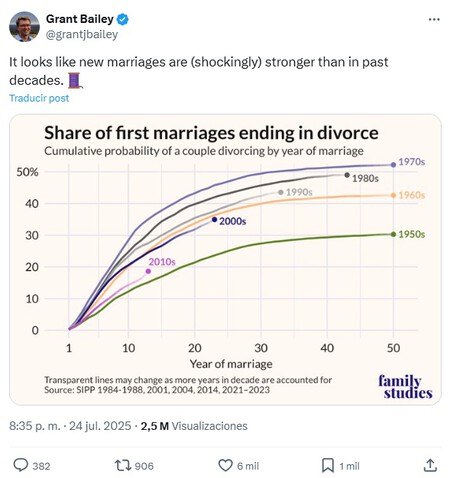
There’s a common narrative that claims half of all marriages end in divorce. However, research by the Institute for Family Studies (IFS) indicates a more nuanced reality. According to their findings, approximately 40% of marriages result in divorce—a number that has actually been decreasing in recent years. For instance, only 18% of marriages formalized between 2010 and 2012 ended in divorce after ten years.
Interestingly, the percentage of couples born in the 1950s who dissolved their marriages after ten years was 14% , which gradually escalated to 30% for those married in the 1970s. In contrast, the trend appears to be reversing for more recent unions. The IFS suggests that today’s marriages are more robust and stable compared to those of the past decades.
What Contributes to Marriage Stability?
One significant factor contributing to the increased stability of modern marriages is the selectiveness of partners. Couples today often engage in extensive dating and relationship exploration before committing. As a result, they tend to marry later and, in many cases, are more compatible, leading to stronger unions . The IFS provides evidence that marriages formed in the 2000s have demonstrated greater stability compared to previous decades.
Additionally, modern couples generally enter marriage with a more mature outlook. Many prioritize effective communication and shared values as foundational elements of their relationships, which can reduce conflicts and increase satisfaction.
The Rise of “Gray Divorce”
A noteworthy emerging trend is the phenomenon termed ” gray divorce ,” where couples over the age of 50 choose to divorce. In Spain, for example, 33% of divorces in 2022 involved couples who had been married for more than two decades. This trend can often be traced back to societal changes and the increased acceptance of divorce as a viable option at any life stage.
Public Perception and Cultural Shifts
Marriage, once seen as a societal obligation, is increasingly viewed as a personal choice dependent on individual fulfillment and happiness . As reported in a CEU demographic analysis, about 43-47% of today’s young Spaniards are expected to remain single by the time they reach 50, a significant shift from previous generations where marriage was almost a guarantee.
This cultural change signifies a profound transformation in public perception about relationships. Promoting cohabitation , partnerships, and other relational setups without the need for marriage is becoming more socially acceptable, further influencing how young people view commitment .
Conclusion
The evolving landscape of marriage reflects broader societal changes, including increased freedom , empowerment , and individual choice . As we continue to observe a decrease in marriage rates and an increase in divorce rates among older couples, it’s essential to recognize that today’s unions, while different, are not necessarily weaker. Instead, the growing focus on personal happiness , compatibility, and mutual respect suggests that contemporary marriages are redefining what it means to be together in a modern world.