
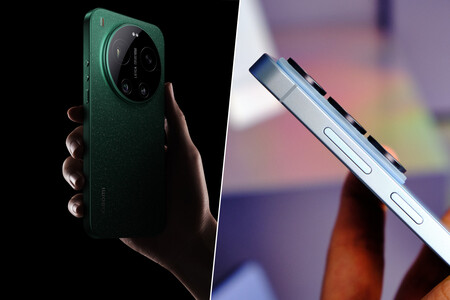
February has been an eventful month, especially with the announcement of the new generations of smartphones from Samsung and Xiaomi. Anticipation is high for these five devices, but the question remains: what sets them apart? Let’s explore the key points of the Xiaomi 17 and Samsung Galaxy S26 families.
Differences Between Samsung Galaxy S26 and Galaxy S25 Families
Thinnest Ultras in History
This generation appears to be a collaborative effort between Xiaomi and Samsung, as both the Xiaomi 17 Ultra and Samsung Galaxy S26 Ultra claim to be the thinnest yet in their “Ultra” range. The thickness difference is minimal: the Xiaomi measures 8.29 mm, while the Samsung comes in at 7.9 mm.
Although it may seem trivial at first glance, the Samsung’s sub-8 mm thickness contributes to a more comfortable grip, making it less cumbersome to carry in pockets compared to Xiaomi’s model, which can feel bulkier due to its slightly thicker profile.
A Distinct Screen
When comparing the two devices, a notable feature unique to the Samsung Galaxy S26 Ultra is its privacy screen. Utilizing artificial intelligence, this technology deactivates pixels on the display to prevent prying eyes from viewing your screen when tilted. This integrated feature is somewhat akin to privacy screen protectors found in the market, enhancing user privacy.
Latest Qualcomm Processors, with a Caveat
For high-end smartphones, it’s standard practice to integrate cutting-edge processors like the Snapdragon 8 Elite Gen 5. This is where one of the main differences between Xiaomi and Samsung emerges. Both the Xiaomi 17 and 17 Ultra come equipped with Qualcomm’s processor. In contrast, the Samsung Galaxy S26 features the Exynos 2600, while the S26 Ultra includes the Snapdragon. This choice in processors has historically impacted battery performance and heating, making the Galaxy S26 and S26+ models worth scrutinizing.
The Era of AI: Who is Better Prepared?
As brands increasingly embrace artificial intelligence in their offerings, the functionality of a smartphone hinges on its ability to process AI tasks locally, necessitating more RAM. Both the Samsung Galaxy S26 Ultra and Xiaomi 17 Ultra come with a maximum RAM configuration of 16 GB. However, Xiaomi offers this capacity across all storage options, while Samsung reserves it for the 1 TB variant, meaning that different RAM amounts will apply to the 256 GB and 512 GB configurations.
Software and Update Longevity
Each brand has a distinctive approach to customization. Samsung’s One UI has been meticulously refined over the years, whereas Xiaomi’s Hyper OS has improved significantly since its introduction. Samsung guarantees up to seven years of support for the new Galaxy models, while Xiaomi is expected to provide a minimum of five years, although specifics remain uncertain.
Cameras: A Head-to-Head Comparison
Both the Xiaomi 17 and Samsung Galaxy S26 families promise excellent photographic capabilities. On paper, the Xiaomi 17 features a balanced setup with three sensors: a 50 MP main camera, a 50 MP ultra-wide, and a telephoto lens. The 17 Ultra scales things up with a 200 MP telephoto lens, enhancing detail. The Samsung Galaxy S26 Ultra, however, stands out with its dual telephoto setup (x3 and x5), allowing for enhanced versatility.
Let’s Talk Batteries
More milliamp hours (mAh) does not equate to better battery life. Samsung’s devices typically feature lower battery capacities, yet their optimized software helps them perform well in terms of battery life. Xiaomi’s latest models, however, are designed with larger batteries: the Xiaomi 17 has a 6,330 mAh battery, while the Ultra has 6,000 mAh. In contrast, the Samsung Galaxy S26 variants feature batteries ranging from 4,300 to 5,000 mAh.
Charging power is another point of differentiation. Xiaomi leads in this arena, boasting impressive charging speeds of 100W for the 17 model and 90W for the Ultra. In comparison, Samsung’s charging specs, notably 25W for the Galaxy S26, are on the lower end of the spectrum.
Summary: Which Samsung Phones to Choose Based on Your Tastes and Needs
Each smartphone has its strengths. The Xiaomi 17 excels in offering more RAM configurations, enabling faster charging and superior processing capability. Alternatively, the Samsung Galaxy S26 Ultra offers a wide storage range and enhanced camera versatility.
When the Xiaomi 17 Makes More Sense
- If you need more RAM: The Xiaomi 17 Ultra presents more varied storage configurations than the S26 Ultra.
- If you prioritize fast charging: The fast charging offered by the Xiaomi phones outpaces Samsung’s options.
- For the best Qualcomm processing power: Both models in the Xiaomi 17 family utilize Qualcomm’s best chip.
When the Samsung Galaxy S26 Makes More Sense
- For advanced features: The privacy screen on the S26 Ultra provides unique functionality.
- More versatile camera systems: The S26 Ultra incorporates two telephoto lenses for better shooting options.
- Longer support period: Cellular longevity is greater for Samsung devices.
Technical Specs: Key Differences Between Xiaomi and Samsung Families
| Model | Xiaomi 17 | Xiaomi 17 Ultra | Samsung Galaxy S26 | Samsung Galaxy S26+ | Samsung Galaxy S26 Ultra |
|---|---|---|---|---|---|
| Screen | 6.3″ OLED, 2656 x 1220 pixels, Up to 120 Hz | 6.9″ OLED, 2608 x 1200 pixels, Up to 120 Hz | 6.3″ AMOLED 2X, FHD+ | 6.7″ AMOLED 2X, QHD+ | 6.9″ AMOLED 2X, QHD+ |
| Dimensions & Weight | 151.1 x 71.8 x 8.06 mm, 191 g | 162.9 x 77.6 x 8.29 mm, 218.4 g | 149.6 x 71.7 x 7.2 mm, 167 g | 158.4 x 75.8 x 7.3 mm, 190 g | 163.6 x 78.1 x 7.9 mm, 214 g |
| Processor | Snapdragon 8 Elite Gen 5 | Snapdragon 8 Elite Gen 5 | Exynos 2600 | Exynos 2600 | Snapdragon 8 Elite Gen 5 for Galaxy |
| RAM | 12 GB | 16 GB | 12 GB | 12 GB | 12 / 16 GB |
| Storage | 256 / 512 GB | 512 GB / 1 TB | 256 / 512 GB | 256 / 512 GB | 256 / 512 GB / 1 TB |
| Front Camera | 50 MP, f/2.2 | 50 MP, f/2.2 | 12 MP, f/2.2 | 12 MP, f/2.2 | 12 MP, f/2.2 |
| Rear Camera | 50 MP, f/1.67; 50 MP ultra-wide; 50 MP telephoto | 50 MP, f/1.67; 50 MP ultra-wide; 200 MP telephoto | 50 MP, f/1.8; 12 MP ultra-wide; 10 MP telephoto | 50 MP, f/1.8; 12 MP ultra-wide; 10 MP telephoto | 200 MP, f/1.7; 50 MP, f/1.9; 50 MP tele (x5); 10 MP tele (x3) |
| Battery | 6,330 mAh, 100W | 6,000 mAh, 90W | 4,300 mAh, 25W | 4,900 mAh, 45W | 5,000 mAh, 60W |
| Connectivity | 5G, WiFi 7, Bluetooth 6, NFC | 5G, WiFi 7, Bluetooth 6, NFC | 5G, WiFi 7, Bluetooth 5.4, NFC | 5G, WiFi 7, Bluetooth 6.0, NFC | 5G, WiFi 7, Bluetooth 6.0, NFC |
| Price | From €999 | From €1,449 | From €999 | From €1,249 | From €1,449 |
Some links in this article may be affiliate links that can generate income for Xataka. Availability and prices may vary.
Images | Xataka, Xiaomi, Samsung
For more in-depth reviews, check out the best smartphones we’ve tested.